Review: Lost and Found

Lost and Found: The Younger Unchurched and The Churches That Reach Them, is a book by Ed Stetzer, Richie Stanley, and Jason Hayes.  In it, the authors provide a great analysis of who eighteen-to-twenty-somethings are and what churches are doing to reach them.  It’s no secret that many young adults leave or never enter the fellowship of a local church. This book seeks to find the answer not only to why congregations are not reaching them, but how they can effectively reach out to them.  It is full of surprises and challenges.  I highly recommend it to pastors, church leaders, and anyone with an interest in reaching the young adult population.

41uMhcTRhZL

The book is divided into three main categories.

  • Polling. Which covers the raw data and the reasoning for the survey.  The author’s do a great job of breaking the data down into charts and statistics that can easily be interpreted and understood.
  • Listening. In addition to polls, the research team also invested in over 5oo personal interviews with young adults across the polling spectrum in order to gain more valuable information.  The findings of the interviews are shared in chapter format covering the generalities in regular text and setting out key images that often rose to the top.
  • Reaching. In this section of the book the authors’ turn their attention to the churches that are reaching this segment of the population in seemingly unprecedented numbers.  In doing so they breakdown what seem to be the similarities among how they appeal to young adults and the practical steps they are taking to be even more diligent in reaching this generation.

Lost and Found is a great read and the authors  include several good features.  The authors strive to present the material in such a way as to engage the reader not only with where young adults are, but  how to reach them.  They infuse the book with enough stories and quotes to ensure that the reader has not only heard the statistics, but has also heard the voice of this generation.  I give it five star rating.

It helps to be Mr. Right when looking for Mrs. Right: otherwise it’s all wrong

So often when it comes to dating and looking for a future spouse,  the focus is on finding the “one person who was made for me.”  I’ve even heard speakers talk about developing a list of qualities you are looking for in a future spouse and stick to the list. That is really not that bad of an idea (depending on how picky your list is).  I actually had a list but the thought occurred to me, “what if I found someone who fit my list, but I didn’t fit theirs?”

At the time  I was being challenged to discover Biblical manhood and womanhood.  It also helped that near the same time I overheard a girl at one of the local colleges talk about her list.  After hearing her list and evaluating her lifestyle I  thought, “there is no way that someone who matched that list would marry her.”  She was just dreaming because her lifestyle wouldn’t attract the guy on her list.  She would either have to change or change her list.

Such thoughts had caused me to come to some serious introspection and I decided to take some time away from the dating scene (because of my failure to come more introspection before dating, I had proven myself a dismal failure as a boyfriend in a relationship throughout college).  I didn’t want to come to the table looking for Mrs. Right and not be Mr. Right.  It was evident there were things that had to change in me.  I was looking for needs to be met by a girlfriend or future spouse that were meant to only be met in God.

I was  unable to obtain Mrs. Right’s list (I didn’t know God would be so kind as to let me marry Avia) and I thought it was a little arbitrary to blindly make a list of qualities in myself that I needed to submit before God.  So I simply asked God for guidance.  In his kindness I was able to rediscover the books of I Timothy and Titus.  I began to use these books as guides to understanding how to become a godly young man. I also began searching out role models in my life.  Men of character and wisdom who would be wise guides and would give me honest feedback about things I needed to submit before God.

In the midst of this I discovered that one of the qualities of leadership is to be a one woman man (I Timothy 3:1, Titus 1:6).  God broke my heart of the disillusionment that I had been keeping this standard because I wasn’t married.  Though I wasn’t even dating at the time, I was putting on pretense in the form of flirtation that lead several young women to think I was interested in them.  Though I was single and not in any type of defined relationship, my failure to clearly define my friendships and my willingness to lead others on was evidence that I was not a one woman man (part of me loved the attention).  The details about what God worked in me and how it came about probably deserve its own post at a later time.  I only bring it up only now because I see many young single men (and women for that matter) who like I did are casting nets of wide spread flirtation in search of someone rather than baiting the hook with godliness.

    Choosing to Date Differently

    I remember the day that I called my mom and said, “Had I known it would be like this, I would have never dated.  I would have skipped every prom, homecoming, and barn warming dance (a Missouri thing).  I am hopelessly in love with the woman I want to marry and I just now realized that I have wasted my life  trying to be some other girls’ hero… I am ready to be a husband.” That statement represented a huge paradigm shift that took place in my life from being a serial dater to dating with the intent for marriage.

    Over the years God has blessed my wife Avia and I with the opportunity to share with many single people about how we dated (some would call this courtship).  Sadly the story I will share over the next few blog post will sound completely contrary to the dating culture.  I remember my own years of looking for “love” and going about it in all the wrong ways.  I have sat across the table from enough lonely and desperate people to know that things haven’t changed much.

    If you are single and looking for the right way to date hopefully these blog posts will be an encouragement to you about how God can guide you through this time of your life.  My aim is 3 fold.  1. I will be sharing in a story format how Avia and I came to be married.  2. I will be sharing practical principles and steps we took. 3. I will be sharing the scripture that lead us to those principles and steps.

    Stay tuned…. Here are some of the titles of upcoming blog posts

    Review: The [expanded] Bible

    The [E_200_350_Book.75.coverxpanded] Bible (a modified version of the NCV) by Thomas Nelson Publishers is a great resource for readers who are looking for a clearer understanding of the biblical text.  The expanded Bible presents the base text of the Bible translation in a bold print and then additional information for each phrase or verse in a lighter text.  The idea behind the expanded Bible is that when the Bible is translated from the original languages to another (like English) that bits and pieces can get lost in the translation.  It would be a bit like watching the Wizard of Oz in black and white (translation) versus color (original language). The ideas come across, but nuances are missing.   The expanded Bible attempts to help bridge the gap and fill in the details that are lost in translation (making the yellow brick road shine and the ruby red slippers glisten).

    The Expanded Bible is very easy to use.  The notes are easy to locate and understand.  The headings are placed to the side and a one inch margin provides a great place for reader notes.   Unlike a traditional Bible it is difficult to read in a continuous fashion, due to the notes being included in the text.  However I have found it to be a great aid as a study Bible for the very same reason.

    For Bible study there are better tools available, but this book serves its purpose well in providing a quick reference and helping to grasp a particular passage. As supplemental study material, or for those looking for an easy to use bible study tool The Expanded Bible is an excellent resource. The retail price is $29.99 (Hardcover), and is available at places like Amazon for $13.59.

    Disclaimer: As a blogger I received a free review copy from the Thomas Nelson’s Book Review Blogger program  (http://brb.thomasnelson.com/ ).  There was no requirement to give it a positive review, just for the reviewer to call it like they see it.

    7 Steps of a Unified Group

    My aim in writing this post is to point you in the right direction on unity.  Most often the discussion on unity is centered on how a group of people are not unified and how they should be.  The problem with this kind of discussion is that it tends to lead the group to become even more fractured as those discussing the issue of unity become frustrated with the behaviors of others (all the while missing thier own missbehavior along the way).  Supporting the following seven steps is one underlying principle: We find unity in common purpose.  For the Christian and hence the church (youth group, etc.) unity is found in Glorifying God through Jesus Christ.

    Puzzling

    Rather, speaking the truth in love, we are to grow up in every way into him who is the head, into Christ, from whom the whole body, joined and held together by every joint with which it is equipped, when each part is working properly, makes the body grow so that it builds itself up in love. Now this I say and testify in the Lord, that you must no longer walk as the Gentiles do, in the futility of their minds. They are darkened in their understanding, alienated from the life of God because of the ignorance that is in them, due to their hardness of heart. They have become callous and have given themselves up to sensuality, greedy to practice every kind of impurity. But that is not the way you learned Christ!– assuming that you have heard about him and were taught in him, as the truth is in Jesus, to put off your old self, which belongs to your former manner of life and is corrupt through deceitful desires, and to be renewed in the spirit of your minds, and to put on the new self, created after the likeness of God in true righteousness and holiness. Therefore, having put away falsehood, let each one of you speak the truth with his neighbor, for we are members one of another. Be angry and do not sin; do not let the sun go down on your anger, and give no opportunity to the devil. Let the thief no longer steal, but rather let him labor, doing honest work with his own hands, so that he may have something to share with anyone in need. Let no corrupting talk come out of your mouths, but only such as is good for building up, as fits the occasion, that it may give grace to those who hear. And do not grieve the Holy Spirit of God, by whom you were sealed for the day of redemption. Let all bitterness and wrath and anger and clamor and slander be put away from you, along with all malice. Be kind to one another, tenderhearted, forgiving one another, as God in Christ forgave you.

    (Ephesians 4:15-32 ESV)

    Step One: Speak the Truth (In Love)

    In Ephesians 4:15 and again in verse 25 we are told to “Speak the Truth.”  Truth speaking should always come from a heart of  love and a desire to grow and see others grow in the likeness of Christ (Ephesians 4:15).  We are not to be deceptive.  We are not to lie, manipulate or pretend in front of others about what is going on in our lives.  Speaking the truth about our selves makes us vulnerable and accountable for the sake of the larger vision (seeing more of Jesus in our lives).  Speaking the truth to others shows genuine concern and accountability.

    Step Two: Be Angry, but don’t sin

    People are not perfect and the truth is that sometimes you will get angry with others.  Anger is a natural emotion.  However, many people use anger as an excuse to sin against others. They justify small and petty acts of retalliation like gossiping about someone, being mean or hostile to people, or defriending them.  However, these expressons of anger rarely solve the problem, they usually create more problems like bitterness, division, and hatred.  A better expression of anger is to address the issue that has stired the anger (in an non-sinful way).

    We are  told to not to let anger go beyond a day (Ephesians 4:26).  Letting anger grow and fester becomes a foothold for the devil to create more issues in our life and keep us side tracked from the greater vision of Glorifying God.  If you find yourself handeling your anger in the wrong way you need to repent and ask God for healthier ways to evaluate and express your anger.  Don’t let anger cause you to lose focus.

    Step Three: Be Generous…Work to Share with Others

    Ephesians 4:28 reminds us that we are not to steal, but rather work hard so we will have something to share with everyone else.  Too often people come looking for what they can get, rather than what they can give.  In nature parasites are identified as creatures that take from thier host, but never offer anything in return.  If we all come to the group as parasites looking for what we can get, but never offering to others we have missed the point of growing in Christ likeness.  We are to work hard to so we have something to offer everyone else who is there.  You will find the more you serve and meet the needs of others, the more your needs are met.

    Step Four: Watch what you Say

    Paul says in Ephesians 4:29-30 that we should guard out mouths.  You do not glorify God by using your words to teardown, belittle, and destroy the efforts of others.  You grieve the Holy Spirit of God when your words are designed to tear down.  You may have a different preference than others on certain side issues, but you do not have  to verbally assault everyone who holds a different opinion than you.  When you talk about or too your group it should be to build it up, not to tear it down.  (By the way, this includes talking about all those people who are “in the way” of your group being unified).

    Step Five: Put Away Bitterness

    Bitterness is a disease that is rampant in our churches and congregations today.  Bitterness happens when you disagree with someone (rightly or wrongly) and you hold  a grudge.  The grudge grows and festers to effect the way you see that person.  What started out as a small dissagreement between two people is all the sudden blown up into a larger scale drama where the person you are holding a grudge against can’t do anything right (in your eyes).  Bitterness causes us to lose focus on Glorifying God and growing in Christlikeness and focus on small and petty disputes.

    Step Six: Be Kind

    The goal of a group is to work to gether to glorify God.  Kindness goes a long way in helping others to feel accepted, invited, and part of the project.  Kindness can disarm the wepons of the enemy.  Deal with others kindly (they way you would want to be treated).  When you deal withpeople who are not  on task with the goals or mission of the group treat them kindly.

    Step Seven: Forgive

    This is probably the hardest step to take.  If you have been wronged it can be difficult to forgive a person for what they have done.  I’ve written more on forgiveness here.

    Forgiveness

    The idea of forgiveness can be a hard one to handle.  It is not always easy to forgive or even to ask for forgiveness.  Sometimes it seems like it is easier to harbor a grudge or exact our revenge than to forgive.  However, forgiveness is not just an option but it is a mandate for the Christian life.  We are told repeatedly in the New Testament that we are to forgive others as we have been forgiven in Christ.

    Forgive me Father, for I have sinned...

    Peter once asked Jesus just how often he was supposed to forgive his brother.  He thought he was being generous when he asked, “Up to seven times?”  Can you imagine his shock when Jesus replied, “up to seventy times seven.”  Then Jesus told this parable.

    “Therefore the kingdom of heaven may be compared to a king who wished to settle accounts with his servants. When he began to settle, one was brought to him who owed him ten thousand talents. And since he could not pay, his master ordered him to be sold, with his wife and children and all that he had, and payment to be made. So the servant fell on his knees, imploring him, ‘Have patience with me, and I will pay you everything.’ And out of pity for him, the master of that servant released him and forgave him the debt. But when that same servant went out, he found one of his fellow servants who owed him a hundred denarii, and seizing him, he began to choke him, saying, ‘Pay what you owe.’ So his fellow servant fell down and pleaded with him, ‘Have patience with me, and I will pay you.’ He refused and went and put him in prison until he should pay the debt. When his fellow servants saw what had taken place, they were greatly distressed, and they went and reported to their master all that had taken place. Then his master summoned him and said to him, ‘You wicked servant! I forgave you all that debt because you pleaded with me. And should not you have had mercy on your fellow servant, as I had mercy on you?’ And in anger his master delivered him to the jailers, until he should pay all his debt. So also my heavenly Father will do to every one of you, if you do not forgive your brother from your heart.”  (Matthew 18:23-35 ESV)

    The point of this parable was to show the heart of God in forgiveness.  God does not forgive grudgingly because He is obligated.  He gives it freely!  Our God is a benevolent God!  He lavishes His grace and mercy upon the most unworthy people.  Just as the master did not owe his servant forgiveness of the debt, but had compassion and forgave the debt anyway, so God forgives us our debt of sin through Christ.

    But when we are recipients of such extravagant forgiveness we are supposed to live with the memory of that forgiveness and let if affect the way we deal with others.  This servant got it all wrong when he saw the extravagant grace the master was capable of, yet still forced his fellow servant into prison to pay up.  When you receive abundant mercy you are to show abundant mercy.

    In the same way there was another time that Jesus told a story of extravagant grace to teach us about forgiveness.  Do you remember the story about the lost son found in Luke 15?  A young man goes to his father and asks for his inheritance and leaves home.  Once he has been away for a while and has spent all his money he finds himself feeding pigs and even eating their slop just to get by.  He remembers his father’s house and how well the servants there have it and he determines to go home, not looking for forgiveness, just a place to work so he can be clean and eat a good meal.  But when the father sees him in the distance, he runs to the boy and orders a feast in his honor.  We understand the father in that parable to be God and the lost son to be a repentant sinner.  The boy had taken his inheritance and gone.  He did not deserve a feast.  He did not deserve a warm embrace.  He did not deserve his father’s forgiveness.   Yet, when he topped that hillside and the father saw his form in the distance … he ran!  When a repentant sinner comes to God, God is always quick to forgive.  He lavishes his grace upon us when we do not deserve anything from his hand.

    The character of God is marked with the ability to forgive great debts and likewise the character of a Christian is marked with the ability to forgive and seek forgiveness.  Paul admonishes the Colossian believers in Colossians 3:13b, “even as Christ forgave you, so you must do.”  He also told the Ephesians in Ephesians 4:32, “be kind to one another, tenderhearted, forgiving one another, even as God in Christ forgave you.”  Each time the appeal for forgiveness is based on the character of God to forgive us.  We should forgive others, because we have been forgiven a greater debt.  In forgiving others we are displaying the character of Christ!  We are called to a lifestyle of extravagant grace.

    We are to be like God in our forgiving.  This is tough stuff.  It is not really easy.  I wish it were.  The thing that enables us to forgive is not found with in us, it is rooted in the character of God!  I am free to forgive others debts against me because I have been forgiven my debt.

    My Story (Part 4): Waking up from a Dream

    flickrcom-photos-indigogoat-174393301One night I had a dream.  In my dream there stood a small round table with a porcelain stature of Jesus praying.  I remembered the statue from my childhood.  It was on of the figures that had always been in my parents house.

    In my dream there was an open magazine with a picture of Satan.  The kind of picture you see at Halloween with a red face, horns, and a pitchfork.  Yet the eyes had been cut out and taped on the statue of Jesus.

    I was indignant and mad.  I can remember saying, “Who has done this thing!  Who dares to defile this statue of Jesus?  This is blasphemy!”  And just at that moment as still, small voice said, “It is you!”

    In that moment I understood the weight of my sin before a holy and righteous God and knew that he would be good and right to send me to Hell.  I felt in that instant more terror than I have ever known.  I was sure that I was going to Hell.  Yet I awoke clutching the covers in a silent scream.  My mouth hung open,  my lungs had sized, my breath was caught in my throat and I was unable to actually produce a sound.

    I understood then that I was lost, but tried to rationalize with myself that it was just a dream.  I contemplated how silly it would look like for me to admit that I wasn’t even a Christian.  Pride keeps many men and women back from what would truly be theirs in Christ.

    A while later I was leading a college group through a Bible study on the 7 churches in Revelation.  As I studied the scripture I came to the Church at Laodicea (Revelation 3:14-22).  What I read changed my life.  I realized that I was standing naked before God and instead of trusting in Jesus Christ to remove my sin and my shame I was trusting in works that didn’t really matter to God.

    I understood it like this.  God had given me a conscience and his word that exposed my wrong motives.  Like a mirror would show a person that they are naked and need clothes.  But instead of Trusting in Jesus and asking God to change my heart I was trying to answer the guilt over my sin by doing good things.  That would be like a naked person painting over a mirror.  It wouldn’t really change the fact that they were naked, it would just make it harder to see in the mirror.  There was nothing I could do to make myself right with God other than go to Him, tell him I was sorry for what I had done, and ask him to change my life.

    I shared with Avia that I was lost and she quoted Isaiah 64:6 confirming that there was truly nothing I could do to make myself right before God other than humble myself and ask for his forgiveness.  The next day I met with an evangelist to learn another Evangelism strategy.  This one was called Christ-Centered Evangelism and rather than focusing on heaven it focused on Christ.

    Brother Ed the Evangelist was teaching me about praying for those who have not yet come to God on his terms and lead me to read Romans 10:1-4.  As I read, he could tell something was wrong and he asked me if  everything was okay?  I couldn’t help but blurt out, “by the witness of these scriptures I am lost.  I have a zeal for the things of God, but I don’t truly know Him.”

    Later that night after searching my heart, I asked Christ to be the Lord of my Life.  I told my pastor and came before my church fully expecting to lose my job.  I didn’t care.  I wanted everything to be right before God and men.

    Jesus Christ changed me.  He saved he makes a difference in the way I live.  I am not a perfect person.  I continually make mistakes, but I know God accepts me based not upon what I have done, but what he has done for me.  I want the whole world to have peace with God like I do.

    For more on the Christian message and how you to can have a relationship with Jesus Christ check out  2 Ways to Live

    What I’m Listening to These Days

    Seriously, I didn’t start out a rap or hiphop fan and probably still don’t qualify.  But, these guys are delivering the message in a totally appealing and intense way.  Just listen to the lyrics.

    Lacrae

    Shai Linne

    Just imagin if these lyrics got stuck in our kids heads instead of some of that other stuff

    3 Questions About Healing and the Kingdom

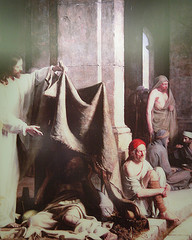
    jesus-heals1 So I guess it is only fair for me to admit my biases up front when it comes to “healing.”  My Theological Assumption: I would like to clearly state that I do believe that God does choose to heal and even miraculously heal certain people at certain times.  My Cultural Assumption: I would also like to state that I believe that many Americans neglect  a healthy understanding of the miraculous and supernatural because of an over dependence on a skeptical mind (how arrogant to assume that all cultures that hold to a supernatural world are living in ignorance).  My Experiential Assumption: I have several friends who despite great prayers and great faith have never experience a divine healing miraculous or otherwise.  They were asked to stand up out of their chairs or extend forth their lame hands all to no avail.  Many were accused of not having enough faith.

    3 Questions About Healing and the Kingdom

    So all of this arises out of the need to get something right in my mind.  A few times now I have been in a situation where a group of folks will get together with the idea to share Christ with the lost world and a brother of mine will stand up and start talking about healing. Usually when this happens they direct my attention to Isaiah 53:5 (By his stripes we are healed) gloss over the whole sacrifice part of the passage and ask if anyone wants to be healed.  The gospel seems to be diminished or passed over by the desire to display a powerful sign of healing.

    I understand  that while in the midst of preaching the kingdom Jesus healed people. In many instances healing and preaching the kingdom were hand in hand and almost inseparable (Matt 4:23, 9:35, 10:7-8, Luke 9:11 and especially Luke 10:9).  Jesus demonstrates that the kingdom is coming by healing and showing us what the kingdom will be like (there will be no sickness or death).  This proves not only to authenticate his message, but help us to visualize what it would look like to live under the rule and reign of such a benevolent king.

    Yet at the heart of what I generally observe when I hear healing preached is not an announcing of the Kingdom of God, but a statement that God wants you healthy and wealthy. Then some take it so far as to say that if you lack health or wealth you have no faith.  I often wonder if such people have searched the scriptures enough to develop and understand a theology of suffering.

    So here are my questions…

    . . . . . . . . .

    • Is there a connection between healing and the kingdom of God?
    • Does your theology of healing allow for a theology of suffering? If so how?
    • Does miraculous healing still happen today?

    Short Post: Christian Heritage Conference

    heritage-conference-2007 So we are on the verge of another great Disciple Now and I started to think about all of the great events that I have had a privilege to be a part of in the past.  God has really blessed me to be a part of some cool things!  Disciple Now’s, Hunger for the Harvest, Camps, Christian Heritage Conference, etc.

    Next to Disciple Now the most amazing events I have ever helped put together were the Christian Heritage Conferences.  We would pray over a theme, set up a team of helpers, develop a registrations strategy, line up a top notch speaker, get the word out, set up a bookstore, and all on a shoe string budget.  It was amazing!

    Christian Heritage Conference

    Though I cannot speak for the reason others were inspired, my inspiration came from a well spring of two sources.

    One: The rappid movement in our day to redefine “church.” In the struggle to go back to Acts 2 many have missed the blessings that the church fathers in the first few centuries have handed to us as a guide to understanding and interpreting the scriptures (mainly the Rule of Faith).  In that many have also completely abandoned church history in order to become a “pure” church like the one in the New Testament.  (Which one? Corinth, Ephesus, Pyrgumum, Colasae?)  I figured that if we were to take our people down such a road that they should not do so with complete ignorance of what God has done through out history with faithful men and women so that we might be able to face the new gnosticism that such a forgetfulness will soon employ.  In short: if we do not learn from the past we are doomed to repeat its error and find ourselves facing the same obstacles that have already once been overcome.

    Two: John Piper’s lectures in  Christian Biography.  I had to make a 16 hour ride home to Missouri one year while in college and was blessed to be able to listen to over 16 hours straight of the lives and times of great men that God had used to bring glory to his name throughout history. I understood then why history (for good or for ill) contributes to who we are today.

    From these two wells of inspiration and a great friend and partner in ministry (Kyle Claunch).  The Christian Heritage Conference was born to popularize an education of Church history for the benefit of the whole church.

    Like all things it morphed and changed over the years.  We covered a variety of historical figures and had a variety of Top notch Speakers.  We learned to advertise outside of our local areas and expand our vision beyond college students.   We contacted home-school associations, history and theology departments at local colleges and history clubs at local high schools.    We also contacted pastors in the surrounding associations.  We began to hold registrations so we could pull more people in earlier in the next years event.