Confession of Sin (Nehemiah 1:6-7)

let your ear be attentive and your eyes open, to hear the prayer of your servant that I now pray before you day and night for the people of Israel your servants, confessing the sins of the people of Israel, which we have sinned against you. Even I and my father’s house have sinned. We have acted very corruptly against you and have not kept the commandments, the statutes, and the rules that you commanded your servant Moses. (Nehemiah 1:6-7 ESV)

We often want to see God move, but seldom ever are we willing to address the offenses that have caused our situation to begin with. We don’t mind confessing the sins of others to God. It is rare to see someone own their sin and even rarer for them to own the sin of someone else.

Cover

Here in his prayer Nehemiah not only addresses the reason for Jerusalem’s wall-less situation (Israel’s sin). He confesses that it is his sin too. He wasn’t alive when all of this took place so he actually owns the sin of his ancestors. They are most likely dead and gone so he brings a petition before God confessing their sin and his sin. The wall is in ruins because that was a prophesied outcome for a nation who rejected their God by rejecting His commands.

This is where revival begins! When religious people care more about the character and nature of God than they do about what others think. They confess their sins and they confess the sins of their ancestors.[1] The illusion of control is totally removed from Nehemiah’s hands. He confesses that he is not in a position to make bargains with God, manipulate God or even compel God to act. He throws himself on a part of God’s character he knows to be true from the scriptures (as we will find out). He throws himself on mercy. It is only by God’s mercy that these sins would be forgiven and the wall restored.

We are good at pointing to the poorer communities and slums or those riddled with crime saying, “They need revival!” It is easy to look off and say, “They need revival!” Nehemiah didn’t do that here. He offers his prayer from perhaps the nicest section of Susa, a city with walls. Before revival would come and a wall would be rebuilt in Jerusalem, revival had to come in Nehemiah’s heart in Susa. Perhaps our desire to see others repent and turn to God is often a deflection from the issues that need to be addressed in our heart rather than a reflection of our heart. We should be primarily concerned that God should be honored and obeyed in our house! When real revival comes to our house, perhaps it will also come to the city.

Take a moment to confess your sins and the sins of the people around you. Be specific, don’t hold back or be general. What is it that is happening in our city right now that you know displeases God?

As I have studied more modern movements of Revival there seems to be a reoccurring theme of genuine repentance and confession of sin. I confess that too often pride has held me back from following the Spirit’s guidance in confessing my sin before God and others. Too often I have cared too much about what other people would think of me. But if we would really see God move, we must acknowledge and address the issues that are in the way, including our pride. We must own our part and perhaps even the sins of those before us in order to see real restoration and revival.

[1] I think at this point that it is fair to note that confessing the sins of your ancestors is necessary before holy God. Even if you are not guilty of such sins, you have an opportunity to distance yourself from sinful behavior and acknowledge before God that though you come from such stock, you desire something greater for you and your generation.

Fasting Brings Feelings into Focus (Nehemiah 1:4)

As soon as I heard these words I sat down and wept and mourned for days, and I continued fasting and praying before the God of heaven. (Nehemiah 1:4 ESV)

Cover

What do you do when you have deep feelings about injustice in the world? How do you move? What is the next step? Is it just emotion or can that emotion be channeled into something productive? Take a look at Nehemiah. We are only four verses into this book and already we see his strength of character to ask the question about how others were doing, to hear and respond with weeping, but then he does…MORE.

First he does more feeling. He adds fasting to the mix. He wants his body to ache because his heart aches. This is a long forgotten discipline in our culture. Fasting is the intentional with drawl from food so you can focus on what you feel. In your body it serves as a detox or a cleanse, kind of like a reboot for your digestive system.  Spiritually speaking it does something similar.  In Nehemiah’s time a fast would mean taking time away from meal preparation which included everything from the purchase at the market to the actual cooking of the meal. This was a big time saver, but more than that it was a way not to focus on the day to day things that can consume our thinking and allow a pure focus on what God might have for Nehemiah. Too often we drown out God’s voice because of all the other voices we fill our lives with. In a modern context fasting might also include setting aside entertainment, social media, and other voices that have a way of consuming out thoughts so that we might be able to hear clearly from God. Fasting brings feelings into focus.

Our feelings alone can lack focus. We have a crush on a person who just looks cute, but when we get to know them we find out they are a jerk… but until your feelings are brought into focus by reality you move and act as if they are a perfect person. Feelings are a helpful response to where we are and how things have been, but they are unreliable guides to our future. This is why we should never just act on our feelings alone.  Just ask anyone who has said or done something stupid in a moment of anger.

Nehemiah feels a deep sadness for his countrymen and especially for Jerusalem being a city without walls, instead of jumping into action though he brings his feelings into focus by fasting and he brings his thoughts to God in prayer.

Now lots of folks think that prayer is where we move God to action, but they have it backwards. We don’t pray to tell God what he should do; we pray to ask God what we should do. The point of prayer isn’t to conform God’s will to ours, but to conform our will to God’s (Matthew 6:9-10).  Nehemiah goes to God to get God’s perspective, as we will see in the coming days and weeks, God sees the need clearer than Nehemiah ever could.

You may be at a crossroads in your life where you feel like God is calling you to do something but you are unclear about what he wants you to do. Fasting may be a very helpful option to bring things into focus. Consider setting aside some of the distractions in your life so that you can hear his voice more clearly. It is wise to get clarity on what God is doing before you act.

Feeling Bad News (Nehemiah 1:3-4)

And they said to me, “The remnant there in the province who had survived the exile is in great trouble and shame. The wall of Jerusalem is broken down, and its gates are destroyed by fire.” As soon as I heard these words I sat down and wept and mourned for days, and I continued fasting and praying before the God of heaven. (Nehemiah 1:3-4 ESV)

Cover

We live in a society where people flee from pain and discomfort. Sometimes we would rather not hear news at all than to hear bad news. We burry our head in the latest video game, music album or endless search for funny memes and videos rather than face the reality of the situation in front of us. It would have been easy for Nehemiah to dismiss the discomfort of his countrymen as their problem. After all, he lived in a city with walls.

Something you should understand about city walls. They were like locks on our doors today. They served to keep people inside safe and people with bad intentions out. Imagine moving to a new neighborhood only to find out that the new place you are living in doesn’t have locks. What’s worse is that it doesn’t have doors and there is no police force to call when someone breaks in. That was the situation the people in Nehemiah’s home town were experiencing.

Nehemiah allowed himself to feel a deep empathy for his fellow countrymen who lived in a city that had no protection from its enemies. As we will find out in the rest of this book, he’s not a weak man, but here he sobs like a child. He isn’t running from the issue, he is feeling the full force of it.

Sometimes we can become desensitized to the humanity of people who are suffering. Maybe we’ve seen the images of one too many starving children on the TV screen to care anymore. We have grown callous. In our hearts we think, “That’s somebody else’s problem” or “I can’t do anything about that,” and we move on to the next Pokémon to capture or meme to post. (Not that these things are bad in and of themselves, but when we use them as diversions from what God is pressing on our hearts).

I think that feelings are important. We will learn later that they aren’t a good guide, but that they can be a good indicator of where we are. How do you feel about the current state of your school, neighborhood, or workplace? Take time to journal your thoughts today.

For me it was frustration. I saw a huge need, but didn’t know how to address it. Obviously the things we were doing in student ministry were working with churched kids but we were struggling to reach people who hadn’t been to church (which as it turns out was most of the public school population). I also felt sadness, like we were losing a generation. I wondered about what could be done to reach students who had never heard the gospel.

Who Do You Care For?

When I was sixteen years old I came home drunk late on a Saturday night and was sneaking to my room. I had to go past my parent’s room to get to my room and as I passed by I heard my mom talking. Which I thought was strange because I knew my dad was working overnight as a security guard at the local hospital. I listened in to see who she might be talking too on the phone so late at night.

I soon found out that she wasn’t on the phone, she was praying. And it wasn’t just any prayer it was a deep and raw emotional prayer. She was sobbing, literally crying out to God. Then I heard my name. She was praying for me. She was asking God that I would repent of my sins and believe on Him. She was asking that I would be protected from the things that I couldn’t even see. She was pouring her heart out… for me.

Long story short, my mother’s prayer that night and many nights before and since have brought me to faith in God. They have shaped my life in more ways that you could ever imagine. Today we are going to look in the scriptures at the story of a Nehemiah a man of boldness, compassion, and prayer.

Cover

Now it happened in the month of Chislev, in the twentieth year, as I was in Susa the citadel, that Hanani, one of my brothers, came with certain men from Judah. And I asked them concerning the Jews who escaped, who had survived the exile, and concerning Jerusalem. And they said to me, “The remnant there in the province who had survived the exile is in great trouble and shame. The wall of Jerusalem is broken down, and its gates are destroyed by fire.”  (Nehemiah 1:1-3 ESV)

It was an ordinary day when Nehemiah’s life took on a bold new direction. The sun didn’t shine any brighter, the birds didn’t sing any louder, and there wasn’t a melody hinting that his world was shifting direction. He wasn’t at youth camp, He wasn’t sitting in a conference and he wasn’t out on a mission trip.  It was just a normal day like any other. Yet, it was on this normal day that God did something extraordinary in Nehemiah’s heart.

God can do extraordinary things in our hearts and lives on ordinary days. You don’t need the buzz of fancy lights and loud music to know that God is up to something. You don’t have to hear from professional camp speakers or evangelists for the Holy Spirit to stir your heart. The God of the Universe is able to find you right where you are!

It all began with a simple question. Nehemiah simply asked about how everything was going back in Judah. Now here is the thing, we will find out a bit later that Nehemiah is a little bit of a big shot. He has a demanding job in the government and he sees people from all over the empire. He’s got plenty of stories to tell about all sorts of people and places, but when his brother comes from his rural home town he takes time to ask about how everything was back in Jerusalem.

Nehemiah was concerned about the welfare of his people. They mattered to him. He takes time to ask about home and he listens! The message he hears alters the direction of his life. He finds out that the people back in Jerusalem have no walls for protection and are open to exploitation by those around them.

Who do you care for? If you are a teenager in public school, I want you to ask yourself, “How is everyone at my school doing?” Or if you are home school you might focus on your neighborhood, “How is everyone in my neighborhood doing? If you work, consider your job, “how are people at work doing?” What is life like for these people? Do they have any needs? Odds are you may have never stopped to reflect on this before (we’ll talk about that more in the days ahead) but right now take time to consider how it is going with the people where you live.

I had an ordinary day like Nehemiah where God did something extraordinary in my life. It began with a student I met in Mobile, AL named Steven. Steven had grown up driving by churches all of his life and had never heard about how Jesus had died for his sins. I did some digging to find out how many students might be out there like Steven and I found out that roughly 85-88% of public Middle school and High students don’t attend church and many have not even heard the simplest of bible stories. It reminded me of Romans 10:14 where Paul says, “How can they hear without a preacher?” and it became my Nehemiah moment.

Intentional Living by John Maxwell (A REVIEW)

Intentional LivingI’ve not always been a John Maxwell fan, but his more recent books are really good. This book, Intentional Living, is by far one of his best. Maxwell is older than I am and typically is read better in my parents generation. With this book though, his focus has changed and he comes across as more approachable. He shares stories and details of his life creating a brilliant synthesis of autobiography and life principles.

Maxwell also offers a seven day online video encouragement course (for Free) that pairs quite nicely with this book. He shares a brief (usually 5 min or less) message and then issues a challenge (that usually takes less than 10 minutes to complete). It’s a great course that complements and extends the value of the book. To be sure though it also leads into a 30 day course that costs to participate. Nothing wrong with the cost of the 30 day course, my guess is that you are more likely to complete it if you paid something for it.

Over all I thought that, Intentional Living, was a great read and well worth the time it takes to read it. If you had to pick one John Maxwell book to read, I’d say pick this one. In the mean time check out some of my other reviews of John Maxwell’s books.

Try Audible and Get Two Free Audiobooks

Amazon.com – Read eBooks using the FREE Kindle Reading App on Most Devices

Disclosure of Material Connection: I received this book free from the publisher. I was not required to write a positive review. The opinions I have expressed are my own. Some of the links in the post above are “affiliate links.” This means if you click on the link and purchase the item, I will receive an affiliate commission. Regardless, I only recommend products or services I use personally and believe will add value to my readers. I am disclosing this in accordance with the Federal Trade Commission’s 16 CFR, Part 255: “Guides Concerning the Use of Endorsements and Testimonials in Advertising.”

How High Will You Climb By John Maxwell (A Review)

_225_350_Book.1162.cover Attitude. That’s what How High Will You Climb?: Determine Your Success by Cultivating the Right Attitude is about…attitude. Mostly the focus in on how to have a positive attitude. That’s the real game changer according to Maxwell. The ability to face challenges, short-term defeat and the obstacles in our path with a gutsy determination that everything will be fine. John Maxwell offers two compelling lines of argument through the book. One seems to follow a biblical pattern (at least the scripture verses are fairly quoted). And the other is squarely placed in the self-help camp (He’s done some outside reading).

As with most books I review I put it through the “wait” test. For those unfamiliar, the wait test is simply this. Read the book well, then simply… wait. If what you remember was actually helpful, practical, and perhaps even relevant then it passed the test. What I came away with after reading this book was that a good attitude is better than a bad attitude. I hardly needed a book to tell me that, but this one comes across more like a pep-rally and some folks need that sort of thing.

So here is the deal, if you generally have a good attitude, you don’t need this book. However on the other hand if you are a perpetual grumpy pants you probably could benefit from reading this book (You need the pep-rally). And If you know a grumpy person, you might give them this book as a kind of inside joke, but also as an encouragement to adopt a different perspective on life. John Maxwell is a talented writer. He flirts with a few elements of the sovereignty of God in this book that I wish he would have taken all the way to their conclusions.

Disclosure of Material Connection: I received this book free from the publisher as part of their Reviewer program. I was not required to write a positive review. The opinions I have expressed are my own. Some of the links in the post above are “affiliate links.” This means if you click on the link and purchase the item, I will receive an affiliate commission. Regardless, I only recommend products or services I use personally and believe will add value to my readers. I am disclosing this in accordance with the Federal Trade Commission’s 16 CFR, Part 255: “Guides Concerning the Use of Endorsements and Testimonials in Advertising.”

Did you enjoy this post? Did you consider it helpful? Subscribe by e-mail on the top right of this page and get fresh articles like this one and more sent straight to your e-mail inbox. Don’t for get to share on Facebook or Twitter.

5 Benefits of a Blogging Pastor

I was first introduced to the bold new concept of a blogging pastor by the book “The Blogging Church.” Much has transpired since that time, but one thing remains the same: Blogging can be an effective tool for pastors and churches if used wisely. I have a few years of blogging experience under my belt and have enjoyed reading the blogs that my Pastor and others have produced. More recently I took somewhat of a long blogging vacation (more than a year on this blog) and I noticed that I was still constantly referring people to my blog posts (not for vanity sake, but because I thought what I posted would be truly helpful them). I composed this list of five benefits of a blogging pastor not only as a reflection on how I use my blog and other bloggers have influenced me, but also as a reminder to keep blogging for the sake of those I shepherd as well as those whom I have never met.
To Help Your People Facing a Cultural Issue. Our culture is moving and changing at a rapid pace. Often times our folks have had a week at the water cooler to discuss issues before they ever walk in the door on Sunday (and that’s just your regular attendees). Many are struggling to figure out where to embrace and where to challenge culture. It’s easy to be right on an issue, but wrong on an approach. Having a blog can be a great outlet for pastors to address cultural issues from a biblical perspective. Not just being right on the issue, but also seeking to demonstrate a godly approach. I was deeply impressed and somewhat glad when my pastor posted his thoughts on issues pertaining to the Boy Scouts of America this past year. Though I don’t yet have a Boy Scout, I know his insights were helpful to those trying to form an intelligent opinion about the issues at stake.

Your Blog is Available When You Aren’t. Pastors are busy people. Much busier than most people would expect (but that’s another post). The more people that you have a charge over the harder it can be to have a conversation about important topics or issues. Having a blog is like having another preaching post. It helps put you in front of people (even when you can’t be… like at 3AM in the morning). It also provides a great place to send people who are dealing with issue. “I blogged about that last year, check out the article I wrote and then let’s sit down and talk about it over coffee.”

Share Resources with Your Congregation. Having a blog allows you to share resources with your congregation. Whether you are sharing about a good book, blogging on a cultural issue, or just sharing links to resources and posts by other authors, a blog can be a great place to house those referrals. For example if you are speaking on spiritual gifts, you can link to several other articles or spiritual gifts surveys or if you are challenging people to pray for the nations, you can link to several mission sights. Even if you write a blog post quoting from other sights and link to them, you are broadening the horizon of those who follow your blog and giving them resources they might not otherwise have had.

Deal With Issues or Questions that May be Under the Surface. Often times a pastor is aware of issues that lurk in the shadows but may have a difficult time finding the proper forum to address it. A blog allows a pastor to begin a dialogue that can lead to more personal discussion offline. I’ve found that many of my posts dealing with various issues from pornography to leading a family devotional time have allowed folks to talk more freely about issues or concerns they have offline.  Quite often I’ve heard the words, “I saw on your blog the other day…”

To Engage with A Variety of People. One of the neat things that hosting a blog has done for me is to allow me to see things from outside my box. What I mean is that I get the benefit of hearing from atheists, Muslims, people living in different cultures, places, etc. When they are generous enough to leave a comment or question on my blog I am better informed on how they perceive what I write. Opening up the conversation to those who are outside of my worldview not only tests the integrity of my worldview but also provides a unique opportunity to engage in a conversation over issues that are too often just left to insiders.

Obviously this list isn’t exhaustive. What are some of the other benefits of a blogging pastor that you have noticed? If you’re a pastor and have a blog, I’d love to check it out. Please feel free to share a link in the comments (or if your pastor has a pretty great blog, share his blog address in the comments).

Here are some links to the pastor friends that I follow:

Chris Aiken

Gerald Kirby

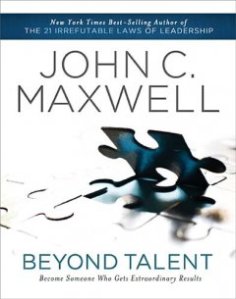
“Beyond Tallent” by John Mawell (A Review)

Beyond Talent: Become Someone Who Gets Extraordinary Results by John Maxwell is a great book about maximizing potential.  Of all the Maxwell books I’ve read, I like this one the best.  The book is full of wisdom and insights that are intended to challenge the reader to maximize their potential.
I found this book to be very readable, practical and to the point.  I really appreciated the candor and self-disclosure of the author making the hard points palatable. This book has deffinately earned a spot in the leadership section of my library.

Over all its a great read and I highly recommend it to anyone interested in maximizing their potential.  This book is especially good for young leaders and professionals. I wish I had read this book at 18. The retail price of Beyond Talent is $16.99 (Paperback), and is available around the web in places like Amazon.com for $11.55.  I gave it five stars.

Disclosure of Material Connection: I received this book free from Thomas Nelson as part of the BookSneeze program. I was not required to write a positive review. The opinions I have expressed are my own. Some of the links in the post above are “affiliate links.” This means if you click on the link and purchase the item, I will receive an affiliate commission. Regardless, I only recommend products or services I use personally and believe will add value to my readers. I am disclosing this in accordance with the Federal Trade Commission’s 16 CFR, Part 255: “Guides Concerning the Use of Endorsements and Testimonials in Advertising.”

Servant Leadership: When is The Right Time to Delegate?

The book of Exodus contains a conversation between Moses and his father-in-law Jethro about one of the most important aspects of leadership, delegation.  Jethro challenges Moses to relieve the burden of being the sole judge for the whole nation. He counsels him to establish laws and appoint trustworthy men to handle the smaller issues of justice.  Jethro claims that if Moses will make these small changes, “God will direct you, you will be able to endure, and all this people also will go to their place in peace” (Ex. 18.23).

Likewise, in the New Testament book of Acts Luke records the history of the office of deacon.  Deacons were selected from among the people to meet an urgent need that was taking the Apostles away from their main duties. Luke records the twelve as saying, “It is not right that we should give up preaching the word of God to serve tables. Therefore, brothers, pick out from among you seven men of good repute, full of the Spirit and of wisdom, whom we will appoint to this duty” (Acts 6:2-3).

Delegation is one of the most important aspects of servant leadership.  Through delegation leaders are able to focus clearly on the greater needs of the organization or ministry they serve.  Delegation also charges leaders to responsibly recognize the gifts of others in the organization and empower them to accomplish larger tasks. Generally, as a result of good delegation, organizations are able to grow and leadership is multiplied. 

WHEN IS IT TIME TO DELGATE?

Knowing when to delegate can be an arduous task.  Leaders may feel that the tasks they accomplish quite readily or even with great agitation will suffer under the oversight of someone else.  Some leaders may sense a loss of control by handing responsibilities of a given task over to another individual, even if that individual is a subordinate.  However, the risk of not delegating at the right time is even greater.  Leaders who delegate well are helping their organization in a long term capacity.  Leaders who do not delegate tend to have only a short-term view in mind.

Leaders who do not delegate efficiently are hampering the growth of their organization. Delegation enlarges an organization’s leadership pool.  Therefore, an organization will never grow larger than its leader’s ability to delegate. Oswald Sanders writes in his book Spiritual Leadership, “A one person office can never grow larger than the load one person can carry.”[2]

Both in the case of Moses and the twelve leading disciples the time to delegate came when they could no longer move forward doing what they had been doing.  The time to delegate presented itself in the midst of crisis.  On occasion, a leader will find that he has taken on more tasks than he has time to adequately manage.  When this occurs something inevitably is let go.[3] While a leader may get by with this for a season, after a while, burning the candle at both ends generally leads to burnout and is unhealthy both for the leader and the organization he serves.

When a leader finds that she has too many tasks on her plate for one person to accomplish she should scrutinize her schedule.  Henry Blackaby and Richard Blackaby write in their book Spiritual Leadership, “The key to successful leadership is not creating more time in one’s life or packing more activities into one’s day, but staying on God’s agenda.”[4] Sometimes a leader will need to say no to items that others would like to place on her agenda. Henry Blackaby and Richard Blackaby go on to state, “Great leaders don’t allow their busy lives or their vast responsibilities to overwhelm them.  Rather, they become the masters of their schedules through determined and conscience effort.”[5]

When is the right time to delegate?  All the time.  Stay tuned for more on delegation tomorrow.

How about you?  Are you good at delegation? What is the hardest part of delegation for you?


[2] Oswald Sanders, Spiritual Leadership (Chicago:  Moody Press, 1994), 138.

[3] Ibid., 140.

[4] Henry Blackaby and Richard Blackaby, Spiritual Leadership (Nashville: B & H, 2001), 200.

[5] Ibid., 201.

Check out “Real-life Discipleship” by Jim Putman (this guy gets it)

Real-Life Discipleship: Building Churches That Make Disciples by Jim Putman is a must read for anyone serious about discipleship!  It is packed with Biblical, simple, and time-tested  strategy on how to help people grow in Christ. I really appreciated Jim’s pastoral style of writing that bleeds through on every page.  While handling the truth of God’s word, Jim is sure to pull readers into the story of redemption and call them to take up the mantle of discipleship. After reading hundreds of books I have come to learn that not all books are equal.  If you had to read only one book on discipleship (besides the Bible), this is the book. I was blessed, encouraged and even rebuked in areas of my own life while reading this book.

I was first turned on to this resource after reading Avery Willis and Mark Snowden’s book Truth that Sticks (another book well worth a read).  After reading that book I commented that more books would be needed, this is one of those books!  I am excited an encouraged all at once about the series of books that are coming out of NavPress on the topics of discipleship.

Real-life Discipleship is a clarion call back to a biblical model of discipleship.  I highly recommend it to anyone interested in developing a biblical model of discipleship in their church.  The retail price is $17.99 (Hardcover), and is available at a discount at  Amazon.com for $12.23. I gave it FIVE stars

Disclosure of Material Connection: I received this book free from NavPress as part of their Blogger Review Program. I was not required to write a positive review. The opinions I have expressed are my own. Some of the links in the post above are “affiliate links.” This means if you click on the link and purchase the item, I will receive an affiliate commission. Regardless, I only recommend products or services I use personally and believe will add value to my readers. I am disclosing this in accordance with the Federal Trade Commission’s 16 CFR, Part 255: “Guides Concerning the Use of Endorsements and Testimonials in Advertising.”