Mark 13: it will get worse before it gets better

In Mark 13 Jesus describes the future to a few of His disciples. The picture He paints isn’t a beautiful one. He describes in mild detail the effects of sin on our world. There will be wars, earthquakes, food shortages, family strife, etc. And many will be persecuted for Jesus’ name sake….

But then it will get better! Jesus will return in all his Glory! Sin and all of it’s ill effects will be wiped away!

But we should be ready. We should be diligent. We must not assume we have more time. Jesus said it’s not for men to know the day or hour of His return, but to know that He will return. We should be diligent to watch, pray & look for His return. We should not east the days like lazy servants of a master are tempted to do, but we must make the most of every opportunity.

The message is this… We are not home yet! The curse of sin still plagues this planet. People hurt people. The planet groans under the weight of sin. We can not lay back idle while the world passes by as though the best Christ has to offer is a peaceful life now… No. He offers eternal life and while we breath, while we move, while we live we must labor diligently to see Him high and lifted up. We shouldn’t live as though we are retired… We must live preparing for His return.

Mark 12: The Authority of Rejects, or the Rejection of Authority

Mark 12 starts out with the parable of the wicked tenants. They are wicked because they reject the authority of the owner to collect what is due and kill his son. (more on this parable can be found by clicking on the vodpod video to the right on my blog http://www.followjonathan.wordpress.com)

The parable carries over from the conversation in chapter 11 about authority. Jesus’ authority had been questioned by the religious leaders. This parable illustrates that the religious leaders had already rejected God’s authority and that they were like the tenants in this parable… Judgement was coming.

At the end of the parable Jesus tacks on a fuller statement about a cornerstone. He is quoting from Psalm 118. The meaning is that the leaders had rejected Him as the cornerstone (foundation and guideline) for their lives, but that even though he was rejected by them, He would still be the guideline by which their lives were judged.

Application: Many people reject Jesus. Even seemingly Christian people can conduct life under a set of rules apart from a relationship with Christ. Remember that Jesus is telling this parable within earshot of the Religious leaders of the day. They are simply living under rules and not in a relationship with Christ. The difference is deadly.

Jesus Christ is the cornerstone of a believers life. The Holy Spirit is moving and working in each one of us to conform us to the image of Christ. To be confirmed to the image of Christ, we must accept God’s authority in our lives. What authority do you submit to? Is it a false standard of self imposed rules made by yourself and/ or others? Do you go which ever way the wind blows trysting your emotions to be your guide? Have you entrusted yourself to the Lord Jesus Christ to save you, change you, and transform you into His image through His work on the cross for your sins?

Mark 11: Who said you could do that?

At the end of Mark 11 the religious leaders come to Jesus asking by what authority He does things. Specifically they probably have in mind the fact that He entered the temple kicking over tables and throwing out the people who were selling stuff there. They also probably wondered why a few days earlier he had come into town riding a colt and there was a lot of commotion and praise going on.

After all they were the ones with the authority. The were religious “leaders.” Jesus just appeared to be a radical irreverent teacher. But they really had it all wrong. Jesus wasn’t just a teacher, He was God… God in the flesh! He was the ultimate authority!

Furthermore, while these men were in leadership some serious things were going on that actually hindered the worship of the people. These men had added customs and made them equal to the law. They had put a store out front in the temple to change money or sell animals.

I wonder how often we treat Jesus like that in our own lives. We reduce his words to just good teaching and rib them of their authority. We treat them as ideas to be followed or forgotten, we forget that they are commands and that Jesus is the ultimate authority.

Bow your knees in prayer today and trust God to be the ultimate authority in your life. Are there things you have been refusing to trust Him with? Areas of your life that you have tried to manage apart from Him?

Mark 10: the cost of discipleship

Near the end of Mark 10 we read the story of the rich young ruler. This man was seeking eternal life, but when Jesus told him to sell all that he had, he went away sorrowful. In short Jesus asked for a total commitment of his heart, but the man loved the comfort of his wealth more than he desired to follow Jesus. For this man the cost of discipleship was too much.

Don’t get me wrong we are saved by grace through faith in Christ alone. No one earns or can work for his or her salvation. I believe we are even made more in the image of Christ by His grace as we walk each day, not by our works. But discipleship does have a small cost to it. To truly be a disciple I need to forsake all things that would compete for my love and obedience to Christ. But to be honest this really doesn’t cost me anything.

I gave up my free agency on the singles market the day I married my wife. I forsook all other potential relationships for her. My marriage cost me my free agency. But I’ll be the first to tell you I got way more than I ever gave up! I’m glad married my beautiful wife and I wouldn’t trade her for anything. But in order to have an exclusive relationship you must give up all rights to whatever would compete for your attention. This is the cost of discipleship.

Though the cost is small, it is one that must be paid non-the-less. We must forsake all in order to follow Christ. What we get by following Christ by grace is more than we could ever afford or deserve, but requires that we let go of lesser treasures that do not satisfy in order to gain the ultimate treasure of trusting Christ (matt. 44-46).

The question is are you following Christ? Are you letting of the things that would become an idol in your heart? Have you given Christ your all, so that you might have the true joy of following Jesus?

Yes, there is a cost to discipleship, but it is not the price of admission, it is the price of exclusivity. Are you willing to pay it today?

Mark 9: who is the greatest?

In the middle of the passage the disciple begin to argue about who will be the greatest in the coming kingdom. Jesus knowing their hearts pulls up a small child and reminds the disciples that his kingdom is made of such. We are not to be fervent self-seekers, but rather ardent givers. We are to put others ahead of ourselves. In this way the first will be last and the last will be first. In essence everyone serves and gives to their ability, for God is not interested in what we have to bring him, but what he has to give us.

Sometimes we can fall into the pit of bitterness by thinking God owes us favor or respect over others. The truth is that we owe God more than we could ever pay for our salvation. To be part of hHis kingdom is reward in itself and to see others come into the kingdom and encourage one another along the way ought to be enough.

Mark 8: Don’t You Know Me By Now?

Mark 8 begins with Jesus feeding the 4000 with a few loaves and fish. He did a similar thing with a crowd of 5000 back in Mark 6. Soon after feeding the crowd he gets in a boat with His disciples and heads across the lake. They land and are immediately met with a group of religious leaders demanding a sign. It’s important that we pause here and reflect. For anyone serious about seeing If Jesus were the messiah or not, there were already plenty of signs. Jesus had fulfilled prophecy, healed people, fed massive crowds on a few loaves and some fish, and even taught in the synagogues. But still these leaders were looking for a sign. A sign not to believe him, not to follow him, but a sign to test him.

Jesus responds that their won’t be a sign and hops back in the boat with the disciples and they head off on the lake again. While in transit Jesus mutters, “beware the leaven of the Pharisees” (religious leaders). The disciples think it’s a backhanded rebuke for forgetting to bring the bread. Jesus reminds the that he fed the 5000 and 4000 with just a few loaves of bread and fish. He doesn’t want bread, he wants them to be aware that the kind of doubt that is constantly looking for a sign (though plenty are evident) is both dangerous and contagious.

The point: When you already know the will of God follow it with obedience, don’t keep testing. If God has called you to ministry, go. If You know Gods will but refuse to follow for the sake of testing, isn’t that disobedience? I’ve heard other pastors tell stories of how they put the fleece out before God wanting Him to confirm something in their life (the fleece story comes from judges 6:36-40 where Gideon, knowing the will of the Lord (v36), puts out a fleece to confirm what he already knows). I can understand this if they are uncertain about an issue and want to know that God is in it or if they doubt their own heart and wonder if their motives might be mixed and need clarity. But to know the will of God, or in the case of Jesus, to know by signs, wonders, and prophecy that Jesus is the Messiah and to still demand a sign is flat out disobedience.

This kind of disobedience is contagious and dangerous. Whole congregations can be lead astray by doubting the will of God and refusing to follow on faith in His promises.

Mark 7: keep the main thing the main thing

At the beginning of this chapter, Jesus’ disciples are taken to task by some of the religious leaders for not washing their hands. To be honest, washing your hands is very wise behavior. I was taught to wash my hands before meals as a child and still do on most occasions, even if I have to use hand sanitizer. I wash though to keep germs somewhat at bay and prevent disease. Again… Washing hands is very wise behavior. However, the issue arrises when the religious leaders raised the wise behavior to the level of the law and imposed it on the disciples.

Jesus immediately corrects the situation and calls the leaders on their hardness of heart. They were more concerned with what went in a person than what came out. Jesus declared that the heart was the issue. The disciples could have a right heart and practice some unwise behavior by not washing their hands. However, the religious leaders were in the habit of washing hands, but were far from God in their hearts as they were actually finding ways to dishonor heir parents while still appearing right with God.

The point is that God is most concerned with our actual obedience, not just the appearance of obedience. It’s easy to elevate wise behavior to the level of law and think that we are okay before God because we wash our hands, rinse our vegetables, and put a thermometer in our meat, but the real issue is are we testing God in obedience?

An Open Letter to all My Legalistic Friends

Mark 6: An uncommon man in common clothes

Mark 6 begins with the account of Jesus teaching in his home town. The people there recognize him and are amazed at his teaching. They knew that he had no real formal education and chose to reject him. They marveled at his works, but must have assumed that it was some sort of trick. They knew him too well. They knew his family. They knew that Joseph was a carpenter. They thought they had him all figured out, but they didn’t.

They missed the message, they missed the miracles, but most importantly the missed the Messiah because they were focused on familiar. They couldn’t see the forest for the trees. They threw the baby out with the bathwater. They were indignant because they thought they knew him. They thought he was a common man trying to be uncommon it never entered their minds that he could be the uncommon reaching out to the common.

Do we miss seeing what He would do in our lives because we have treated Him as common? The culture and sub-culture in which I live is in danger of missing Jesus because he has become common. We treat him like a genie or Santa Clause, we relegate him to the world of mystical cultural phenomenon, but really pay him little attention. Have we forgotten that He is God? have we forgotten that He is the only path to peace with God? Have we forgotten that its His kingdom?

Review: John (St. Andrew’s Expositional Commentary) By R.C. Sproul

John (St. Andrew’s Expositional Commentary) by R. C. Sproul is a great commentary on the Scriptural book of John.  For years I have appreciated Dr. Sproul’s ability to communicate difficult truths in easy to understand ways.  I have appreciated his skills as a bible scholar, pastor, and teacher from afar by listening to him on the radio.  I was thrilled when I got a PDF copy of this commentary to review.  Dr. Sproul has applied his keen expositional skills to the book of John and has produced a very readable and reliable guide to this beloved book of Scripture.

The commentary is divided up into 57 chapters that focus on the various portions of scripture.  The chapters work in order through the book of John.  Each chapter appears as a written sermon complete with illustrations and pertinent background information (similar to the commentaries by James Montgomery Boice in his commentary,  Gospel of John, The (5 Vol. Set), though Sproul covers John in one volume and it takes Boice five).
This commentary has several practical uses.  I can see it being a great benefit for those who are looking for a devotional guide to the book of John.  It also functions well as a commentary for those who are looking for some basic background information on a passage.  When preparing a message, one of the last things I do is see how other pastors and teachers have approached a text, especially when considering a difficult passage… This volume has been extremely helpful in allowing me to see how a seasoned expositor handles the expression of the text.

This was a great commentary and I would highly recommend it pastors and laymen alike.  The book is easy to read, follows a predictable pattern and draws a steady point of application. John (St. Andrew’s Expositional Commentary) is an excellent resource. The retail price is $27.00 (Hardcover), and is available at a discount at steep discount at  Amazon.com for $17.82. I gave it five stars.

Disclosure of Material Connection: I received this book free from Reformation Trust Publishers as part of their Blog for a Free Book Program. I was not required to write a positive review. The opinions I have expressed are my own. Some of the links in the post above are “affiliate links.” This means if you click on the link and purchase the item, I will receive an affiliate commission. Regardless, I only recommend products or services I use personally and believe will add value to my readers. I am disclosing this in accordance with the Federal Trade Commission’s 16 CFR, Part 255: “Guides Concerning the Use of Endorsements and Testimonials in Advertising.”

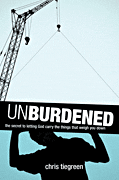
Review: “Unburdened” by Chris Tiegreen

Unburdened: The Secret to Letting God Carry the Things That Weigh You Down (affiliate link) by Chris Tiegreen is a great book for people dealing with stress, work, caring for a sick family member, worry, or any kind of burden for that matter. I was not a big fan of the cover art at all, but the book was great proving that you really can’t judge a book by its cover.  I really could have used this book (affiliate link) a few years ago when I went through  a summer of sleepless nights filled with worry after my concussion.

The author does a great job of drawing the reader into the focus of the book (affiliate link).  One of the best parts of his writing style is that his writing is very quotable, meaning the contents of the chapter often find expression in short, memorable and pity statements that carry on with the reader long after the book has been read. I was deeply impressed with the author’s persistence to bring the scripture into the conversation.  The real value to this book is that it works as a great tool to discovering and applying God’s word to the burdened believer.   Through this is the first book I’ve read by Chris Tiegreen his engaging and transparent writing style won me over and sent me to the book store looking for more of his books and wondering why I haven’t heard of him sooner.

I would highly recommend this book (affiliate link) to anyone who wrestles with trusting God with some of life’s most delicate burdens.  This book also makes a great gift for those you know who are stressed to the max, overfilled with worry, or carry the burden of depression. The cover art and perhaps event the title make it a bit hard to give away, but the contents are well worth the investment.

The retail price is $13.99 (Paperback). It is also available at places like Amazon.com for $10.07 (affiliate links). I gave it 4 Stars

Disclosure of Material Connection: I received this book (affiliate link)  free from Tyndale House Publishers as part of their Tyndale Blog Network. I was not required to write a positive review. The opinions I have expressed are my own. I am disclosing this in accordance with the Federal Trade Commission’s 16 CFR, Part 255: “Guides Concerning the Use of Endorsements and Testimonials in Advertising.”