9 Reflections on Disciple Now (Part 3)

7. Our students were challenged to grow in their relationship with Christ and develop a cosistent habit of going to the scripture on a daily basis.

8.  Our students were given a frame work for discerning how scripture applies to their lives.  In other words: Implications from passages such as Genesis 1:27 were drawn to how we should value men and women as both being made in the image of God and thus we were equal but different.

9. Our students were provided to discuss their understanding of manhood and womanhood in a small group of their peers allowing for accountability and encouragement.

3 Questions About Healing and the Kingdom

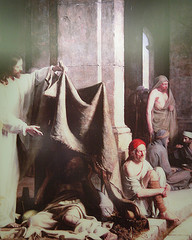
jesus-heals1 So I guess it is only fair for me to admit my biases up front when it comes to “healing.”  My Theological Assumption: I would like to clearly state that I do believe that God does choose to heal and even miraculously heal certain people at certain times.  My Cultural Assumption: I would also like to state that I believe that many Americans neglect  a healthy understanding of the miraculous and supernatural because of an over dependence on a skeptical mind (how arrogant to assume that all cultures that hold to a supernatural world are living in ignorance).  My Experiential Assumption: I have several friends who despite great prayers and great faith have never experience a divine healing miraculous or otherwise.  They were asked to stand up out of their chairs or extend forth their lame hands all to no avail.  Many were accused of not having enough faith.

3 Questions About Healing and the Kingdom

So all of this arises out of the need to get something right in my mind.  A few times now I have been in a situation where a group of folks will get together with the idea to share Christ with the lost world and a brother of mine will stand up and start talking about healing. Usually when this happens they direct my attention to Isaiah 53:5 (By his stripes we are healed) gloss over the whole sacrifice part of the passage and ask if anyone wants to be healed.  The gospel seems to be diminished or passed over by the desire to display a powerful sign of healing.

I understand  that while in the midst of preaching the kingdom Jesus healed people. In many instances healing and preaching the kingdom were hand in hand and almost inseparable (Matt 4:23, 9:35, 10:7-8, Luke 9:11 and especially Luke 10:9).  Jesus demonstrates that the kingdom is coming by healing and showing us what the kingdom will be like (there will be no sickness or death).  This proves not only to authenticate his message, but help us to visualize what it would look like to live under the rule and reign of such a benevolent king.

Yet at the heart of what I generally observe when I hear healing preached is not an announcing of the Kingdom of God, but a statement that God wants you healthy and wealthy. Then some take it so far as to say that if you lack health or wealth you have no faith.  I often wonder if such people have searched the scriptures enough to develop and understand a theology of suffering.

So here are my questions…

. . . . . . . . .

  • Is there a connection between healing and the kingdom of God?
  • Does your theology of healing allow for a theology of suffering? If so how?
  • Does miraculous healing still happen today?

9 Reflections on Disciple Now (Part 2)

3. Our teenagers glorified God by serving others with the work projects this weekend (They painted a house, built a ramp, hosted a backyard bible club, and took cookies to the home bound).

4. Our teenagers were given at least one more point of contact with our church family (they stayed in the home of church members and the relationships at Calvary were deepened and  developed as students and adults interacted)

5. Our Teenagers were given a positive aim for their life and real reason to remain pure (to glorify God in manhood and womanhood!)  Too often the loftiest aim we give our kids is to stay out of trouble… ie… “true love waits” and we fail to provide a positive challenge to our kids to raise the standard.

9 Reflections on Disciple Now (Part 1)

2227885657_25a043b6e5_m The event is over.  The students have gone home and the quiet descends on what was once a room full of chaos and chatter.  The lives that were united for a few hours this weekend have temporarily scattered across Pensacola.  As I pray over the quiet room I recount all the events of the weekend and I can not help but give God the glory for all he has done.

9 Reflections on Disciple Now 2009

  1. Our teenagers were confronted with the gospel. (One of our students gave her life to Jesus Christ as her Lord and Savior!)
  2. Our teenagers were challenged with a biblical definition of manhood or womanhood. (they can no longer live in ignorance of the issue, they must now choose their actions each day based on the knowledge of an existing framework for how men and women can glorify God together).
  3. our teenagers were exposed to a model of successful discipleship where students become teachers (all of our leaders had been through this topic with me before…With the exception of John who has lead his students through similar material).

3 things you should know before you judge your friends

Judge not, that you be not judged. For with the judgment you pronounce you will be judged, and with the measure you use it will be measured to you. Why do you see the speck that is in your brother’s eye, but do not notice the log that is in your own eye? Or how can you say to your brother, ‘Let me take the speck out of your eye,’ when there is the log in your own eye? You hypocrite, first take the log out of your own eye, and then you will see clearly to take the speck out of your brother’s eye. “Do not give dogs what is holy, and do not throw your pearls before pigs, lest they trample them underfoot and turn to attack you.  (Matthew 7:1-6 ESV)


1. You will be Judged by the Same Standard you use with others (7:2)

It is easier to apply a stricter set of rules and regulations to others that it is to ourselves sometimes.  We see others faults much more clearly than our own.  We can be pretty harsh critics and most of us can be pretty good at fault-finding.  Think about this though, we should be expected to be judged for our faults to the same degree that we judge others.  I don’t know about you, but this makes me back off the need to be a harsh critic sometimes.

2. Sometimes the sin you see the most in others is the same sin you struggle with (7:4).

Ever notice how both the speck and the log were in the eye.  It’s easy to call out people who have sin in the same areas that we struggle.  This past week I have heard so many people condemn a girl about getting pregnant outside of marriage (don’t get me wrong… sex outside of marriage is a sin).  Though she is repentant she will feel shame for a while, her sin has become obvious to the world and is no longer private.  However, some of the people who seemed to take a perverse pleasure in her dilemma had requested help earlier for their struggle with pornography.  It’s easy to see in others the sin we struggle with.

3. It is difficult to do the right thing with the right motives (7:5).

It might be the right thing to lovingly confront a brother about his sin.  ( I would want to be confronted about mine.) However it can be difficult to do it in a way that glorifies God and does not promote your own ego.

.  .  .  .  .  .  .

People try to be righteous (right before God) in three different ways.

  1. Some try to do as much good as they can hoping God will overlook the bad things they have done.
  2. Some point out the flaws of others around them and say that since they are not as bad as others they must be okay.
  3. Some come to God knowing that there is nothing that they can do on their own and so they humbly trust in what Jesus Christ has done for them to save them.

The first group points to their deeds, the second points to their lack of bad deeds, the third points to Jesus Christ as a their source of Righteousness. Which group do you think is actually right before God?


When Church People do Bad Things

from-flikerSo here is the deal.  Most Wednesdays I teach and part of our strategy of discipleship is reteaching.  Which means that we challenge our students to take what they learn on a Wednesday and introduce it into conversation or get two or three of their friends together for a small groups Bible study using the Revelation Application Guide as teaching guide (its something we are working on and not a finished product).  So what better way to readdress the issues we discuss than to put up a blog post on Thursdays that highlights what we have learned on Wednesdays?

When Church People do Bad Things

“If your brother sins against you, go and tell him his fault, between you and him alone. If he listens to you, you have gained your brother.  But if he does not listen, take one or two others along with you, that every charge may be established by the evidence of two or three witnesses.  If he refuses to listen to them, tell it to the church. And if he refuses to listen even to the church, let him be to you as a Gentile and a tax collector.” – Matthew 18:15-17

It’s Not about You

One of the best things that can ever happen is for a believer to truly understand that it is not about being offended or hurt, but about individual relationships with God and each other.  Many times we are too easily offended because we love ourselves too much.  Self-love is not what should motivate us to seek out a right relationship with our brother in Christ, it is God-love.

For this reason it is important that that offended party (or the one who witnessed the brother in sin) go to him.  You should not wait for an apology before you attempt to reconcile with a Christian brother.  This models the way that Christ has come to us (Romans 5:8).

You Should Go Alone

It is not about you when someone has sinned against you.  It is about their relationship with God.  You should approach them about their offense in private in a way that makes much of God and minimizes your pride.  You should not use the world of social media (Facebook, Myspace, Twitter, etc…) to defame the person who has offended you.  You should seek to reconcile things in the peaceful quiet of a one on one conversation.

The Goal is Restoration

The aim is to gently and persuasively pull your brother back into right relationship with Jesus Christ and others.    The gospel is preached and the drama of redemption is played out when we lovingly confront our brother’s sin for the purpose of restoration.  Real love does not allow sin to go unchecked but holds others accountable for the purpose of godliness.

I love my daughter and because I do I will prevent her from doing things that will cause her great harm and pain.  It is love to restrain and compel my three year old daughter that playing with knives is wrong.  It is hate to let her contently play with knives to the point that she causes serious harm to herself or others.  In the same way love compels us to reach out to our brother in sin and bring him back into the fold (Matthew 18:12-14).

. . . . . . .

Obviously there is a lot more to this passage that I have time for here.  We can pick up the debate about the later stages of this process later, but in the meantime check out some of the following passages that address this issue.

  • Matthew 7:1-7
  • Galatians 6:1-2
  • Romans 12:19

5 Growth Challenges

300819410_8dfff801d5_m Are you looking to grow deeper in your relationship with God?  The challenges below are a great place to start.

1. Proverbs Challenge… Read a chapter of Proverbs each day.  Read Proverbs chapter 7 on the 7th of the month; chapter 8 on the 8th of the month and so on.  Our pastor Chris Aiken does a daily blog commenting on one chapter of scripture and a daily take away from the book of Proverbs.

2. Journal Challenge… Take the Bible reading one step further and keep a journal that you can record your thoughts in.  I like to ask myself two questions after I have read and prayed thought the scripture: 1. What does this say about God? 2. How will I respond?

3. My Story Challenge… Write out the story of how you became a Christ follower in 100 words or less and let me review it. Try use every day language and avoid words that are church specific.  Highlight three things:

  1. Life before you met Christ.
  2. How you met Christ.
  3. How your life is different now.

You can see a version of mine in the “About Me” section of “Meet Jonathan.”  After it has been reviewed take the opportunity to tell others your story and get their input.  Post it on your facebook and myspace profiles.

4. Teach others challenge… I encourage our students to take notes on the Sunday Morning sermon and the Wednesday night message.  Study their notes and then either through intentional study (like an established Bible study) or in regular conversation (“guess what I learned this week”) share what they have learned in a way that teaches others.

5. Accountability Challenge… I challenge our kids to encourage one another with what they have been learning and doing in smaller groups.  I do this by sending out a mass text each asking for prayer requests from those who subscribe and sharing a verse that stuck out to me that day from my daily bible reading (usually from Proverbs since that is one of the challenges).