3 Keys to a Good Disciple Now Weekend (Part: 3)

The Follow Up

Ok.  Here is perhaps the most important part of the whole Disciple Now weekend, Follow Up!  It begins as soon as the students head home after the morning service.  There are generally three major areas that I like to follow-up with as quickly as possible (to help keep the events of the weekend fresh).

1. Leaders

I typically enjoy having lunch with all of my leaders or scheduling another time to meet with them.  I like to discuss the event while it is still fresh in their minds.  Each leader gets an opportunity to discuss challenges the weekend posed for them, opportunities for further ministry (as they see it), and an evaluation of the whole weekend.  I treasure this time as it provides for me a great opportunity to coach my leaders through processing the event as well as provides me with another perspective on leading our students.

2. Host Homes

I usually try to follow-up with host homes casually on an individual basis in the week after the Disciple Now weekend.  I also like to give out a brief survey on things that went well and things that we can improve before the next Disciple Now weekend.  Though they did not make it to my big 3  list for a successful Dnow weekend, host homes are crucial.  Getting key insight from adults who have just spent a weekend in their home with your students is never a bad idea.

3. Students

After having an opportunity to gather as much information as possible after the event from leaders and host homes it is important to use that information to engage students.  Sometimes this comes in passing information on to LIFE group leaders (the real everyday hero’s in student ministry) in discussing how to better minister to individual students.  Sometimes this provides great opportunity to follow-up with a student who was asking questions at Disciple Now weekend.  Other times the information is applied to working on group dynamics.  As a Student Pastor or Student Ministry Leader you will be uniquely equipped to figure out the best strategy to take the information you have gathered and shepherd students.  The goal is to help move students along in process of becoming fully devoted followers of Jesus Christ.  Not just to hold a successful event.  Events are just tools that we can use along the way to develop disciples.

Review: Finding Purpose Beyond Our Pain

_200_350_Book.98.cover

Finding Purpose Beyond Our Pain: Uncovering the Hidden Potential in Life’s Most Common Struggles by Dr. Paul Meier and Dr. David L. Henderson is a great book  for readers who are looking to see a greater purpose in the painful moments of life.   Through out this book the authors challenge the reader to not seek a pain free existence, but rather to learn and grow through pain to see God’s greater purpose. Both authors share keen insights from both personal and clinical experience.

The book is divided into seven sections with four chapters each.  The sections include Injustice, Rejection, Loneliness, Loss, Discipline, Failure, and Death.  Each section is stand alone and the reader can jump ahead to a section without fear of having missed vital information in a section prior.

I appreciated authors’ writing styles.  The use of real life stories and examples helped to insure that this book was an easy read and never boring.  I enjoyed reading the keen insights from two brilliant men who have years of Biblical counseling experience in walking with people through pain.  The credibility of the authors, the easy to reference sectioning, and the readable style has guaranteed this book a spot on my shelf for years to come.


This is a very practical and readable book on pain and adversity.   Finding Purpose Beyond Our Pain is an excellent resource. The retail price is $22.99 (Hardcover), and is available at places like Amazon.com for $16.55. I gave it four stars.

Disclaimer: As a blogger I received a free review copy from the Thomas Nelson’s Book Review Blogger program  (http://brb.thomasnelson.com/ ).  There was no requirement to give it a positive review, just for the reviewer to call it like they see it.

3 Keys to a Good Disciple Now Weekend (Part: 2)

The Leader

The second key to planning a great Disciple Now weekend is the leaders.  Once the theme is figured out, it is time to figure out who will be leading your small group bible studies in the homes.  I used to get college students from the local Christian University or BCM (Baptist Campus Ministries) group to help me out on this one.  However, as I have had opportunity to be a youth pastor in one church for an extended period of time, I have enjoyed having kids who have come through the program start leading small groups once they have hit college.  Its great for the younger students to see a student who has come all the way through the student ministry and its good for the leaders to be able to give something back to the group they came from.  On top of that, I get to test the kids who have been under my teaching and provide them with further opportunities for growth and experience.

Wherever you get your leaders, the key is that they exhibit a growing relationship with God.  At the end of the day you want someone who will reinforce what it looks like to grow and mature in a relationship with God.  I like the idea of college students because it gives your students a good role model for their next steps on the journey.

Even though I generally know my leaders before they come lead the Disciple Now weekend.  I generally like to sit down with them a month or two before the weekend and brief them on the Theme, the idea of what kids will be in their group, and the material they will be teaching through.  I also like to catch up and find out how things are progressing at school and what God is teaching them.
//
//

3 Keys to a Good Disciple Now Weekend (Part: 1)

Ok are you ready?  I am about to share the three keys for an awesome Disciple Now weekend.  This might surprise some of you, but I am not about to say, “The Band, The Speaker, and the T-shirts,” though those may be important in their own right.  There are 3 other things that I have seen bring about more lasting change than any band, speaker, or T-shirt has ever done.  In my estimation, if you can get these 3 right you can make up for a bad band or t-shirt (its really hard to make up for a bad speaker so we’ll make him the unofficial 4th key to a good D-Now Weekend).

www.mrg.bz So1lxO

1. The Theme (go large view over small view)

When designing a D-Now Weekend I like to start with the theme.  Generally speaking there are a lot of good and average themes out there (and I’ve done some of them).  You have your run of the mill, “back to the basics,” “true love waits,” etc, etc…  truth be told these are not bad themes.  They just lack the substance I am looking for.  If I’m going to invest the man hours that it takes to pull of a great disciple now weekend I want a theme that my students see practically 8 months down the road. (meaning they remember the theme as well as the event, and more importantly apply it to life.)

So what does that look like?  Take the “True Love Waits” theme and think about it.  Is that really the big issue?  What do you want to teach your kids? “Don’t have sex until you are married? Waiting for Sex is good?  Purity is better than impurity?”  Nothing overtly wrong with those statements, but what if you had the chance to cover the whole “don’t have Sex until you are married” theme put it in a positive light (give the kids something to strive for… rather than something to strive against) and at the same time lead your kids toward maturity in Christ?

How do you do that?  You take it a step deeper.  God didn’t just make you a sexual being he made you to be a man or be a woman.  The questions now isn’t, “will you wait?” But what kind of man or woman will you be?  The challenge changes from waiting to being.  As a pastor I am not so much interested in behavior modification as I am in leading students into a growing relationship with Jesus.  While “If you love them, you will wait” is not a bad theme, it is a small goal compared to God made you for a purpose as a man or a woman.

The bigger theme we went for in DNow last year and several years ago was “Biblical Manhood and Womanhood.”  The point was to help kids understand who they were in God’s eyes even down to their gender, realize how men and women compliment one anther, challenge our guys to be men, free our girls to be women, and help them to know how to encourage one anther in ways they will receive it.  While true love waits was part of it, it wasn’t all of it.

So now months later I can ask our young men to filter a thought our an action and do it along the terms of biblical manhood.   It doesn’t mean they all drank the cool-aide and are running around using the lingo, but it does mean we have introduced a filter to a world view that will help them evaluate their actions according to what kind of man or woman they are becoming.  This year we are going to do it all over again with the theme of Servant Leadership.

I realize that this idea Biblical Manhood and Womanhood may be new to many of you, so I have included a link to a previous post throughout this article.
//
//

5 Keys for Developing Long Term Strategy in Student Ministry

I’ve been asked to speak a few times on the topic of Student Ministry and here lately have had a few great conversations with fellow youth pastors about Student Ministry.  The following is a short version of my notes I have used on occasion.  The bold sections are a revision of my thoughts.

http://mrg.bz/C3Qy3c

The culture is changing rapidly and it provides us an excellent opportunity to examine how we should change our approach to student ministry. But there is one thing you need to know, even before the culture began pick up the pace Student Ministry was failing. The statistical data on Student Ministry is not pretty. We have a 75-85 % failure rate depending on whose statistics you read. To get a picture of how huge that number is…for every 4 kids actively involved in student ministry one makes it to church as an adult. Much can be said about why, how, and who obtained the various statistics but what I would like to do is use the current buzz around student ministry to help us evaluate our methods and begin exploring what success looks like in student ministry.

Create Long-term Goals

We need to create long-term goals for student ministry. Too often success in Student Ministry is measured in short term numbers. Nothing is wrong with using numbers to measure success. but are we using the right numbers? One sales job I had required you to wait 60 days before you collect your pay check. The reason was simple. People bring things back and you don’t get paid on what gets returned. (I’m not staying that kids lose their salvation, its just that sometimes they don’t really make genuine commitments. I’ve had students “get saved” at a concert because the invitation was offered in conjunction with a free bracelet from the evangelist. The were responding to a free bracelet offer and got counted as trusting in Christ. What is really sad is that i don’t think the evangelist was trying to cause this kind of confusion. He preached a sincere gospel message.)

Be Able to Measure

One of the key problems in this assessment is that most tangible numbers for student ministry are short term (decisions and attendance) and therefore get the most focus. Most long term goals in student ministry are intangible or we just haven’t developed a measuring stick and therefore in many ministries get little or no focus.  The questions we should be asking about student ministry isn’t, “how many?”, but “what do students who graduate from our group look like?”  Our focus needs to shift from entertainment with a christian vibe to discipleship (By discipleship I mean teaching our kids to know and put into practice the word of God in their lives… Not just know how to hotly debate side issues of doctrine.  Jesus tells us in the great commission that part of disciple making is “teaching them to observe all that I have commanded you.” ) One of our measurements at a church I served was having students who are able to teach or disciple others.

Know where you are

Once you have determined the measuring stick, figure out where you are.  Get an honest assessment of how close or far away from the goal you are.  You may need to enlist the help of outsiders to give you an honest evaluation of your group.  If you are new to your position, ask a leader or youth worker who has been around if they know where the students are in relation to your goal of (bible reading, scripture memory, acts of service, leadership, discipleship, etc…) Ask yourself questions.  Ask your students questions  (Something as simple as a survey would work for “how often do you read your bible”)

Develop the playbook

If you set long term goals then you won’t achieve them overnight.  In fact, depending on your students, announcing your long term goal may backfire on you.  Sometimes it is better to establish short term goals that will help you get closer to your long term goal. For example, having students assist in teaching children at a backyard bible club is less intimidating that to disciple a peer.  The next step would be to have a student teach at a backyard Bible club.  Then maybe it is a student Sunday where students team up and teach adult classes, lead music, and preach.  Then maybe its calling on the older students to teach younger students in the course of a disciple now weekend.  Each one of these is a strategic step towards a larger goal of having students who are able to teach.  (Hint: celebrating each step along the way will help students develop the confidence and trust in God to take the next big step)

Stick around for the Results

Unless you build from the ground up or start with just a small handful of students it will take time to see strategy come to fruition.  If you develop a 4 year strategy and leave after two years you were only halfway through the plan.  That is kind of like quitting the game at half-time.  I know that sometimes circumstances are beyond your control or God calls you to go somewhere. But where possible see it through.  Discipleship is a lifelong commitment.

A Few Thoughts on Fatherhood

Getting ready for kid number two in a few months has me reminiscing about fatherhood.  So I thought I would take a moment and share about how God prepared me for fatherhood the first go round.

My preparation for fatherhood began when I was a child watching my own father.  I was gifted to have a strong and capable dad.  I learned so much from him, even when he wasn’t looking.  I must have been a really good student of my father, because I catch myself saying things and acting just like him.  And that’s not bad, because I really love my dad and feel blessed to be his son.  I wonder if he knew he was teaching me about being a father?

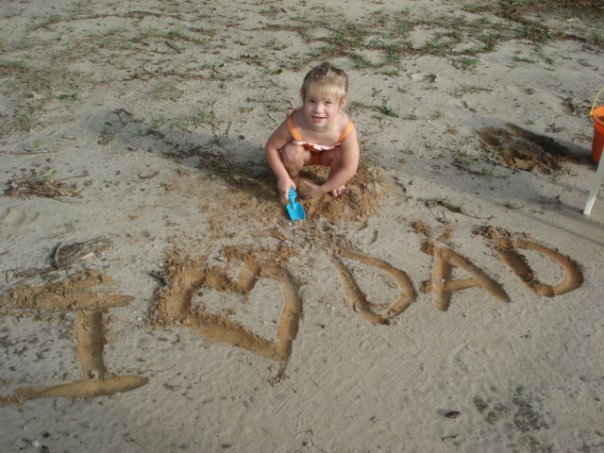
Rebekah Writing in the Sand

Then there was the day that a friend of mine told me that he and his wife were going to have a baby.  We were memorizing scripture together and so we turned our hearts to Psalm 127.  We discussed the meaning of the Psalm and that day Psalm 127 began teaching me that children are a blessing. Though I was young, unmarried, and a long way from fatherhood, God used that psalm to shape my life.  I longed for the day that I would be a dad.

Along the way my job has afforded me the opportunity to watch parents in action.  I have been blessed to see some great parenting from discipline to discipleship.  I’ve learned a lot through the years by partnering with parents in student ministry.

Yet, nothing could have prepared me for the day when I was told I was going to be a dad.  In our marriage, it was something Avia and I were hoping for, but not exactly planning on quite so soon.  Yet there we were, newly-weds, five-months into marriage and Avia became aware that all was not as it used to be and took a special trip to the doctor.

One Wednesday night I came home to see my wife and in my chair there was a little teddy bear holding a pregnancy test.  Tears filled her eyes and then mine and then I quoted Psalm 127.  We were nervous.  We didn’t know what parenthood would be like, but we knew this was a blessing from God.

Nine months later I held my little girl in my arms for the first time.  I held her up and quoted this same Psalm over her and prayed and thanked the Lord for this blessing in our lives.  Then I dedicated her to the Lord and asked for guidance to be a godly father.

“Unless the LORD builds the house, those who build it labor in vain. Unless the LORD watches over the city, the watchman stays awake in vain. It is in vain that you rise up early and go late to rest, eating the bread of anxious toil; for he gives to his beloved sleep. Behold, children are a heritage from the LORD, the fruit of the womb a reward. Like arrows in the hand of a warrior are the children of one’s youth. Blessed is the man who fills his quiver with them! He shall not be put to shame when he speaks with his enemies in the gate.” (Psalms 127:1-5 ESV)

How to Have a Daily Worship Time

What is a Daily Worship Time (DWT)?

A daily worship time is a special time set aside for an individual to grow closer to God.  The DWT most often includes practical and consistent excercise of spiritual disciplines (bible study, prayer, silence, fasting,etc.).  This practice has various other names, such as a daily ‘”quiet time” or “personal devotions”, the name doesn’t matter as much as the concept of intentionally putting ourselves in a place where we are more likely to hear from God.

When Should I have a my Daily Worship Time?

Daily worship times really work best for me when scheduled in the morning before breakfast.  I personally like this time because it helps me start my day out right.  On days that I have missed my DWT, or done it later in the day, I can really tell a difference.  This may be hard for some people because it requires self-discipline.  This early morning time is somewhat important for me, but you haven’t blown it if you need to set up another time.  It is better to be consistent with your DWT than it is to be early and not consistent.  If you have never had a consistent DWT before, you may want to schedule a time with Jesus  (ex. before breakfast, when you get home from school, or 8PM every evening).  You may want to set an alarm clock to remind you or leave yourself notes.   Make it as important as if you were meeting one of your best friends (after all you are meeting with Jesus).

What do I do for a Daily Worship Time?

Many people do different things for their daily worship time.  The main thing is that the focus is on learning about and worshiping God.  Even though people do their DWT differently there are some elements that  should always be involved.

The first important element of a DWT is reading God’s Word. It is by reading what God has said about Himself that we learn about who God is.  When we read His word we are reminded of his unchanging character.  You can learn more about how to read God’s word here.

Another element essential to a DWT is  Prayer. Prayer is how we communicate with God and verbally submit our lives to him.  Through prayer we recognize His ability and our inability over people and circumstances.  There are many parts to prayer, but the main parts are:  recognizing who God is, recognizing our need for God, submitting our lives (and specifically each day) to God, asking God for direction, and asking God to move and work in the lives of other people. I will post more on prayer later.

Some people like to include a Journal as part of their DWT. This is a notebook where you can record your thoughts about who God is or how you need to respond to Him.  A journal can consist of just a few short notes or well thought out paragraphs.  When I was younger and had a hard time praying, I would write out my prayers to Jesus in a journal.  Since then it has been a blessing to look back at my journals and see who and what I was praying for and how God answered those prayers.

Many people like to sing as part of their DWT. They use music to proclaim their delight in God or to remind them of certain things about God like His love or His faithfulness.  We have a few  awesome worship teams at our church both on Sundays and Wednesday nights with our students who have introduced me to several great songs.  If I hear a song that really speaks to me, or reminds me of a particular truth about God, I will do a word search and get a copy of the music and memorize the song so I can sing it during this time. Some of you are very musically gifted and will write songs of praise based off of what you have learned about God in your DWT.

I strongly recommend that near the end of your DWT that you write out what your response to God should be. This allows you to apply God’s word to your life and how you live.  In my own DWT  I call these action steps.  Action steps are practical ways that you will apply the truth you learn each day to your life.  You can read more about action steps in the second half of this post.

A Few Tips on How to Read the Bible

When I was little I knew that it was important to read the Bible, but I didn’t know how.  I used to flip open my Bible and what ever passage it opened to I would read.  I heard a preacher tell a story about a man who was looking for God’s will like that.  He flipped open his Bible and placed his finger on a verse and it said, “Judas went out and hung himself.”  He thought, “that can’t be God’s will for my life.  I need to try again.”  He did it again and this time it came up, “Go thou and do likewise.” We know God would never tell us to go hang ourselves, this man’s idea about how to hear from God was a little flawed.

My bible at Whirled Cup Cafe

Needless to say you don’t normally get a lot from reading the Bible like that.  You can’t get a lot from any book by doing that, especially God’s word.  When it comes to God’s word there are a few things that you need to keep in mind.

1.) The Bible is a collection of books. The Bible is collection of books and those books were meant to be read just like any other book, from beginning to end.  That is how we can make the most sense of other books.  That is how we can make the most sense out of God’s word.

2.)  We call the Bible God’s word because it is what God has told us about Himself. It is a record of how God has dealt with mankind through the centuries.  Hebrews 1:1-2 tells us,”God, who at various times and in various ways spoke in time past to the fathers by the prophets, has in these last days spoken to us by His son.” The Bible is the recorded word of God and so when we read it, whether we are reading about Noah and the Flood, or Jesus’ death, burial, and resurrection, we can rest assured that God has given us His word in order to reveal Himself.  So as we study the Bible we need to ask, “What is God saying about Himself ?”  The story of Noah and the ark isn’t about a floating zoo, its about God’s grace in saving Noah, God’s intolerance of sin, and so much more!  We read God’s word to learn about God.

3.)  But we don’t stop there, we also need to apply it to our lives and so we should ask a second question, “What should my response be to what I have just learned to be true about God?”  We want to be a responsive people.  Think about it.  Why did God give you His word?  He shows you who He is through His word and so as our understanding of God changes our response to God changes.  We can not be the same people.

These two questions help me to develop resolutions or what I like to call action steps. Action steps are tangible things that I can do in my life that day to put into practice what I have learned to be true about Jesus.  They can be as simple and general as “I’m going to call out to Jesus every time I am tempted today because he knows what it was like to be tempted and was yet without sin” (Matthew 4).  Or they can be as specific and complex as, “I am going to ask my mother to forgive me because I was a jerk to her last night because Jesus commands his followers to live in a right relationship with others” (Matthew 5:24).

——————————————————————————————————————-

Just to recap, here are the highlights.

1. Read a book of the bible in the order it was written (don’t randomly flip open the bible and throw your finger down in the middle).

2. Ask two important questions….

  • What does this say about God?
  • How should I respond to God?

3. Use those questions to help you formulate resolutions or action steps

—————————————————————————————————————————

Looking for a place to start?

If you are new to this bible reading thing or haven’t done it in a while and you are looking for a place to start, I encourage you to check out the blog of my friend (and pastor) Chris Aiken.  Each morning he reads a proverb and a chapter from another book of the Bible.  He then makes a blog post commenting on the chapter of scripture he read.  What is really neat about the blog format is that you can post questions or responses to each daily reading.  You can find his blog at http://www.chrisaiken.wordpress.com

Every Student, Every Neighbor

It was 4 AM and I couldn’t sleep.  So I just laid there in bed with thoughts racing through my head about prayer, how to pray, why we pray, why we don’t pray enough and who would be at their flag pole in the morning.  I was worried because I am not normally compulsive about simple events like asking students to show up and pray at their flag pole.  So I eased my mind and began to call out to Jesus for clarity and  for focus.  In my heart he began a burden that was more fully realized later at the flagpole that day.

Flag's at Ransom Middle School (iphone)

I stood around with a crowd of about sixty teenagers at a flag pole as they prayed.  I watched from my huddle of adults as hundreds of other kids piled around the court yard wondering what was going on at their flag pole.  My heart broke for the students.  Sixty at the pole and about three hundred on the outside watching, more arriving each minute.  As I stood there I could see it like a sign over thier heads.  People lost like sheep without a shepherd.  Words about addictions, struggles, and issues that lead to death filled my mind. Words like anorexia, school violence, drugs, depression, peer pressure, alcohol poisoning, drunk driving, bulemia, abortion, suicide, rape, racism, bullying… lies that people believe.  My heart was broken knowing that many have never even heard the name of Jesus other than a cuss word.

Then I called out to God from the noise in my head and pleaded for him to empower these sixty, these few to reach their school for Jesus.  Though much of the freedoms once afforded teachers and other adults on the campus were coming under attack in our area, one thing was clear… students still have the freedom to share the gospel and tell their friends about Jesus.

Yet peer pressure stands in the way.  That is what kept sixty around the pole instead of in the crowds.  Its also what kept students from finding their way to school on time and praying at the pole.  The older I get, the easier it is to see.  Like going on a mission trip and seeing the need in another culture, I look at students, now that I am a generation removed, and see more clearly than ever their need for the gospel.  Indeed, I am a missionary to another culture.

Then it struck home.  What about the place where I live?  What about my culture?  What about my neighborhood just a few blocks away?  Do I see the need there?  There is a need.  Though my neighbors have houses like mine, cars like mine, kids like mine, and experience the same weather I do, many do not know, or have not heard about Jesus.

So I transitioned out of thought and into thoughtful action.  Rebekah (my 3 year old) and I are out walking the streets in the evenings meeting neighbors and developing relationships for a bridge to the gospel.  My aim is to meet and find opportunities to share the gospel with all of my neighbors.

I am still burdened for our schools and the student culture (and their parents) that I have been called to pastor and be a missionary to.  My prayer is that as we pray and ask God to send laborers that students and families would catch a vision for God and He would use them to share the gospel with every student, teacher, and faculty member by the end of the school year.

And Jesus went throughout all the cities and villages, teaching in their synagogues and proclaiming the gospel of the kingdom and healing every disease and every affliction. When he saw the crowds, he had compassion for them, because they were harassed and helpless, like sheep without a shepherd. Then he said to his disciples, “The harvest is plentiful, but the laborers are few; therefore pray earnestly to the Lord of the harvest to send out laborers into his harvest.”  (Matthew 9:35-38 ESV)

For “everyone who calls on the name of the Lord will be saved.” How then will they call on him in whom they have not believed? And how are they to believe in him of whom they have never heard? And how are they to hear without someone preaching? And how are they to preach unless they are sent? As it is written, “How beautiful are the feet of those who preach the good news!” But they have not all obeyed the gospel. For Isaiah says, “Lord, who has believed what he has heard from us?”(Romans 10:13-16 ESV)

What about you?  What is your strategy to reach your neighborhood, school, or workplace?  Are you partnering with others to see Jesus proclaimed where you are?

Why Asking Her Dad Was Easy

Avia and I decided that we were ready to be married.  Now all I had to do was ask her dad.  I know for most guys this kind of thing seems scary.  I generally don’t think it is easy to ask another man if you can marry his daughter.  I can think of a lot more comfortable situations.

Engagement Pictures

What paved the way to make this an easier situation for both her father and I was that we knew each other (though I can’t ever imagine being completely prepared for another man asking to marry my daughter). I had been hanging out at his house three or four times a week for years.  I had been getting to know Avia in the context of her home.  Not to mention that before we started dating, I asked her parents, particularly her dad, if we could date with the view toward marriage.

So when it came time to ask, though I was nervous, it wasn’t hard or difficult to muster up the courage to go see her father.  It was natural and easy.  I really respected Avia’s dad and I knew I was asking to take responsibility for his daughter.  Such things demand man to man conversation.

The details of the discussion we had are private, however, it is sufficient to say that two men met that day and discussed life.  The advice I received and continue to solicit from time to time was excellent advice not only on marriage, but on what marriage would be like with Avia.  I’ve come to the conclusion that no man, before her husband, knows a woman like her father.

With the blessing of her father, mother, and even her brother (after all I had inadvertently used him to get to know Avia better), I set out to propose.  I had the ring in hand, a bible passage to examine, and an anxious girl friend who couldn’t help but wonder when and how I would ask (it was hard for her to ignore that I had gone out of my way to talk with her father, mother, and brother individually).

Finally the time came to go to a Thursday night college Bible study that I was co-leading.  I drove by Avia’s house and picked her up.   On the way, I remembered that I had left a book in the sanctuary of the church and needed to go by and pick it up.  As we came into the sanctuary I had already arranged for all the lights to be off, except for one spotlight shining down on the altar.  The altar was empty except for a large bible open to Ephesians 5 and in between the pages there was an engagement ring.  I got down on one knee and said, “I’ve been reading this passage.  I am scared and I am humbled by it because I don’t think I am everything I need to be.  But it does describe the type of man that I want to be and will work the rest of my life to become if you answer yes to my question in just a moment.  Today I have a ring for you and I want to put it on your finger.  It is a promise, a promise that in a year from now we will stand together in this same place before God, before our parents, before a room full of witnesses and declare our love for each other and accept each other in marriage.  Avia, will you marry me?”

She said “yes” and something to the effect of “you talk too much.”  We embraced and read Ephesians 5:22-33 talked about how we would try and fulfill that passage and prayed together.  Then we went to a Bible study and she showed off her ring.  Eight months later we were married.