3 Thoughts on Facebook, being Missional and the Movies

I have to confess that my Facebook feed has brought me much grief over the last few weeks. Facebook has been an excellent tool in my own life to help me see pockets of hypocrisy and need for growth… it’s also given me a window into the lives and thoughts of others. What saddens me the most is how easily I engage in a debate about the trivial… like my opinion matters more than the person I’m talking too. Rarely ever do we communicate well in these short gusts of phrase and the opportunity for miscommunication is high.

It’s been awful to watch the discussion around the Noah Movie. Before the movie was released there were already debates waging about whether Christians should go see this movie or not. Then the mud began to sling. To be fair I don’t know that anyone on my feed called any person out in particular but there were a lot of straw men put down… Straw men are what we build and destroy to prove a case when no one enters the debate with us. In our minds we may picture real people we are too cowardly to approach or we may just be trying to show an assumed audience that we are with them by verbally attacking a mutually disliked position. How easily Facebook distracts us from the real mission field.

The problem develops when we allow a trivial thing like a movie to cause an apparent rift between brothers and sisters in Christ. We say things in general to the public we would never say to each other in person. A difference of opinion on a movie (mainly whether or not it’s worth someones time to go see it) is all it takes to cause a virtual schism of my Facebook friends. No matter which side of the debate you are on it becomes so easy to build your straw men, aim in the general direction of the opposition, and fire your volleys of well put phrase.

It’s so easy to tear down… So hard to build up. That’s why after some time of thought and reflection I came up with these 3 guidelines to keep me from tearing down my friends (real or imagined) on Facebook over trivial things like the movies.

1. I am accountable to God for everything I post. The following passage is talking about food but given the current conversation there is room to make application to how one posts on Facebook.

So then each of us will give an account of himself to God. Therefore let us not pass judgment on one another any longer, but rather decide never to put a stumbling block or hindrance in the way of a brother. I know and am persuaded in the Lord Jesus that nothing is unclean in itself, but it is unclean for anyone who thinks it unclean. For if your brother is grieved by what you eat, you are no longer walking in love. By what you eat, do not destroy the one for whom Christ died. So do not let what you regard as good be spoken of as evil. For the kingdom of God is not a matter of eating and drinking but of righteousness and peace and joy in the Holy Spirit. Whoever thus serves Christ is acceptable to God and approved by men. So then let us pursue what makes for peace and for mutual upbuilding. Do not, for the sake of food, destroy the work of God. Everything is indeed clean, but it is wrong for anyone to make another stumble by what he eats. (Romans 14:12-20 ESV)

2. Not everything that I’m free to do, is good to do. The following passage also deals with food (in a different way). The gist of the passage indicates that my personal freedom isn’t the most important aspect of my life and that even personal freedom when it comes across a brother of weaker conscience can be limited for the sake of his good and God’s glory.

“All things are lawful,” but not all things are helpful. “All things are lawful,” but not all things build up. Let no one seek his own good, but the good of his neighbor. Eat whatever is sold in the meat market without raising any question on the ground of conscience. For “the earth is the Lord’s, and the fullness thereof.” If one of the unbelievers invites you to dinner and you are disposed to go, eat whatever is set before you without raising any question on the ground of conscience. But if someone says to you, “This has been offered in sacrifice,” then do not eat it, for the sake of the one who informed you, and for the sake of conscience– I do not mean your conscience, but his. For why should my liberty be determined by someone else’s conscience? If I partake with thankfulness, why am I denounced because of that for which I give thanks? So, whether you eat or drink, or whatever you do, do all to the glory of God. Give no offense to Jews or to Greeks or to the church of God, just as I try to please everyone in everything I do, not seeking my own advantage, but that of many, that they may be saved. (1 Corinthians 10:23-33 ESV)

3. Correction and discipline need to be applied in private and on a personal level. There are those occasions where a person has sinned against you and you need to address their sin. They may have sinned against you on Facebook or other areas of the public forum. Their sin still needs to be addressed in a private and personal manner.

“If your brother sins against you, go and tell him his fault, between you and him alone. If he listens to you, you have gained your brother. But if he does not listen, take one or two others along with you, that every charge may be established by the evidence of two or three witnesses. If he refuses to listen to them, tell it to the church. And if he refuses to listen even to the church, let him be to you as a Gentile and a tax collector. Truly, I say to you, whatever you bind on earth shall be bound in heaven, and whatever you loose on earth shall be loosed in heaven. Again I say to you, if two of you agree on earth about anything they ask, it will be done for them by my Father in heaven.
(Matthew 18:15-19 ESV)

I’m not there yet. I have a long way to go. I found that out the other day in the midst of the whole Noah debacle. I thought I’d add to the fray and call some folks out in “general” who were fighting straw men… Little did I realize I was falling to the same temptation.

How about you? What are your thoughts on facebook, being missional and the movies? What other points would you make or add?

3 Tips for Using Smart Phones in Corporate Worship

First off you have to know that I’m perhaps the worst person in the world to write a blog post about smart-phone etiquette in church. Simply put, I’ve broken all the rules. I’m the pastor who heard a phone go off while he was speaking, eyeballed the crowd in a judgmental manner, only to realize that it was MY phone going off, and sheepishly reminded everyone to turn their phones to “off” or “silent”… I’m that guy! I was once caught using Instagram FROM the baptismal pool… ok, I was just kidding on that one, but you get the picture… I’m bad. On the other hand, I am a pastor and I care about people. I care about you.  I want you to experience and enjoy a real and meaningful relationship with God. That’s not just my job, it’s my calling. So while etiquette usually takes into account the feelings and perceptions of those around us the aim of this post is to help us think deeply about our use of, or abstinence from, smart phones in worship. Rather than listing out a series of “best practices” I thought it most practical to lay our some basic guidelines that keep loving God and loving our neighbor at the center of our thoughts on the issue.

3 tips for using Smart Phones in Corporate Worship

Phones are just tools and as tools they can either help us or hurt us, but it really depends on how we use them. To ban phones all together might be oversimplifying the issue and cause us to miss a few real blessings along the way, however to use them incessantly to record events or interact with others who are not in the room may cause us to miss everything entirely.

Be Fully Present. However you use your phone, when it comes to worship, be fully there. If you find that you are distracted by your phone turn it off, on silent, or leave it in the car. However, if the bible app helps you fully engage or if your pastor posts interactive notes on line or even if you take notes with an app that allows you to write notes and record audio to be played back later… use it. The key is how you use your phone. If it takes you to another place mentally, then leave it behind.

Be Respectful of Others. You’re not the only one there. If you choose to use the technology on your phone in a way that helps you be fully present, make sure your presence doesn’t become a distraction to others. If at all possible turn your phone to off or silent. Ask the people sitting beside you if they mind if you take notes on your smart phone or tablet. If someone tells you that they are distracted by your device or you notice the children in your section are peering over trying to see what you are doing, you will want to accommodate others and put up your device or move to a less kid friendly section. If you need to use your phone to call a friend who was supposed to meet you at the service, step out into the foyer or perhaps even outside so as not to be a distraction to others.

Don’t Judge How Other People Use Their Phone. It’s easy to judge others for how they use their phones. We tend to be harsher on others for their bad manners than we are on ourselves. The truth is we seldom have the whole story. Unless you know for a fact that someone is playing a game on their phone, assume they have a legitimate reason for having their phone out, such as taking notes, reading a bible app, looking up words they don’t understand, etc.. If you are distracted by someone’s use of a phone, either politely ask them to refrain from using it or to use it elsewhere, “Excuse me sir, I can’t hear the pastor while you are talking on your phone, can you take your call in the foyer or outside please?” (Wish I was kidding).  Or perhaps you could change sections. Obviously if it’s your kids who are using the phone in church you have a lot more leeway in sequestering phone use and dictating what is acceptable and what isn’t.

A few books that have helped my thinking on this issue are Emily Post’s Manners in a Digital World: Living Well Online and Teaching Generation Text: Using Cell Phones to Enhance Learning which is a book geared towards educators but has significant crossover into the ministry world and of course The Bible which should be our ultimate guide when understanding how to approach God and encourage one another. I’m also greatly indebted to about a dozen folks who took time to comment on  Facebook post in which I asked the question “What about smartphone use at church? Can I check in on FB? Tweet? Use my Bible App? Etc. what’s acceptable and what’s not?” As I glanced back over this article I couldn’t help but notice how several of their comments had slipped into my own thought process on this issue and made their way into this post.

What did I miss? What are some of the apps or practices you use to help engage in the worship service? What are some of the biggest distractions and pitfalls with using smart phones in church? Your comments and suggestions are welcome.

Disclosure of Material Connection: Some of the links in the post above are “affiliate links.” This means if you click on the link and purchase the item, I will receive an affiliate commission. Regardless, I only recommend products or services I use personally and believe will add value to my readers. I am disclosing this in accordance with the Federal Trade Commission’s 16 CFR, Part 255: “Guides Concerning the Use of Endorsements and Testimonials in Advertising.”

I’m Busy Right Now, But Check Out This Book

crazy busyCrazy Busy by Kevin DeYoung is a fascinating book about reigning in the business of life and focusing on what is most important. This book is a breath of fresh air for those who are looking for a biblical perspective on a busy life. DeYoung does not share a single time management trick in this book, rather he shares a biblical approach to a busy life. He brings a solid pastoral perspective and thus shepherds the reader to focus on the things that really matter rather than an aimless pursuit of being busy.

If the book were to have a weakness I would say that it is the author’s tedious qualifications. The tone and the tenor of the book comes across as almost apologetic at times. Indeed the whole first chapter, which serves more as an introduction than a chapter, is one giant qualification on why and how he wrote the book. Though it’s a bit belaboring to read through his qualifications, I do appreciate the clarity and brevity with which DeYoung writes (the book is 128 pages).

Overall I thought it was a fantastic and much needed book. The content was great and the authors style is engaging and helpful. It’s a short read which means that even the busiest of people can find time to read it along the way.

Disclosure of Material Connection: I received this book free from Crossway as part of their Reviewer program. I was not required to write a positive review. The opinions I have expressed are my own. Some of the links in the post above are “affiliate links.” This means if you click on the link and purchase the item, I will receive an affiliate commission. Regardless, I only recommend products or services I use personally and believe will add value to my readers. I am disclosing this in accordance with the Federal Trade Commission’s 16 CFR, Part 255: “Guides Concerning the Use of Endorsements and Testimonials in Advertising.”

Did you enjoy this post? Did you consider it helpful? Subscribe by e-mail on the top right of this page and get fresh articles like this one and more sent straight to your e-mail inbox. Don’t for get to share on Facebook or Twitter.

5 Benefits of a Blogging Pastor

I was first introduced to the bold new concept of a blogging pastor by the book “The Blogging Church.” Much has transpired since that time, but one thing remains the same: Blogging can be an effective tool for pastors and churches if used wisely. I have a few years of blogging experience under my belt and have enjoyed reading the blogs that my Pastor and others have produced. More recently I took somewhat of a long blogging vacation (more than a year on this blog) and I noticed that I was still constantly referring people to my blog posts (not for vanity sake, but because I thought what I posted would be truly helpful them). I composed this list of five benefits of a blogging pastor not only as a reflection on how I use my blog and other bloggers have influenced me, but also as a reminder to keep blogging for the sake of those I shepherd as well as those whom I have never met.


To Help Your People Facing a Cultural Issue. Our culture is moving and changing at a rapid pace. Often times our folks have had a week at the water cooler to discuss issues before they ever walk in the door on Sunday (and that’s just your regular attendees). Many are struggling to figure out where to embrace and where to challenge culture. It’s easy to be right on an issue, but wrong on an approach. Having a blog can be a great outlet for pastors to address cultural issues from a biblical perspective. Not just being right on the issue, but also seeking to demonstrate a godly approach. I was deeply impressed and somewhat glad when my pastor posted his thoughts on issues pertaining to the Boy Scouts of America this past year. Though I don’t yet have a Boy Scout, I know his insights were helpful to those trying to form an intelligent opinion about the issues at stake.

Your Blog is Available When You Aren’t. Pastors are busy people. Much busier than most people would expect (but that’s another post). The more people that you have a charge over the harder it can be to have a conversation about important topics or issues. Having a blog is like having another preaching post. It helps put you in front of people (even when you can’t be… like at 3AM in the morning). It also provides a great place to send people who are dealing with issue. “I blogged about that last year, check out the article I wrote and then let’s sit down and talk about it over coffee.”

Share Resources with Your Congregation. Having a blog allows you to share resources with your congregation. Whether you are sharing about a good book, blogging on a cultural issue, or just sharing links to resources and posts by other authors, a blog can be a great place to house those referrals. For example if you are speaking on spiritual gifts, you can link to several other articles or spiritual gifts surveys or if you are challenging people to pray for the nations, you can link to several mission sights. Even if you write a blog post quoting from other sights and link to them, you are broadening the horizon of those who follow your blog and giving them resources they might not otherwise have had.

Deal With Issues or Questions that May be Under the Surface. Often times a pastor is aware of issues that lurk in the shadows but may have a difficult time finding the proper forum to address it. A blog allows a pastor to begin a dialogue that can lead to more personal discussion offline. I’ve found that many of my posts dealing with various issues from pornography to leading a family devotional time have allowed folks to talk more freely about issues or concerns they have offline.  Quite often I’ve heard the words, “I saw on your blog the other day…”

To Engage with A Variety of People. One of the neat things that hosting a blog has done for me is to allow me to see things from outside my box. What I mean is that I get the benefit of hearing from atheists, Muslims, people living in different cultures, places, etc. When they are generous enough to leave a comment or question on my blog I am better informed on how they perceive what I write. Opening up the conversation to those who are outside of my worldview not only tests the integrity of my worldview but also provides a unique opportunity to engage in a conversation over issues that are too often just left to insiders.

Obviously this list isn’t exhaustive. What are some of the other benefits of a blogging pastor that you have noticed? If you’re a pastor and have a blog, I’d love to check it out. Please feel free to share a link in the comments (or if your pastor has a pretty great blog, share his blog address in the comments).

Here are some links to the pastor friends that I follow:

Chris Aiken

Gerald Kirby

Gospel Deeps (A Review)

ImageGospel Deeps by Jarrod C. Wilson is a book that is intended to take the reader deeper than the modern day surface level appeal of Christianity. The author labors to present pure doctrine and cause his readers to begin/ continue “Reveling in the excellencies of Jesus” (that’s the subtitle anyway). I was hoping for an engaging book and was fully engaged for the first few chapters. Then somewhere around chapter 3 or 4 it became increasingly taxing to read… mostly because of the repetition employed. I put it down and picked it up a few times just to get through it and questioned the whole time if something might be wrong with me (it can be too easy to say that a book is broken when it points to something broken in you).  Finally near the end the writing picked back up and was very encouraging and provoked my heart to worship.

I have of a mixed review on Gospel Deeps. I think it’s a great book and the content at times was completely engaging, thought-provoking and somewhat challenging. Somewhere in the process of reading things began to slow down as the authors style of writing shifted and then picked up again. A commitment to read is the only thing that had me pressing through it.

Overall I thought it was a great book but a little slow near the middle. The content was great and the authors style is mostly engaging.

Disclosure of Material Connection: I received this book free from Crossway as part of their Reviewer program. I was not required to write a positive review. The opinions I have expressed are my own. Some of the links in the post above are “affiliate links.” This means if you click on the link and purchase the item, I will receive an affiliate commission. Regardless, I only recommend products or services I use personally and believe will add value to my readers. I am disclosing this in accordance with the Federal Trade Commission’s 16 CFR, Part 255: “Guides Concerning the Use of Endorsements and Testimonials in Advertising.”

Did you enjoy this post? Did you consider it helpful? Subscribe by e-mail on the top right of this page and get fresh articles like this one and more sent straight to your e-mail inbox. Don’t for get to share on Facebook or Twitter.

Have you been to JonathanHillOnline.com Yet?

Have you been to see JonathanHillOnline.com Yet? It’s the new home of the Hill House blog. I’ll be slowly moving all of these posts over to my new online presence. I’ve also been busy posting new articles, book reviews, etc. You can check out some of them below…

Be Sure and sign-up to receive email updates of New Blog posts over at JonathanHillOnline.com


A Reflection on Being Your Pastor and Friend

Today I am reflecting on the years I have spent in ministry and counting it a blessing to be considered a friend to so many. I’m celebrating four years serving in my current ministry context and nearly fifteen years in ministry all together (counting the near eleven years I spent with my first church). Recently I was listening to a Tim Keller Podcast in which he made a statement that pastors have a unique privilege and responsibility to be a friend to those to whom they minister and as such they often make friends with people who given ordinary circumstances they would never be friends with…

I find this to be true in my own life. I have the awesome opportunity to walk with people of all walks of life through some of life’s most painful and sacred moments.

There have been moments when we were all scared or saddened by life’s events. I have been in the room when we got the news of cancer. I’ve done my share of funerals and hugged the necks and held the hands of the grieving. More than enough times I’ve been called up late to the hospital when their has been an accident.  Too often I’ve held a broken infants in my hands. I’ve seen the tragedies of life and walked with families through the worst parts. I have been one of the few who were ever welcomed into the world of the hurting and I have found that you don’t walk through the valley without developing some kind of kinship.

There have also been moments of joy beyond expression. I’ve held hands and plunged you beneath the water and pulled you back to the surface in baptism based upon your confession of Christ. I’ve been in the room when they said the cancer is in remission. I’ve held healthy newborns and helped sneak an air-horn into graduation ceremonies. I generally get the best seat in the house when it comes to weddings and among other things I get to say, “you may now kiss the bride.”  I’ve shared in some of the happiest moments that life has to offer and found that you don’t reach the summit of the mountain without developing a friendship along the way.

Beyond sharing these moments with you I have prayed with you and for you. I have poured myself out and asked God to allow me to pour some more. To this end I spent years of my life studying His word so that I might be a competent expositor, leader, administrator, communicator, teacher, counselor and ultimately a better friend. I have begged God that I would clearly speak the truth even when you might not count me as a friend because of it. Because my greatest desire for you is to present you complete to Christ.

I’d be a fool to think that friendship is a one-way street. Through the years as you have made me a part of your family and welcomed me into your homes. I have been blessed beyond measure by your friendship. I have learned valuable lessons.  I have eaten vegetables from your garden, dear meat from your freezer and mullet from your cast net. Along the way I confided some of my own fears and insecurities. You have loved me, been to my wedding, held my children, and hugged me and celebrated my birthdays (though sometimes I would like it to pass in obscurity) and anniversaries.  Thank you for being a faithful friend to me and counting this pastor as your friend.

Illustrations and Preaching

I’ve been haunted for several weeks now and it’s time to come clean.  When prepping a message I wrestle with the desire for people to like me, think I’m a decent speaker, etc.  This isn’t anything new to young preachers, I  think it’s something we all can wrestle with from time to time.  I’ve come to really value sermon prep. time because this give me an opportunity to work through these desires and get to the text, the message, what is really important.  I’ve also come to dread sermon delivery time because I know that my flesh is raging to get out and say something silly for no other reason than to gain the favor of the audience (which is not always a bad thing and can be a productive strategy).

I guess the real struggle comes in when I ponder what people will take away.  Will the message be remembered at all?  Will the gospel be savored?  Will people be provoked to worship? Or will the take away be the wrong soundbites from the message?  Will they remember my personal illustrations, but not the point?  Will they remember that joke at the begging of the message that was loosely related to the topic of the text, but not the text?  Will lives be changed because God has spoken or will lives remain the same because in the end I’ve just been an entertainer?

To be sure, I have seen and heard illustrations that really helped bring the gospel into focus for individuals. (My pastor though years of experience is very good at this.)  I’ve also heard several illustrations that have ultimately been a distraction to the truth of the message.  It’s always fun to hear comments after preaching (less convicting when I’m not the preacher by the way) to see what people remember.  Statements like, “He sure hates cats” make me cringe because I know the observer missed the message and I’m left to conclude that either they are really dense or that I was stretching it a bit to bring my hatred of cats into the message (i’ve never heard this statement by the way… it’s an illustration… and I’m still not a fan of cats).  I can’t believe that so many people are that dense, so I’m left to admit that perhaps that was a bad illustration on my part.

My current train of thought is to explore strongly rooted Biblical Metaphor.  I had a chance to do this in the message last night with the expression, “and behold it was Leah” (Genesis 29:25) I didn’t fully exploit it at the time, but now see that I could have done more with it to help make the connection in peoples minds. (Wouldn’t you know it… the day after I preached the message I heard a Tim Keller Sermon where he does this masterfully).

This introduces the question I have for you.  What type of illustrations have driven a message home for you?  If you are a pastor or Bible teacher, what types of illustrations do you look for?

Is Sunday Morning for Discipleship or Evangelism?

When a pastor stands in the pulpit to presents a message a lot of work has gone into preparation of the sermon.  He stands for one brief moment to draw our attention to the very Word of God.  He stands there as a messenger.  God has spoken and we should hear and respond to God in an appropriate way.

file000321626212

So during the weeks and months leading up to a message the pastor is engaged in reading, understanding, praying over and discerning the actual text of the sermon.  He might employ his training the Greek or Hebrew language to help pull out the meaning of a text.  He will do a study in geography and historical context when necessary.  In short, He will do as much research as necessary to determine that he accurately opens up God’s Word before us.

A pastor, however, will also study the culture in which he presents the message.  It is not enough to know the Truth… the Truth must also be applied.  Application can be summed up as How someone should properly respond to the message. The application will take on nuances according to the culture in which the pastor is presenting the message. Will there be hearer’s present who are post-modern thinkers?  Will there be audience members struggling with finances? How does the average hearer treat their children? What percentage of the congregation is single?  How many profess a relationship with Jesus Christ?  How many came just because it is Mother’s Day?  How many came because of special circumstances in their lives?  All these and more are questions a pastor may ask when preparing a sermon. (To know the right kind of questions to ask about culture in sermon preparation a pastor will spend a great deal of time during the week with people; both those inside the church and those outside the church).

Now comes the million dollar question:  Will the pastor tailor the message for insiders (the people who are there week to week)? or will he prep the message for outsiders (the people who may be present for the very first time)?  In essence will he be discipleship oriented or evangelistic?

I think we have convinced ourselves that the pastor can’t preach one sermon that is equally as relevant to both major types of people in the audience. The reason is a faulty paradigm that has entered into the Christian sub-culture. Many have rightly pictured the gospel as necessary for salvation, but have failed to also picture the gospel as necessary for sanctification (growth in Christ).  In essence, we are saved by grace, but work “on our own” after salvation to be more like Christ. While few would blatantly claim this to be true, it is non-the-less a prevalent thought in the way many practice and preach Christianity.

The outworking of such thought is an unfortunate side-stepping of the gospel in favor of a “moral of the story.”  In essence, the sermon becomes more like a fable than a message.  The scriptures are read with a deep desire to get straight to some sort of application like, “you shouldn’t lust” or “give to the poor.”  While there are many lessons to be learned from examples given us in scripture, we set people up for failure when we divorce the “moral” from the gospel message (in fact the outworking of this thought is legalism).

You see the gospel is actually everywhere in the Bible (The Old Testament included)!  Yet often we moralize the message and call it “meat.”  Don’t get me wrong.  The morals are there, but they aren’t there to show us how to live as much as how much we don’t live like we should.  The analogy to “face your giants” is actually just an expose on how you don’t face your giant like you should or the call to “get out of the boat” reveals that you are still in the boat.

So just because there is a moral to the story doesn’t mean that you can live up to it apart from Christ.  That is why believers need the gospel every sermon as much as unbelievers.  We tend to forget that Jesus left heaven for us and that the only way we will ever be able to fulfill the moral to the story is by faith in the only one who has ever perfectly fulfilled the moral of the story.  The truth is that no matter how hard you try you don’t have the power to conquire lust, greed, unforgiveness or any other sin in your life.  The moral just reflects how you have failed and even if you set out to achieve the moral you have to admit that you are starting from a position of failure.  You haven’t had the faith to face your giants in the past, how could you face them now with 3 easy points from the life of David?  This is self-help and it isn’t Biblical.  The gospel (and the Biblical message) is about God-help.  You can’t face your giants until you understand the one who stood in your place and faced the only real giant that could ever really kill you!  The gospel message is the only way that you will ever be able to have victory in your life.  It is the hope of “Christ in you” that gives you any kind of chance to actually overcome the sin in your life.

You can’t fight the sin in your life without the gospel. Don’t pretend that you have out grown it.  We need the gospel every day.  It is good for a pastor to sound more like an evangelist than an in-depth Bible teacher,  he maybe proclaiming what mature believers as well as unbelievers need to hear. If you think that you have moved beyond a need to hear the gospel in every sermon, you may want to reevaluate your motives… are you like those mentioned in I Corinthians 3 and 1 Timothy 1? The gospel continues to be good news long after we have first believed in Christ and it is what separates the Christian message from religion and other fables.

“Radical Together” by David Platt (A Review)

Radical Together: Unleashing the People of God for the Purpose of God by David Platt is a much better book than his first book Radical.  You can catch my opinion of Radical Here.  Dr. Platt has matured as a writer.  He presents a much more solid case in this book for calling churches to reform and addresses questions that the first book raised.
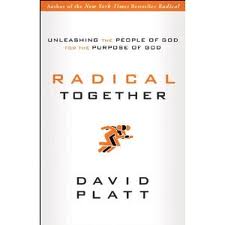
Overall, I’m a huge fan of the book, but more importantly the message that He is proclaiming to the American Church.  I really appreciate his sincerity and honesty in addressing pastors and lay leaders in this book.  My initial concerns withe the first book have been set at ease though not tempered completely.

I still need to see a clearer line of reasoning behind his correlation between poverty in India and comfortableness of  churches (14-15).  He either needs to point out that radical poverty exists in these places because Christians have been actively exploiting the poor. Like when the purchase of sugar supported slavery because the sugar was purchased from plantations run on slave labor.  Or he needs to make a case for how social justice is connected to the gospel.  To do neither makes the comparison an unfair accusation.  Either the church causes the exploitation of these people, or it is God’s clear call for the church to relieve suffering. It would have been worth another chapter to see him make this clear.  Timothy Keller does an excellent job of making the second point in his book, Generous Justice.

I highly recommend Radical Together to anyone interested in examining the pieces of the gospel that Westerners tend to ignore.  I think you will find the book highly motivating and challenging.he retail price of Radical Together is $14.99 (Paperback), and is available around the web in places like Amazon.com for $9.09. I gave it four stars.

Disclosure of Material Connection: I received a copy of this book free from WaterBrook Multnomah Publishing Group as part of their Blogging for Books Program. I was not required to write a positive review. The opinions I have expressed are my own. Some of the links in the post above are “affiliate links.” This means if you click on the link and purchase the item, I will receive an affiliate commission. Regardless, I only recommend products or services I use personally and believe will add value to my readers. I am disclosing this in accordance with the Federal Trade Commission’s 16 CFR, Part 255: “Guides Concerning the Use of Endorsements and Testimonials in Advertising.”