I’m starting a new blog series entitled, “Letters to Young Men.” I hope to post on this topic once every other week or so. Though I’m not particularly old, I have been blessed and encouraged to share insights with several guys in their late teens to early 20’s in regard to life and ministry. Some of you live in far away places and we talk only a few times a year; most of your mentoring is behind you, yet we check in from time to time. Others of you live in closer proximity and we meet on a weekly or monthly basis. Many you who read this post won’t know me, but hopefully you will be blessed through the series, feel free to contact me.
Many of the lessons I will share here I learned the hard way. When appropriate, I will share my failure in hopes that you will miss a few bumps along the way. A precious few lessons I learned under the hand of various mentors in my own life and thus avoided the scars and bruises I would certainly carry apart from their influence. When appropriate I will give them credit and honor for their influence in my own life.
I publish these thoughts to honor, educate, and encourage young men through the trials of life. I will write them as letters. They will be addressed, “Dear Friend.” My intention is not to share particular conversations that have taken place in private. The letters will address subjects that are in some way particular to young men and have developed over many conversations with many people. My goal is to produce letters that appear personal in nature and cover themes that are certainly relevant. My prayer is that these open letters are a source of strength and encouragement to you.
I mean no disrespect by the use of the phrase “young men.” By many accounts, I myself could still be considered a young man. I use the word “young” only in terms of comparative age; I use the word “man” in terms of maturity.
I welcome comments, feedback and input all along the way, but chose the right to delete or edit comments that I deem as disrespectful, rude, or not-profitable for discussion.
Meanwhile the disciples were urging him, saying, “Rabbi, eat.” But he said to them, “I have food to eat that you do not know about.” (John 4:31-32, ESV)
Now the disciples are getting to know Jesus. They were around when he cleaned out the temple, they may have been around to overhear Jesus talking with Nicodemus, they know that sometimes Jesus speaks a little funny. They also know that they just saw him talking to a Samaritan woman which was a very socially unacceptable situation. They also know he is hungry and tired.
Right now they see that he needs something to eat. They knew how hungry they were when they went into town, they know how tired he was when they left him by the well, so they imagine that his number one priority right now is to get something to eat. Jesus, you’re hungry, eat.
They don’t see a man on a mission to save the world, all they see is a hungry and tired teacher. They miss the reality of who Jesus is. They won’t get it until later, much later.
So then they start to look around and see if someone has taken their spot of getting Jesus lunch?
So the disciples said to one another, “Has anyone brought him something to eat?”(John 4:33, ESV)
They see themselves as providers for Jesus, they don’t get that ultimately He is the one who is going to provide for them. They imagine that someone else has brought a party tray by and fed the master. Perhaps they become indignant. It was their job to go into town and buy lunch. Great, now they have too much lunch.
Jesus lets them wrestle with the issue long enough and then fills them in on what he really means when he says, “I have food that you don’t know about.” They need to know that they ultimately do not provide for Jesus, but that Jesus provides for the whole world. They need to see what really drives their master, beyond human appetite. Beyond the desire to have a full stomach, Jesus desires to obey they father. This is worship.
Jesus said to them, “My food is to do the will of him who sent me and to accomplish his work. (John 4:34, ESV)
He challenges his disciples to see past hungry stomachs and see hungry souls, to look beyond the physical reality of a hungry tummy to see that true worship is a heart rightly submitted to God. What fuels Jesus? The disciples must learn here that food is for the body, but worship is for the soul. Jesus is seeing past the physical into the spiritual. If the disciples are ever to be like him they must come to a place where they desire God’s will to be done more than they desire their daily bread. Indeed later Jesus will teach them to pray to the father and before daily bread comes the request that God’s will would be done.
Now like the Samaritan woman before them, he presses his disciples to see all the people coming out of the city. See them with spiritual eyes. They walked into the city to get food, never once did it cross their minds to see the great spiritual need, but now they see it as the whole city comes out to the well.
Do you not say, ‘There are yet four months, then comes the harvest’? Look, I tell you, lift up your eyes, and see that the fields are white for harvest. Already the one who reaps is receiving wages and gathering fruit for eternal life, so that sower and reaper may rejoice together. For here the saying holds true, ‘One sows and another reaps.’ I sent you to reap that for which you did not labor. Others have labored, and you have entered into their labor.” Many Samaritans from that town believed in him because of the woman’s testimony, “He told me all that I ever did.” So when the Samaritans came to him, they asked him to stay with them, and he stayed there two days. And many more believed because of his word. They said to the woman, “It is no longer because of what you said that we believe, for we have heard for ourselves, and we know that this is indeed the Savior of the world.” (John 4:35-42, ESV)
It was a common saying in the day of Jesus to say, “there are four months till harvest.” It was a way of saying, “relax,” don’t worry, don’t be in such a hurry, there isn’t anything you can do right now. Our modern saying is something like this, “Good things come to those who wait.” Here Jesus is saying the opposite. He is saying, “look! You didn’t plant anything and now there is a harvest field.” You didn’t tell anybody in the city about me and now the whole city is coming out to meet me.
I can’t help but be reminded of one of our Wednesday nights a few months ago. I was running around trying to get everything set up. I’m a firm believer that service is more caught than taught and so I set out all the chairs, place connect cards and pens in the seats, open the student center, help count out the cash box, etc. I also speak.
One of our girls was talking about her life. Something told me that I needed to sit down with the band who was already engaged in talking with her. She had several great questions and we listened and prayed with her and then it struck me that God was really dealing with her heart. Long story short she prayed to receive Jesus as her Lord and Savior. What was really interesting about the situation thought was that while she was praying, I was thinking, “you have this all backwards. I haven’t even spoken yet. I’m supposed to preach and then people are supposed to respond.”
The truth of the matter is, it rarely ever works out that way. Sure people may respond after a sermon, but most often times someone has been there before. A praying parent or spouse, a concerned youth worker or Life group leader. I may be the one that someone prays with, but seldom do I sow the first seed.
The woman said to him, “Sir, give me this water, so that I will not be thirsty or have to come here to draw water.” Jesus said to her, “Go, call your husband, and come here.” The woman answered him, “I have no husband.” Jesus said to her, “You are right in saying, ‘I have no husband’; for you have had five husbands, and the one you now have is not your husband. What you have said is true.” (John 4:15-18, ESV)
She says, almost sarcastically, “give me this water.” And then Jesus does something strange by telling her to go get her husband. To us it looks like he is changing the conversation or we think she may have turned a corner and is really interested at this point in what Jesus is saying. But Jesus is doing heart surgery here. He is helping her to see who He is, by asking her to be honest with herself.
It is not as though divorce in Jesus day was unheard of, or that people didn’t get remarried, they did. So it was socially acceptable to have been in one or more marriages. However, if the marriage ended in divorce, it was the woman who was generally though to be at fault. And even if all her husband’s had died, the rule of the day was 3 marriages, beyond that and you were damaged goods. So for a woman to have had 5 husbands and shacked up with another guy there is no hiding the fact that she is a sinner and now this strange Jewish man knows it.
Jesus knows the weight that she carries around on her shoulders and he presses the conversation in a way that must hurt her. I can imagine that her whole life is spent trying to ignore how many bad decisions that she has made; trying to avoid the stares of the town people.
Some people assert that at this point the pain is unbearable and that she is trying to focus the spot light off of herself and so she brings up a theological question; one to steer the conversation away from her painful personal life. But that’s not it at all. Her question actually centers on the proper place for a sinful person to offer sacrifices for their sins. Her question is about worship.
The woman said to him, “Sir, I perceive that you are a prophet. Our fathers worshiped on this mountain, but you say that in Jerusalem is the place where people ought to worship.” Jesus said to her, “Woman, believe me, the hour is coming when neither on this mountain nor in Jerusalem will you worship the Father. You worship what you do not know; we worship what we know, for salvation is from the Jews. But the hour is coming, and is now here, when the true worshipers will worship the Father in spirit and truth, for the Father is seeking such people to worship him. God is spirit, and those who worship him must worship in spirit and truth.” The woman said to him, “I know that Messiah is coming (he who is called Christ). When he comes, he will tell us all things.” Jesus said to her, “I who speak to you am he.” (John 4:19-26, ESV)
This woman’s question is about the right place for worship. When we say worship, we may think of songs and preaching, but when she said worship she was talking about making restitution for her sins. In our day the question might look like this, “The Catholic’s say go to a priest and confess my sins, my Baptist friends come forward at an invitation and rededicate their lives. Which way is right?”
Jesus answer is designed to help her see past the physical reality. She is looking for a place, she doesn’t know that worship isn’t about the right place, it’s about the heart. Jesus tells her that the place is about to be made irrelevant. His sacrifice will be the last sacrifice ever needed. What is needed is a humble and contrite spirit; an attitude of the heart. She also needs to know the truth; worship the true God.
She knows that the messiah is coming and she looks forward to that day and there she makes a startling discovery and Jesus makes a bold claim. I am the messiah.
Jesus declares that he is the messiah just in time for his disciples to come up on the conversation. The next few verses will reveal their thoughts and we will look at them, but first see how this woman responds to his declaration. It is as though a veil has been lifted. All at once she see’s who Jesus is; she sees who she is; she sees what worship is really all about and now she sees her home town of Sychar different than she has ever seen it before.
Just then his disciples came back. They marveled that he was talking with a woman, but no one said, “What do you seek?” or, “Why are you talking with her?” So the woman left her water jar and went away into town and said to the people, “Come, see a man who told me all that I ever did. Can this be the Christ?” They went out of the town and were coming to him. (John 4:27-30, ESV)
She runs back into town, leaving her water jar (as if to say, “I don’t need it any more, I’m satisfied in Jesus). She runs to all those people who’s stares she has tried to avoid. She is no longer worried about how they see her, she see’s them for the very first time. They are thirsty just like she had been. They need to meet this man. Who cares what they think of her. The reality of her situation has just changed. Before her sign might have read, “looking for love in all the wrong places.” And now it reads “rescued from my sin and shame.” She is different and she sees the world as different.
Her neighbors take note. What has caused this shy sinner to now go running throughout town compelling everyone to go out to the well? Something has changed this woman!
In the meantime Jesus is about to help his disciples see the spiritual reality around them. They have just come from doing business in town to buy lunches for everyone and where they saw filthy Samaritans, this woman was now seeing people who needed to meet Jesus.
Now when Jesus learned that the Pharisees had heard that Jesus was making and baptizing more disciples than John (although Jesus himself did not baptize, but only his disciples), he left Judea and departed again for Galilee. And he had to pass through Samaria. So he came to a town of Samaria called Sychar, near the field that Jacob had given to his son Joseph. Jacob’s well was there; so Jesus, wearied as he was from his journey, was sitting beside the well. It was about the sixth hour. (John 4:1-6, ESV)
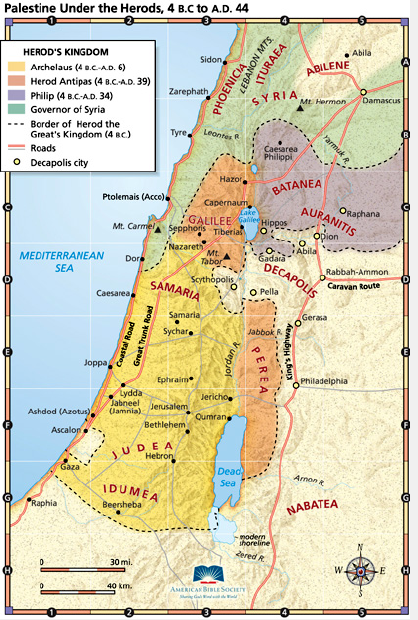
Between Jerusalem and Galilee was a territory known as Samaria. Samaria was filled with a people who could trace their ancestry back to Jewish peasants who intermarried with the foreign people brought into the area when Israel was away in Babylon. The Jews hated the Samaritans and the Samaritans hated the Jews. Most devoutly religious Jews avoided the whole area like the plague. When they had to travel between Galilee and Samaria they would opt to go a longer route and cross the Jordan river and head north that way. The fact that Jesus is traveling through Samaria shows that he is not taking his time getting back to Galilee and perhaps God has some big plans for Samaria.
We learn just a few verses later that Jesus’ disciples go into town to get food, leaving them at the well alone. As he is sitting their tired from their long and hasty journey a woman comes to draw water from the well. Now as she approaches the well, let’s look at things through her eyes. Who does she see when she sees Jesus?
A woman from Samaria came to draw water. Jesus said to her, “Give me a drink.” (For his disciples had gone away into the city to buy food.) The Samaritan woman said to him, “How is it that you, a Jew, ask for a drink from me, a woman of Samaria?” (For Jews have no dealings with Samaritans.) Jesus answered her, “If you knew the gift of God, and who it is that is saying to you, ‘Give me a drink,’ you would have asked him, and he would have given you living water.” The woman said to him, “Sir, you have nothing to draw water with, and the well is deep. Where do you get that living water? Are you greater than our father Jacob? He gave us the well and drank from it himself, as did his sons and his livestock.” Jesus said to her, “Everyone who drinks of this water will be thirsty again, but whoever drinks of the water that I will give him will never be thirsty again. The water that I will give him will become in him a spring of water welling up to eternal life.” (John 4:7-14, ESV)
Does she see Jesus, savior of the world or does she see a Jewish man? She just sees a Jewish man. A strange Jewish man, because men don’t talk to women in public and Jews don’t talk to Samaritans, so for a Jewish man to talk to a Samaritan woman, he must be strange.
Jesus isn’t content with her just thinking that he is a strange, thirsty Jewish man, there is a greater reality to who He is and he is going to help her see that. He tells her that if she just knew who he was that she’d be asking him for water. But she doesn’t get it. Who does this strange Jewish man think He is… he doesn’t even have a pitcher to draw water with, how can he give her water? Is he greater than their ancestor Jacob? She asks as much assuming that he is just a strange man, never quite grasping that she is having a conversation with the Messiah.
The irony here is that Jesus is greater than Jacob! The first readers of this gospel, like us would have understood that right away. It is obvious that this woman doesn’t know who she is talking to. So what does Jesus do? He gently states that he is greater because his water satisfies where as Jacob’s well leaves those who drink from it thirsty again and again.
While she can’t see the reality of who Jesus is, He sees the reality of who she is and he knows that she is thirsty for a real relationship with a holy God and so his next move is to help her see herself. Look at how she responds and what he says.
When I first saw that video I immediately was convicted. Too often I’m the guy in the first part of the video. I get frustrated at things like traffic and long lines at the coffee shop. I don’t ever pause to wonder or think that someone’s mourning the loss of their best friend when they pull in the parking spot ahead of me… I just think that they’re a jerk. And when I get in the parking space ahead of someone else, I just think that their a loser. (Just kidding!)
I do wonder what life would be like though if we really saw everything that was going on? What would it be like if there were an eye-wear service that would let you know more than what meets the eye? More than just someone’s emotional state, but who they really were?
Often when Jesus spoke with people he was pushing them to see past just what met the eye and see a deeper underlying spiritual issue. In John chapter two he drives the money changers out of the temple and people ask him by what authority he does this… and he answers, “Destroy this temple and in 3 days I will raise it up.” They thought he was talking about a building. They thought worship centered on a place. Jesus was talking about his body, worship centers on the person and work of Jesus. They thought worship was making animal sacrifices, Jesus was saying, “I am the sacrifice.” They thought death defined their world. Later they thought they could kill him and it would be the end. They didn’t know that Jesus was on mission to beat death, deliver us from hell, and that his death was just the beginning.
Later in John chapter 3 Jesus speaks with a man named Nicodemus. Jesus tell Nic that if he wants to see the kingdom of God that he must be born again. Nic doesn’t get it. Nic thinks that it’s impossible for old life to have new life. Jesus wasn’t talking about the physical, he was talking about the spiritual. Nic didn’t understand that you don’t enter heaven because of who your parents are, you enter heaven because of who God is. You don’t enter as a master teacher trying to offer God your services, you enter as a helpless babe completely dependent on God for everything.
Tomorrow as we come John chapter 4 and the story of the woman at the well. As we read this story, as we examine this truth, I want to ask you to put on your glasses. Ask God to give us a glimpse of how to see the world as He sees it. Ask him to help us look past the every day and into the eternal. Ask him to apply this truth to our lives. Ask him to help us see people as he sees people
Real-Life Discipleship: Building Churches That Make Disciples by Jim Putman is a must read for anyone serious about discipleship! It is packed with Biblical, simple, and time-tested strategy on how to help people grow in Christ. I really appreciated Jim’s pastoral style of writing that bleeds through on every page. While handling the truth of God’s word, Jim is sure to pull readers into the story of redemption and call them to take up the mantle of discipleship. After reading hundreds of books I have come to learn that not all books are equal. If you had to read only one book on discipleship (besides the Bible), this is the book. I was blessed, encouraged and even rebuked in areas of my own life while reading this book.
I was first turned on to this resource after reading Avery Willis and Mark Snowden’s book Truth that Sticks (another book well worth a read). After reading that book I commented that more books would be needed, this is one of those books! I am excited an encouraged all at once about the series of books that are coming out of NavPress on the topics of discipleship.
Real-life Discipleship is a clarion call back to a biblical model of discipleship. I highly recommend it to anyone interested in developing a biblical model of discipleship in their church. The retail price is $17.99 (Hardcover), and is available at a discount at Amazon.com for $12.23. I gave it FIVE stars
Disclosure of Material Connection: I received this book free from NavPress as part of their Blogger Review Program. I was not required to write a positive review. The opinions I have expressed are my own. Some of the links in the post above are “affiliate links.” This means if you click on the link and purchase the item, I will receive an affiliate commission. Regardless, I only recommend products or services I use personally and believe will add value to my readers. I am disclosing this in accordance with the Federal Trade Commission’s 16 CFR, Part 255: “Guides Concerning the Use of Endorsements and Testimonials in Advertising.”
So through the years God has blessed me to be able to be in a mentor/ coach/ lead/ disciple/ pastor or whatever the next buzz-word will be, several men. For the first several years I didn’t recognize much of what was happening other than the guys who were hanging around me began asking great questions and I was able to teach from where I had been and what I knew to be true from God’s word. These days I’m a little more intentional and I move forward with a larger game plan to develop and strengthen the gifts and talents that these men posses in the Lord.
Regi Campbell shares in his book Mentor Like Jesus that he generally picks the guys that he is going to mentor. I tend to agree Regi’s line of thinking on this. The disciple maker should choose the disciples. For the longest time I didn’t know why I held this as a default position other than the fact that through the years I’ve rejected some folks who wanted my input and sought out others to influence. Then it dawned on me… The guys I picked tended to have one quality in common… They were teachable.
Be Teachable
I learned a long time ago that not everyone who came to me for discipleship really wanted to grow. Sometimes people sought me out for opportunity or endorsement; they didn’t always want to learn what I might have to teach. As a pastor I know that my greatest work for the moment with these type people will not be actual discipleship, but in bringing them to a place of being teachable (which usually involves allowing them to fail repeatedly until they come to a place of frustration and through their frustration they overcome their pride enough to ask for help).
When Jesus called the first few disciples he said, “Follow me and I will make you fishers of men.” The key to becoming fishers of men was to follow Jesus in such a way that he could transform them. In essence they had to be teachable. If you were to ask me to teach you how to fold a paper airplane and I were to repeatedly demonstrate very basic folding patterns while talking about how airflow over a certain shape were to create lift, I would expect you to follow at least the very basic folding patterns even if all the talk about airflow went in one ear and out the other. However, if you were unwilling even to follow my basic folding patterns and try to attempt your own very flawed designs with no regard to how airflow creates lift I would call you unteachable. My best hope at that point would be to move on and teach those who are teachable and hope that after 1000’s of failed attempts to make your plane fly that you would come back for some help with at least the basic folds.
But what if you were teachable? What if you came to me and I taught you paper folds while talking airflow and while at first you didn’t understand airflow you did understand the folds? Then you tried some modifications to my design and some worked and some didn’t. What if then as we talked through why some of your modifications failed and succeeded you all of the sudden grasp what I was saying about airflow and this information fuels modifications and changes that work? Then I would say that you are teachable and soon you will be able to teach others.
So it is with discipleship. The first thing you must do is be teachable. If you are not teachable, all bets are off. I can’t make you into anything. I can’t help you succeed. Your own pride will hang you before we ever get started. You must be willing to listen. You must be willing to learn. You must be willing to attempt under supervision. You must be willing to discuss failure as well as success. You must be teachable. To not be teachable is to not be transformed.
The truth is that to really be a disciple, you must be teachable. Are you teachable?
Even as a leader I strive in my own life to fight pride and to be teachable.
Disclosure of Material Connection: Some of the links in the post above are “affiliate links.” This means if you click on the link and purchase the item, I will receive an affiliate commission. Regardless, I only recommend products or services I use personally and believe will add value to my readers. I am disclosing this in accordance with the Federal Trade Commission’s 16 CFR, Part 255: “Guides Concerning the Use of Endorsements and Testimonials in Advertising.”
Truth That Sticks: How to Communicate Velcro Truth in a Teflon World by Avery T. Willis Jr. and Mark Snowden is by far one of the best books I’ve read on how to communicate the biblical message. I’ve read dozens of books just on the subject matter of speaking and dozens more on preaching, yet none with the simplicity and authenticating case studies presented in this book. The idea is simple: The Bible has lots of truth telling stories and stories stick.
The idea is so simple that we were already practicing it with the non-readers in our house. I’ve read the Jesus Storybook Bible to my daughter 4 or 5 times now just by reading a few stories per night. Sunday afternoons we pull out a set of pictures we have that tell the major stories of the Bible and she asks questions about the pictures and I tell the stories. I just never thought of teaching adults, or students through stories… that is until I read Made to Stick by Dan and Chip Heath. Then I thought it was possible, but I struggles with how to go about teaching adults through story. Then this book made it’s way to my hands and has become a primer.
To be honest another book is needed (and I think one is on the way) with more specifics on how to teach small groups, large group, etc. through the power of Biblical stories.
This book is a great for people looking to share the gospel or help disciple others, Sunday school teachers, pastors, etc. I highly recommend it. The retail price is $14.99 (Paperback), and is available at a discount at Amazon.com for $10.19. I gave it FIVE stars
Disclosure of Material Connection: I received this book free from NavPress as part of their Blogger Review Program. I was not required to write a positive review. The opinions I have expressed are my own. Some of the links in the post above are “affiliate links.” This means if you click on the link and purchase the item, I will receive an affiliate commission. Regardless, I only recommend products or services I use personally and believe will add value to my readers. I am disclosing this in accordance with the Federal Trade Commission’s 16 CFR, Part 255: “Guides Concerning the Use of Endorsements and Testimonials in Advertising.”
Transforming Church in Rural America by Shannon O’Dell is a must read for any young pastor leading a congregation in rural America! I was deeply blessed by almost every page in this book and even a little humbled. Having grown up in rural churches and having many friends who are pastoring rural churches I can testify that Shannon has hit the mark. What you will find with this book is a no-nonsense, practical, count-the-cost design for much needed change in many of our rural churches. Shannon knows from first hand experience the cost of bringing change and leading a dying church back to vibrant health and he has a story to tell.
Throughout Transforming Church in Rural America, Shannon tells the story of how he was called by God from being on staff at a large church to pastoring a small South Side Baptist Church in an 88 resident town in Arkansas. Over the last six years God has blessed Shannon to be at the forefront of change in rural America to reach people with the gospel. Today Shannon’s church, now renamed, Brand New Church reaches out to thousands of people each week through multiple campuses. Shannon’s passion to reach rural America at any cost is contagious. Note this quote from the book…
As far as too many soldiers have shown us, it takes great personal sacrifice to willingly enter a conflict. But if we are to fulfill our vision, we have no other choice. It’s change, conflict, growth; change, conflict, growth; and you have to walk through that process. It happens on a personal level every time we see someone freed from a massive addiction. The person makes a change, then there is a major conflict, but then there is unbelievable growth. It’s the same with church; we must go through change and then conflict in order to see growth. Nobody told me that before I went to rural America. but it’s part of the game – one of the rules you will have to abide by play after play. When conflict comes most rural pastors give up on change. It’s just too hard. What can we do? We must be resolved to conflict in its many forms; we must pick our battles carefully, and we must choose which hills we are willing to die on- just as Jesus chose Golgotha. (page 81-82).
I highly recommend Transforming Church in Rural America. In fact if you are considering a call to pastor a small church or a church in rural America, its a must read. You won’t find this kind of transparency and passion for rural churches anywhere else. The retail price is $12.99 (hardcover), and is available around the web in places like Amazon.com for $10.39. I gave it four stars.
Disclosure of Material Connection: I received this book free from Thomas Nelson as part of the BookSneeze program. I was not required to write a positive review. The opinions I have expressed are my own. Some of the links in the post above are “affiliate links.” This means if you click on the link and purchase the item, I will receive an affiliate commission. Regardless, I only recommend products or services I use personally and believe will add value to my readers. I am disclosing this in accordance with the Federal Trade Commission’s 16 CFR, Part 255: “Guides Concerning the Use of Endorsements and Testimonials in Advertising.”


 by Jim Putman is a must read for anyone serious about discipleship! It is packed with Biblical, simple, and time-tested strategy on how to help people grow in Christ. I really appreciated Jim’s pastoral style of writing that bleeds through on every page. While handling the truth of God’s word, Jim is sure to pull readers into the story of redemption and call them to take up the mantle of discipleship. After reading hundreds of books I have come to learn that not all books are equal. If you had to read only one book on discipleship (besides the Bible), this is the book. I was blessed, encouraged and even rebuked in areas of my own life while reading this book.

 by Avery T. Willis Jr. and Mark Snowden is by far one of the best books I’ve read on how to communicate the biblical message. I’ve read dozens of books just on the subject matter of speaking and dozens more on preaching, yet none with the simplicity and authenticating case studies presented in this book. The idea is simple: The Bible has lots of truth telling stories and stories stick.
 by Dan and Chip Heath. Then I thought it was possible, but I struggles with how to go about teaching adults through story. Then
 by Shannon O’Dell is a must read for any young pastor leading a congregation in rural America! I was deeply blessed by almost every page in this book and even a little humbled. Having grown up in rural churches and having many friends who are pastoring rural churches I can testify that Shannon has hit the mark. What you will find with this book is a no-nonsense, practical, count-the-cost design for much needed change in many of our rural churches. Shannon knows from first hand experience the cost of bringing change and leading a dying church back to vibrant health and he has a story to tell.
 . In fact if you are considering a call to pastor a small church or a church in rural America, its a must read. You won’t find this kind of transparency and passion for rural churches anywhere else. The retail price is $12.99 (hardcover), and is available around the web in places like
  The Hill House