Review: The Ishbane Conspiracy

I generally don’t read a lot of fiction, but this book was handed to me by one of my student’s parents and I found that I couldn’t put it down.  Randy Alcorn, noted author and speaker, co-wrote this book with his two daughters, Angela and Karina.  Though I have heard of Randy Alcorn before, this is actually my first book of his to read.  Needless to say it won’t be my last.

51dqLExOTqL

The story that Randy Alcorn and his daughters weave in The Ishbane Conspiracy centers around the lives of four teenagers Jillian, Brittany, Rob and Ian and takes place over the course of a year.  Three of the teenagers are making the transition from high school to college.  Rob, the oldest in the group starts the book as a college freshman.

The authors do a great job of leading the reader through the high school world and touch on real life subjects.  As a student pastor and having been on high school campus’ quite a bit over the last twelve years it is surprising how accurately the issues are represented in this book.  Yet, the Christian students in this book struggle through these issues (or walk with their friends through these issues) and though the road is difficult at places, they find guidance and deliverance in Christ.

Each chapter is followed by a letter from one demon to another in a similar style to C.S. Lewis’ The Screw Tape Letters.  The letter’s contain hell’s strategy for leading students to death, or at least a wasted life.  The letters increase in length throughout the course of the book.  Each one providing more commentary on the temptations that teenagers face.

Due to the mature themes that run through the book I would recommend it to parents and students in high school.  The issues are real and aren’t really over-exagerated, but may appear shocking to parents who don’t have kids in high school.  If you are a high school student looking for a practical guide on how to live for Christ in your school, a parent looking for more insight into the issues that surround teenagers today, or just a good fan of great fiction, I highly recommend this book to you.  I give it four out of five stars.

Try Audible and Get Two Free Audiobooks
Amazon.com – Read eBooks using the FREE Kindle Reading App on Most Devices

Disclosure of Material Connection: The opinions I have expressed are my own. Some of the links in the post above are “affiliate links.” This means if you click on the link and purchase the item, I will receive an affiliate commission. Regardless, I only recommend products or services I use personally and believe will add value to my readers. I am disclosing this in accordance with the Federal Trade Commission’s 16 CFR, Part 255: “Guides Concerning the Use of Endorsements and Testimonials in Advertising.”

Review: Lost and Found

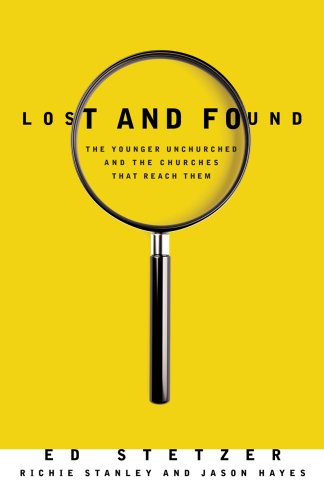
Lost and Found: The Younger Unchurched and The Churches That Reach Them, is a book by Ed Stetzer, Richie Stanley, and Jason Hayes.  In it, the authors provide a great analysis of who eighteen-to-twenty-somethings are and what churches are doing to reach them.  It’s no secret that many young adults leave or never enter the fellowship of a local church. This book seeks to find the answer not only to why congregations are not reaching them, but how they can effectively reach out to them.  It is full of surprises and challenges.  I highly recommend it to pastors, church leaders, and anyone with an interest in reaching the young adult population.

41uMhcTRhZL

The book is divided into three main categories.

  • Polling. Which covers the raw data and the reasoning for the survey.  The author’s do a great job of breaking the data down into charts and statistics that can easily be interpreted and understood.
  • Listening. In addition to polls, the research team also invested in over 5oo personal interviews with young adults across the polling spectrum in order to gain more valuable information.  The findings of the interviews are shared in chapter format covering the generalities in regular text and setting out key images that often rose to the top.
  • Reaching. In this section of the book the authors’ turn their attention to the churches that are reaching this segment of the population in seemingly unprecedented numbers.  In doing so they breakdown what seem to be the similarities among how they appeal to young adults and the practical steps they are taking to be even more diligent in reaching this generation.

Lost and Found is a great read and the authors  include several good features.  The authors strive to present the material in such a way as to engage the reader not only with where young adults are, but  how to reach them.  They infuse the book with enough stories and quotes to ensure that the reader has not only heard the statistics, but has also heard the voice of this generation.  I give it five star rating.

5 Reasons to Read (Non-fiction)

I like to read.  I really like to read.  I really like to read non-fiction.  Granted there are many people in this world who are more excellent readers and read quite a lot more than I do on a regular basis (I try to average 1 book every other week).  So when I was asked why I read so  much I was kind of shocked (I’ve heard of people who will read a book a day).  First that someone would not know of good reasons to read and second that they thought I read a lot of books (truthfully I consider myself  a slow reader).  So I decided I would post a few reasons to read non-fiction.  These are just a few of the many benefits of reading.
http://www.flickr.com/photos/austinevan/1225274637/

1.  Reading engages the mind of a person in thought in ways that other types of media do not.  Reading is a long conversation with the author of the book.  Thoughts, ideas, illustrations, and stories are all presented in such a way as to provoke the reader to profound thought on a variety of subjects from the simplicity of beauty to the depth of our understanding of physics.

2. Reading provides clarity. Writing is the most referenced form of communication.  What is written can easily be referenced and referred back to.  Readers can highlight and underline passages.  Words can be looked up and examined.  Troubling thoughts find themselves explained in the context of the larger work.

3. Reading is reader paced. Not everyone reads at the same pace.  Those who read and comprehend faster can enjoy gaining information at their own personal pace.  Likewise slower readers are not hurried through material.

4. Reading is an act of humility. When one submits to read a non-fiction book for the sake of gaining information on a project or concept the reader is admitting that he/she can gain from the insight of others.  This is an act of humility.

5. Reading is prudent. You can read anywhere.  Reading is a good use of time when waiting in line or for a lunch appointment to show up.  Before the great inventions of Tivo and DVR much of my reading was done while the compercials were showing.

Are you a reader?

Why do you read or not read?

What books have had the most profound influence on your life? (I’ll share my top 5 in the next post)

What I’m Listening to These Days

Seriously, I didn’t start out a rap or hiphop fan and probably still don’t qualify.  But, these guys are delivering the message in a totally appealing and intense way.  Just listen to the lyrics.

Lacrae

Shai Linne

Just imagin if these lyrics got stuck in our kids heads instead of some of that other stuff

9 Reflections on Disciple Now (Part 2)

3. Our teenagers glorified God by serving others with the work projects this weekend (They painted a house, built a ramp, hosted a backyard bible club, and took cookies to the home bound).

4. Our teenagers were given at least one more point of contact with our church family (they stayed in the home of church members and the relationships at Calvary were deepened and  developed as students and adults interacted)

5. Our Teenagers were given a positive aim for their life and real reason to remain pure (to glorify God in manhood and womanhood!)  Too often the loftiest aim we give our kids is to stay out of trouble… ie… “true love waits” and we fail to provide a positive challenge to our kids to raise the standard.

9 Reflections on Disciple Now (Part 1)

2227885657_25a043b6e5_m The event is over.  The students have gone home and the quiet descends on what was once a room full of chaos and chatter.  The lives that were united for a few hours this weekend have temporarily scattered across Pensacola.  As I pray over the quiet room I recount all the events of the weekend and I can not help but give God the glory for all he has done.

9 Reflections on Disciple Now 2009

  1. Our teenagers were confronted with the gospel. (One of our students gave her life to Jesus Christ as her Lord and Savior!)
  2. Our teenagers were challenged with a biblical definition of manhood or womanhood. (they can no longer live in ignorance of the issue, they must now choose their actions each day based on the knowledge of an existing framework for how men and women can glorify God together).
  3. our teenagers were exposed to a model of successful discipleship where students become teachers (all of our leaders had been through this topic with me before…With the exception of John who has lead his students through similar material).

3 things you should know before you judge your friends

Judge not, that you be not judged. For with the judgment you pronounce you will be judged, and with the measure you use it will be measured to you. Why do you see the speck that is in your brother’s eye, but do not notice the log that is in your own eye? Or how can you say to your brother, ‘Let me take the speck out of your eye,’ when there is the log in your own eye? You hypocrite, first take the log out of your own eye, and then you will see clearly to take the speck out of your brother’s eye. “Do not give dogs what is holy, and do not throw your pearls before pigs, lest they trample them underfoot and turn to attack you.  (Matthew 7:1-6 ESV)


1. You will be Judged by the Same Standard you use with others (7:2)

It is easier to apply a stricter set of rules and regulations to others that it is to ourselves sometimes.  We see others faults much more clearly than our own.  We can be pretty harsh critics and most of us can be pretty good at fault-finding.  Think about this though, we should be expected to be judged for our faults to the same degree that we judge others.  I don’t know about you, but this makes me back off the need to be a harsh critic sometimes.

2. Sometimes the sin you see the most in others is the same sin you struggle with (7:4).

Ever notice how both the speck and the log were in the eye.  It’s easy to call out people who have sin in the same areas that we struggle.  This past week I have heard so many people condemn a girl about getting pregnant outside of marriage (don’t get me wrong… sex outside of marriage is a sin).  Though she is repentant she will feel shame for a while, her sin has become obvious to the world and is no longer private.  However, some of the people who seemed to take a perverse pleasure in her dilemma had requested help earlier for their struggle with pornography.  It’s easy to see in others the sin we struggle with.

3. It is difficult to do the right thing with the right motives (7:5).

It might be the right thing to lovingly confront a brother about his sin.  ( I would want to be confronted about mine.) However it can be difficult to do it in a way that glorifies God and does not promote your own ego.

.  .  .  .  .  .  .

People try to be righteous (right before God) in three different ways.

  1. Some try to do as much good as they can hoping God will overlook the bad things they have done.
  2. Some point out the flaws of others around them and say that since they are not as bad as others they must be okay.
  3. Some come to God knowing that there is nothing that they can do on their own and so they humbly trust in what Jesus Christ has done for them to save them.

The first group points to their deeds, the second points to their lack of bad deeds, the third points to Jesus Christ as a their source of Righteousness. Which group do you think is actually right before God?


Short Post: Christian Heritage Conference

heritage-conference-2007 So we are on the verge of another great Disciple Now and I started to think about all of the great events that I have had a privilege to be a part of in the past.  God has really blessed me to be a part of some cool things!  Disciple Now’s, Hunger for the Harvest, Camps, Christian Heritage Conference, etc.

Next to Disciple Now the most amazing events I have ever helped put together were the Christian Heritage Conferences.  We would pray over a theme, set up a team of helpers, develop a registrations strategy, line up a top notch speaker, get the word out, set up a bookstore, and all on a shoe string budget.  It was amazing!

Christian Heritage Conference

Though I cannot speak for the reason others were inspired, my inspiration came from a well spring of two sources.

One: The rappid movement in our day to redefine “church.” In the struggle to go back to Acts 2 many have missed the blessings that the church fathers in the first few centuries have handed to us as a guide to understanding and interpreting the scriptures (mainly the Rule of Faith).  In that many have also completely abandoned church history in order to become a “pure” church like the one in the New Testament.  (Which one? Corinth, Ephesus, Pyrgumum, Colasae?)  I figured that if we were to take our people down such a road that they should not do so with complete ignorance of what God has done through out history with faithful men and women so that we might be able to face the new gnosticism that such a forgetfulness will soon employ.  In short: if we do not learn from the past we are doomed to repeat its error and find ourselves facing the same obstacles that have already once been overcome.

Two: John Piper’s lectures in  Christian Biography.  I had to make a 16 hour ride home to Missouri one year while in college and was blessed to be able to listen to over 16 hours straight of the lives and times of great men that God had used to bring glory to his name throughout history. I understood then why history (for good or for ill) contributes to who we are today.

From these two wells of inspiration and a great friend and partner in ministry (Kyle Claunch).  The Christian Heritage Conference was born to popularize an education of Church history for the benefit of the whole church.

Like all things it morphed and changed over the years.  We covered a variety of historical figures and had a variety of Top notch Speakers.  We learned to advertise outside of our local areas and expand our vision beyond college students.   We contacted home-school associations, history and theology departments at local colleges and history clubs at local high schools.    We also contacted pastors in the surrounding associations.  We began to hold registrations so we could pull more people in earlier in the next years event.

5 Growth Challenges

300819410_8dfff801d5_m Are you looking to grow deeper in your relationship with God?  The challenges below are a great place to start.

1. Proverbs Challenge… Read a chapter of Proverbs each day.  Read Proverbs chapter 7 on the 7th of the month; chapter 8 on the 8th of the month and so on.  Our pastor Chris Aiken does a daily blog commenting on one chapter of scripture and a daily take away from the book of Proverbs.

2. Journal Challenge… Take the Bible reading one step further and keep a journal that you can record your thoughts in.  I like to ask myself two questions after I have read and prayed thought the scripture: 1. What does this say about God? 2. How will I respond?

3. My Story Challenge… Write out the story of how you became a Christ follower in 100 words or less and let me review it. Try use every day language and avoid words that are church specific.  Highlight three things:

  1. Life before you met Christ.
  2. How you met Christ.
  3. How your life is different now.

You can see a version of mine in the “About Me” section of “Meet Jonathan.”  After it has been reviewed take the opportunity to tell others your story and get their input.  Post it on your facebook and myspace profiles.

4. Teach others challenge… I encourage our students to take notes on the Sunday Morning sermon and the Wednesday night message.  Study their notes and then either through intentional study (like an established Bible study) or in regular conversation (“guess what I learned this week”) share what they have learned in a way that teaches others.

5. Accountability Challenge… I challenge our kids to encourage one another with what they have been learning and doing in smaller groups.  I do this by sending out a mass text each asking for prayer requests from those who subscribe and sharing a verse that stuck out to me that day from my daily bible reading (usually from Proverbs since that is one of the challenges).