A Reflection on Being Your Pastor and Friend

Today I am reflecting on the years I have spent in ministry and counting it a blessing to be considered a friend to so many. I’m celebrating four years serving in my current ministry context and nearly fifteen years in ministry all together (counting the near eleven years I spent with my first church). Recently I was listening to a Tim Keller Podcast in which he made a statement that pastors have a unique privilege and responsibility to be a friend to those to whom they minister and as such they often make friends with people who given ordinary circumstances they would never be friends with…

I find this to be true in my own life. I have the awesome opportunity to walk with people of all walks of life through some of life’s most painful and sacred moments.

There have been moments when we were all scared or saddened by life’s events. I have been in the room when we got the news of cancer. I’ve done my share of funerals and hugged the necks and held the hands of the grieving. More than enough times I’ve been called up late to the hospital when their has been an accident.  Too often I’ve held a broken infants in my hands. I’ve seen the tragedies of life and walked with families through the worst parts. I have been one of the few who were ever welcomed into the world of the hurting and I have found that you don’t walk through the valley without developing some kind of kinship.

There have also been moments of joy beyond expression. I’ve held hands and plunged you beneath the water and pulled you back to the surface in baptism based upon your confession of Christ. I’ve been in the room when they said the cancer is in remission. I’ve held healthy newborns and helped sneak an air-horn into graduation ceremonies. I generally get the best seat in the house when it comes to weddings and among other things I get to say, “you may now kiss the bride.”  I’ve shared in some of the happiest moments that life has to offer and found that you don’t reach the summit of the mountain without developing a friendship along the way.

Beyond sharing these moments with you I have prayed with you and for you. I have poured myself out and asked God to allow me to pour some more. To this end I spent years of my life studying His word so that I might be a competent expositor, leader, administrator, communicator, teacher, counselor and ultimately a better friend. I have begged God that I would clearly speak the truth even when you might not count me as a friend because of it. Because my greatest desire for you is to present you complete to Christ.

I’d be a fool to think that friendship is a one-way street. Through the years as you have made me a part of your family and welcomed me into your homes. I have been blessed beyond measure by your friendship. I have learned valuable lessons.  I have eaten vegetables from your garden, dear meat from your freezer and mullet from your cast net. Along the way I confided some of my own fears and insecurities. You have loved me, been to my wedding, held my children, and hugged me and celebrated my birthdays (though sometimes I would like it to pass in obscurity) and anniversaries.  Thank you for being a faithful friend to me and counting this pastor as your friend.
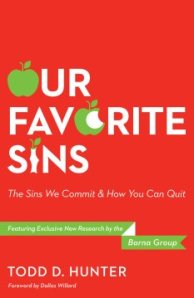
Our Favorite Sins by Todd Hunter (A Review)

Have you ever wrestled with a sin issue? You knew that you had to change, but change seemed impossible. Or maybe you’ve been attending a bible study or even church service and while you feel educated at the end of the event you know somehow that transformation doesn’t just come with education. Something more needs to happen.  Then this book is for you.

In his book, Our Favorite Sins, Todd Hunter undertakes the topic of fighting sin and does it in an ancient, yet relevant way. I think he is on to something. Many of us in the mainline protestant churches have been quick to dismiss many of the traditional church seasons and disciplines simply because we’ve considered them to be the “Catholic” thing, without giving much thought to the actual benefits of say fasting or praying the hours.  It’s a great book and well worth a read and I think it will help anyone who is seriously interested in dealing with the sin in their lives.
I really enjoyed reading Our Favorite Sins. I had the pleasure of reading it on my Kindle Touch and found myself unable to put it down.  I highly recommend it to anyone interested in growing in a relationship with Christ.

Disclosure of Material Connection: I received this book free from Thomas Nelson as part of the BookSneeze program. I was not required to write a positive review. The opinions I have expressed are my own. Some of the links in the post above are “affiliate links.” This means if you click on the link and purchase the item, I will receive an affiliate commission. Regardless, I only recommend products or services I use personally and believe will add value to my readers. I am disclosing this in accordance with the Federal Trade Commission’s 16 CFR, Part 255: “Guides Concerning the Use of Endorsements and Testimonials in Advertising.”

Read the New Testament in 90 Days!

I’ve been inspired by my friend and pastor Chris Aiken to read through the New Testament during the first 90 days of 2012.  We will be reading three chapters of Scripture a day and posting our comments on our respective blogs. I will be posting over at NewTestament90.wordpress.com instead of here in order to appeal to different audiences. That being said, feel free to cruise on over and subscribe to follow at NewTestment90.wordpress.com if you are interested.   Chris will be posting on his blog over at chrisaiken.wordpress.comI’ll be limiting my posts to 300 words or less to ensure that each day’s posting is brief. Jump in, comment about the scripture passage, questions, etc. Feel free to join in with the challenge even if you don’t come from a Christian background.  Honest skeptics and people from other faith perspectives are welcome. I will be writing from a Christian background.  However, I will instill a stipulation that all comments should be in good taste (you have the right to disagree with my opinion or another commentator, however you are expected to express your views in polite terms… more on this later).

If you plan on joining in and blogging along (and I hope you will), please be sure to comment below and I’ll include a link to your blog on the side bar over at newtestament90.wordpress.com Please be patient over the next few days as I get everything established there.

I’ll be publishing my first comments later tonight on John 1-3 and should be caught up by Tuesday morning January 3rd.

Is Church Designed for Sissies?

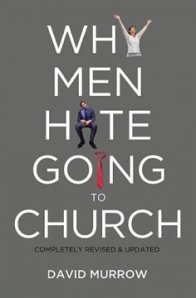
  Why Men Hate Going to Church by David Murrow is a compelling book about the gender gap that is growing in congregations world-wide.  Women outnumber men in some congregations with the differential ratios as high as 63 to a measly 37 percent.   In his newly revised ground breaking book Murrow attempts to explain the feminization of the church and what pastors and leaders can do to restore the masculine appeal.

The thing that piqued my interest most about Why Men Hate Going to Church is that way that Murrow lines out his argument for masculine church being a Biblical model.  According to Murrow (and he has some interesting stats and historical data on his side), the church (in general) has slowly drifted into a feminized form of Christianity which by nature appeals to women and excludes men.  The most damaging element of the slide into gender favoritism is that Church has historically appealed to men.

I really enjoyed reading this book and give it a full five stars. I can see it being useful to pastors and ministry leaders who are looking to restore some of the biblical and redeemed cultural initiatives that appeal to men.  For women who are interested in helping men find their way back to church, David Murrow has written another book that you may find helpful as well, How Women Help Men Find God.  You can find out more about author David Murrow and the book Why Men Hate Going to Church on his website: churchformen.com

Disclosure of Material Connection: I received this book free from Thomas Nelson as part of the BookSneeze program. I was not required to write a positive review. The opinions I have expressed are my own. Some of the links in the post above are “affiliate links.” This means if you click on the link and purchase the item, I will receive an affiliate commission. Regardless, I only recommend products or services I use personally and believe will add value to my readers. I am disclosing this in accordance with the Federal Trade Commission’s 16 CFR, Part 255: “Guides Concerning the Use of Endorsements and Testimonials in Advertising.”

Is Sunday Morning for Discipleship or Evangelism?

When a pastor stands in the pulpit to presents a message a lot of work has gone into preparation of the sermon.  He stands for one brief moment to draw our attention to the very Word of God.  He stands there as a messenger.  God has spoken and we should hear and respond to God in an appropriate way.

file000321626212

So during the weeks and months leading up to a message the pastor is engaged in reading, understanding, praying over and discerning the actual text of the sermon.  He might employ his training the Greek or Hebrew language to help pull out the meaning of a text.  He will do a study in geography and historical context when necessary.  In short, He will do as much research as necessary to determine that he accurately opens up God’s Word before us.

A pastor, however, will also study the culture in which he presents the message.  It is not enough to know the Truth… the Truth must also be applied.  Application can be summed up as How someone should properly respond to the message. The application will take on nuances according to the culture in which the pastor is presenting the message. Will there be hearer’s present who are post-modern thinkers?  Will there be audience members struggling with finances? How does the average hearer treat their children? What percentage of the congregation is single?  How many profess a relationship with Jesus Christ?  How many came just because it is Mother’s Day?  How many came because of special circumstances in their lives?  All these and more are questions a pastor may ask when preparing a sermon. (To know the right kind of questions to ask about culture in sermon preparation a pastor will spend a great deal of time during the week with people; both those inside the church and those outside the church).

Now comes the million dollar question:  Will the pastor tailor the message for insiders (the people who are there week to week)? or will he prep the message for outsiders (the people who may be present for the very first time)?  In essence will he be discipleship oriented or evangelistic?

I think we have convinced ourselves that the pastor can’t preach one sermon that is equally as relevant to both major types of people in the audience. The reason is a faulty paradigm that has entered into the Christian sub-culture. Many have rightly pictured the gospel as necessary for salvation, but have failed to also picture the gospel as necessary for sanctification (growth in Christ).  In essence, we are saved by grace, but work “on our own” after salvation to be more like Christ. While few would blatantly claim this to be true, it is non-the-less a prevalent thought in the way many practice and preach Christianity.

The outworking of such thought is an unfortunate side-stepping of the gospel in favor of a “moral of the story.”  In essence, the sermon becomes more like a fable than a message.  The scriptures are read with a deep desire to get straight to some sort of application like, “you shouldn’t lust” or “give to the poor.”  While there are many lessons to be learned from examples given us in scripture, we set people up for failure when we divorce the “moral” from the gospel message (in fact the outworking of this thought is legalism).

You see the gospel is actually everywhere in the Bible (The Old Testament included)!  Yet often we moralize the message and call it “meat.”  Don’t get me wrong.  The morals are there, but they aren’t there to show us how to live as much as how much we don’t live like we should.  The analogy to “face your giants” is actually just an expose on how you don’t face your giant like you should or the call to “get out of the boat” reveals that you are still in the boat.

So just because there is a moral to the story doesn’t mean that you can live up to it apart from Christ.  That is why believers need the gospel every sermon as much as unbelievers.  We tend to forget that Jesus left heaven for us and that the only way we will ever be able to fulfill the moral to the story is by faith in the only one who has ever perfectly fulfilled the moral of the story.  The truth is that no matter how hard you try you don’t have the power to conquire lust, greed, unforgiveness or any other sin in your life.  The moral just reflects how you have failed and even if you set out to achieve the moral you have to admit that you are starting from a position of failure.  You haven’t had the faith to face your giants in the past, how could you face them now with 3 easy points from the life of David?  This is self-help and it isn’t Biblical.  The gospel (and the Biblical message) is about God-help.  You can’t face your giants until you understand the one who stood in your place and faced the only real giant that could ever really kill you!  The gospel message is the only way that you will ever be able to have victory in your life.  It is the hope of “Christ in you” that gives you any kind of chance to actually overcome the sin in your life.

You can’t fight the sin in your life without the gospel. Don’t pretend that you have out grown it.  We need the gospel every day.  It is good for a pastor to sound more like an evangelist than an in-depth Bible teacher,  he maybe proclaiming what mature believers as well as unbelievers need to hear. If you think that you have moved beyond a need to hear the gospel in every sermon, you may want to reevaluate your motives… are you like those mentioned in I Corinthians 3 and 1 Timothy 1? The gospel continues to be good news long after we have first believed in Christ and it is what separates the Christian message from religion and other fables.

PFHS Baccalaureate Service

Why Are There So Many Versions of the Bible?

I have been asked recently and am often asked why there are so many versions of the Bible.  I thought I would just throw up a blog post here for everyone to see and get my perspective on the matter.  The answer is really two fold.

1. There are many versions of the Bible because it is a translated book.

The Bible was written in Greek, Hebrew, and Aramaic.  Most of us are unfamiliar with these languages and therefore need a translator of some sort. (By the way this is why often times you hear different “versions” of the Bible referred to as “translations”).  It would be rather weird and expensive for us to get a translator every time we sat down to read or hear the Bible.

So we have “translations” or “versions” of the Bible.  Someone somewhere (usually several scholars working together) produced a “translation” of the Bible into English. Generally speaking they all say the same thing.  However, translation is a tricky business.  Words are not always equal and sometimes translators struggle to put a Greek or Hebrew thought into coherent English and some choose some words over others.

Then you also have to account for the audience for whom you will be translating.  I sometimes have to “translate” what I am saying in English to my less articulate 5-year-old.  When it comes to the Bible, translation theory also plays a big part.  Are translators going for a “word for word” translation or a “thought for thought” translation… in other words which has more importance, the actual words of the Bible or the thoughts/ message, or both?

So in large part we have several “versions” or “translations” of the Bible because translators are going for different things. The New American Standard (NASB)  folks are going for a more conservative “word for word.” The New International Version (NIV) folks are going for a “thought for thought” kind of translation.  Then there are versions like The Message and the New Living (NLT) that are more like “paraphrases.” A paraphrase is like a retelling in simpler language.  Like when I retell my thoughts to my daughter in a way that she will understand them.

2. Translations are Copyrighted.

The second reason that there are so many versions of the Bible is quite simply publishing companies copyright their translations.  Rightly or wrongly whoever produces a translation of the Bible owns rights to that translation and can control how it is printed and used.  Rather than pay money to use another publishing company’s translation or jump through the hoops of securing rights to use another companies translation on a project, many have assembled a team of scholars and developed their own translation.  For example The Message (Nav Press), The New Living Translation (Tyndale) and the New Century Version (Thomas Nelson) though different versions of the Bible are all geared toward the same type audience.

The fact that their are a variety of translations of the Bible isn’t really a bad thing.  In fact it can be helpful to read two or three translations of a passage to get a good grasp on the meaning of a difficult passage of scripture.  I hope this helps.

Personally I use the English Standard Version (ESV) the most, but I do have copies of several other translations as well.

How to Pray for Your Pastor

In the book of Malachi a scathing indictment is issued against priests who cut corners and received less than acceptable sacrifices from the people.  The priests were called to a special office of mediation between the people and God which made the charge against their office even more significant.  In Malachi 2:5-7  God reminds the priests about the covenant he had established with them through their fathers.

My covenant with him was one of life and peace, and I gave them to him. It was a covenant of fear, and he feared me. He stood in awe of my name. True instruction was in his mouth, and no wrong was found on his lips. He walked with me in peace and uprightness, and he turned many from iniquity. For the lips of a priest should guard knowledge, and people should seek instruction from his mouth, for he is the messenger of the LORD of hosts.
(Mal 2:5-7)

Pastors are not priests.  The pastoral ministry is significantly different than the ministry of Old Testament Priests especially considering the work of Christ.   Christ offered himself as the perfect sacrifice and now stands as the mediator between God and men (I Tim. 2:5, Hebrews 9:15, 12:24).   (This is one reason why many protestants stand so staunchly against the Roman Catholic notion of priest as mediators and mass as a perpetual offering of sacrifice.)

4 Ways to Pray for Your Pastor

Though Pastors are not priests, there are aspects of their ministry that parallel the duties of the priests in Malachi’s day.  Pastors are responsible to teach and oversee the body of the church. (Piper does a fantastic job of fleshing this out so I won’t belabor the point.)  It is from examining Malachi in this light that I have pulled application from the failure of the priest in Malachi into four ways to pray for pastors.

. . . . . . .

So here is how I pray for myself and the other pastors I know:

  1. To stand in fear and awe of God’s name
  2. True instruction to be found on his lips
  3. To walk with the Lord in peace and uprightness
  4. To turn people away from iniquity

Related Links:

On This Day in Christian History (A Review)

I like history.  I really like Christian History.  Just take one glance around my office and you will notice that most of the books on my shelves were written by dead guys (actually they wrote the books and then they died).  You might also notice a long shelve filled with biographies and still another shelf filled with volumes of Church history.  You will also notice a magazine stack of Christian History Magazines.  I’m a history guy.  I’m a Christian history guy.

So when On This Day in Christian History: 365 Amazing and Inspiring Stories about Saints, Martyrs and Heroes came up for review, I jumped at the chance to review it.  And it didn’t disappoint.  There are so many things that I like about this book and  it is hard to summarize in just a few words, so let me say this… it’s the perfect gift for a guy like me.  I can also see it being a great read for someone who is interested in getting a glimps at the people and events of Christian history.
The stories are generally inspiring.  There is a scripture verse at the bottom of the page that brings relevance and meaning to the previously read story.  There is a fascinating topic index in the back of the book allowing readers to look up stories according to topic. Over all it does a great job at achieving its purpose (a bite sized reading of what happened in Christian history on a particular day) in a way that encourages readers to stay engaged in the book.  I dare you to just read one day’s history when you get the book.

I  highly recommend On This Day in Christian History to anyone interested in Christian history.  To beginners its an easy read, small commitment book that will give you a broad spectrum view of Christian History.  To well educated history nerds like myself it will allow you to pull out of a narrowed genre of Church history (I find myself often in the Reformation and the Puritan Eras)  to appreciate a broader scope of history in a way that doesn’t take a lot of time.  Plus, everyone wants to know what happened in Christian history on your birthday.   The retail price is $12.99 (paperback), and is available around the web in places like Amazon.com for $9.35. I really like this book and at under $10 it makes a great dirty Santa gift when you are getting together with history nerds… unfortunately, we are a rare breed.  I gave it five stars.

    Disclosure of Material Connection: I received this book free from Thomas Nelson as part of the BookSneeze program. I was not required to write a positive review. The opinions I have expressed are my own. Some of the links in the post above are “affiliate links.” This means if you click on the link and purchase the item, I will receive an affiliate commission. Regardless, I only recommend products or services I use personally and believe will add value to my readers. I am disclosing this in accordance with the Federal Trade Commission’s 16 CFR, Part 255: “Guides Concerning the Use of Endorsements and Testimonials in Advertising.”

    The Best book I’ve Read on Communicating Truth

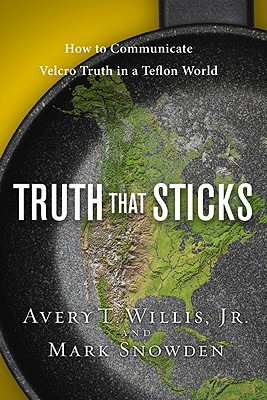
    Truth That Sticks: How to Communicate Velcro Truth in a Teflon World by Avery T. Willis Jr. and Mark Snowden is by far one of the best books I’ve read on how to communicate the biblical message.  I’ve read dozens of books just on the subject matter of speaking and dozens more on preaching, yet none with the simplicity and authenticating case studies presented in this book.  The idea is simple: The Bible has lots of truth telling stories and stories stick.

    The idea is so simple that we were already practicing it with the non-readers in our house.  I’ve read the Jesus Storybook Bible to my daughter 4 or 5 times now just by reading a few stories per night.  Sunday afternoons we pull out a set of pictures we have that tell the major stories of the Bible and she asks questions about the pictures and I tell the stories.  I just never thought of teaching adults, or students through stories… that is until I read Made to Stick by Dan and Chip Heath.  Then I thought it was possible, but I struggles with how to go about teaching adults through story.  Then this book made it’s way to my hands and has become a primer.

    To be honest another book is needed (and I think one is on the way) with more specifics on how to teach small groups, large group, etc. through the power of Biblical stories.

    This book is a great for people looking to share the gospel or  help disciple others, Sunday school teachers, pastors, etc. I highly recommend it.  The retail price is $14.99 (Paperback), and is available at a discount at  Amazon.com for $10.19. I gave it FIVE stars

    Disclosure of Material Connection: I received this book free from NavPress as part of their Blogger Review Program. I was not required to write a positive review. The opinions I have expressed are my own. Some of the links in the post above are “affiliate links.” This means if you click on the link and purchase the item, I will receive an affiliate commission. Regardless, I only recommend products or services I use personally and believe will add value to my readers. I am disclosing this in accordance with the Federal Trade Commission’s 16 CFR, Part 255: “Guides Concerning the Use of Endorsements and Testimonials in Advertising.”