Teenagers and the Gospel (Part 2)

Teenagers are Self Interested

Most Teenagers are a product of their culture and our culture is all about the consumer. Marketers have been targeting our kids for years and playing to their emotional needs. Ten’s of thousands of hours of screen time and all the related ads can’t be undone in a 30 minute pep talk. Because of this when it comes to Teenagers; they will understand most biblical truths through the lens of how it affects their lives.  Cognitively they should be able to think outside of themselves, however in our society it’s not an issue of ability, it’s an issue of conditioning. To reach teenagers you have to make a personal appeal or they will tune you out.

teenagers and the gospel

Even kids who have grown up in Christian families and have a strong background in church will have a hard time paying attention if you don’t address how the scripture relates to them personally. Quite frankly teenagers have been programed to be self-interested thinkers. You need to get to know them well enough to relate biblical truth to their personal needs. However, don’t make the mistake here of falling into moralism (good apart from the gospel). Teenagers need the gospel. Help them to see their need for the Savior.

Having a self-interested teen can be a mixed blessing. On one level you can’t compete with millions of dollars of marketing, well written scripts, and super model actors… on the other hand… those people don’t know “your” teen. While you may be less entertaining than the latest super bowl commercial, a little time well spent learning about the teens in your life can give you more credibility than axe body spray ever had.

Teenagers are Emotional

Teenagers make decisions based on feelings more than rational thought.  Physiologically they are still developing the rational part of their brain while the emotional impulse part of the brain is already developed.  They default to what they know. Something which seems cut and dry to you, is a major issue to them because they simply lack the development in their brains to process the situation the way you can as an adult.

They can still get there, it’s just not the preferred method and it requires you to connect a lot of the dots for them. Think of this as exorcising a weak muscle. The tendency to default to emotion is why students can sometimes be prone to “drama.” Teens often use the filter of feeling (“how does this make me feel”) to evaluate their circumstances and to make decisions. We need to guard our kids in this area because it leaves them open to manipulation.

The positive side of this is that teenagers are able to be empathetic. However, rarely do they ever get there without some help or guidance along the way. It is generally good when ask “How do you think it made them feel?”  When talking about how our actions effect others.

Grumpy Teen: If you are a parent dealing with a grumpy teen take in to account how many hours of sleep your child is getting each night. Most studies indicate that middle school age kids need around 9 hours of sleep or more per night and only about 15% of teens are getting enough sleep (There is a reason they would sleep till noon on Saturday if you’d let them). If 13 year-old Tommy is acting like the 3 year-old Tommy when he didn’t get his nap, it’s probably because 13-year-old Tommy is tired.

Challenge: How well do you know the teens in your life? If you don’t already, schedule regular personal time with your teen doing something you both value.  What emotions tend to rise to the top when you are carrying on a conversation? Pray for the teenagers in your life. Ask God to give you wisdom in applying the scripture to their needs. How is their sleep schedule? Sometimes a late weekend wake up is due to not enough sleep during the week.

The Modern Day Pharisee

Someone I once respected as a Christian leader told me that he didn’t read his Bible every day. I was amazed. He said that for him it had become something to do, just checking off another box. I heard him speak and ridicule people who just “check the box” on reading their Bibles

I guess it made sense at the time. I was impressionable. So I too started to NOT read my Bible when I didn’t feel like it and I checked another boxthe box of being so spiritual that I would not allow myself to fall into the kind of legalism. I thought I had reached a whole new plain of Christianity, one that had all the buzzwords like “authentic.” I started to revel in my failures so people would know that I wasn’t perfect. I was… authentic. I wore my flaws with pride and flaunted the fact that I didn’t read the Bible every day, or really much at all anymore. I didn’t need to. I was… spiritual.

I became so jaded that I soon could sense the hypocrisy in everyone around me. People would say that they were praying for someone, but I knew in my heart that they were not sincere. I had developed the gift of sensing the hypocrisy of others. I didn’t want to be a hypocrite so I stopped praying for people or I would pray with them once on the spot and completely forget about them later. I was becoming so spiritual.

Then it happened. I read the Bible again one day and then the next. I realized that I wasn’t spiritual at all. My frustration with church and the hypocrisy around me was a projection of my own dry and barren soul on those around me. I had never really seen my brothers and sisters in Christ for who they were because I was so busy judging myself in them.

When I began reading the Bible again it was like a deep and refreshing drink of cold water on parched lips. It hurt, but it felt so good. It was what I needed. I had been without for so long. I had almost forgotten how life transformational the gospel really is. I had been living in a self-imposed dessert for too long.

And so now I check the box on reading the Bible every day, not because I am a legalist or a Pharisee. No, I did that quite well without reading the scripture. I go to the well of God’s word everyday now because I know how thirsty I really am and how much I need to hear from Him (even if I don’t feel like it). I’m convinced once again that “holiness” though it isn’t a buzz word is what God has called me to and I’m not as proud as I used to be of being “authentic” with my flaws.

Oh, I’m still flawed. But now I would rather boast in Christ through my failure than boast in my failure. It’s different now that I’m a recovering from being a Pharisee. I wish I never believed the lie that it was somehow spiritual to not use one of the very tools God has given us to grow. Sometimes the most dangerous lies to believe are the ones that Satan puts in the mouths of Christian leaders.

3 Tips for Using Smart Phones in Corporate Worship

First off you have to know that I’m perhaps the worst person in the world to write a blog post about smart-phone etiquette in church. Simply put, I’ve broken all the rules. I’m the pastor who heard a phone go off while he was speaking, eyeballed the crowd in a judgmental manner, only to realize that it was MY phone going off, and sheepishly reminded everyone to turn their phones to “off” or “silent”… I’m that guy! I was once caught using Instagram FROM the baptismal pool… ok, I was just kidding on that one, but you get the picture… I’m bad. On the other hand, I am a pastor and I care about people. I care about you.  I want you to experience and enjoy a real and meaningful relationship with God. That’s not just my job, it’s my calling. So while etiquette usually takes into account the feelings and perceptions of those around us the aim of this post is to help us think deeply about our use of, or abstinence from, smart phones in worship. Rather than listing out a series of “best practices” I thought it most practical to lay our some basic guidelines that keep loving God and loving our neighbor at the center of our thoughts on the issue.

3 tips for using Smart Phones in Corporate Worship

Phones are just tools and as tools they can either help us or hurt us, but it really depends on how we use them. To ban phones all together might be oversimplifying the issue and cause us to miss a few real blessings along the way, however to use them incessantly to record events or interact with others who are not in the room may cause us to miss everything entirely.

Be Fully Present. However you use your phone, when it comes to worship, be fully there. If you find that you are distracted by your phone turn it off, on silent, or leave it in the car. However, if the bible app helps you fully engage or if your pastor posts interactive notes on line or even if you take notes with an app that allows you to write notes and record audio to be played back later… use it. The key is how you use your phone. If it takes you to another place mentally, then leave it behind.

Be Respectful of Others. You’re not the only one there. If you choose to use the technology on your phone in a way that helps you be fully present, make sure your presence doesn’t become a distraction to others. If at all possible turn your phone to off or silent. Ask the people sitting beside you if they mind if you take notes on your smart phone or tablet. If someone tells you that they are distracted by your device or you notice the children in your section are peering over trying to see what you are doing, you will want to accommodate others and put up your device or move to a less kid friendly section. If you need to use your phone to call a friend who was supposed to meet you at the service, step out into the foyer or perhaps even outside so as not to be a distraction to others.

Don’t Judge How Other People Use Their Phone. It’s easy to judge others for how they use their phones. We tend to be harsher on others for their bad manners than we are on ourselves. The truth is we seldom have the whole story. Unless you know for a fact that someone is playing a game on their phone, assume they have a legitimate reason for having their phone out, such as taking notes, reading a bible app, looking up words they don’t understand, etc.. If you are distracted by someone’s use of a phone, either politely ask them to refrain from using it or to use it elsewhere, “Excuse me sir, I can’t hear the pastor while you are talking on your phone, can you take your call in the foyer or outside please?” (Wish I was kidding).  Or perhaps you could change sections. Obviously if it’s your kids who are using the phone in church you have a lot more leeway in sequestering phone use and dictating what is acceptable and what isn’t.

A few books that have helped my thinking on this issue are Emily Post’s Manners in a Digital World: Living Well Online and Teaching Generation Text: Using Cell Phones to Enhance Learning which is a book geared towards educators but has significant crossover into the ministry world and of course The Bible which should be our ultimate guide when understanding how to approach God and encourage one another. I’m also greatly indebted to about a dozen folks who took time to comment on  Facebook post in which I asked the question “What about smartphone use at church? Can I check in on FB? Tweet? Use my Bible App? Etc. what’s acceptable and what’s not?” As I glanced back over this article I couldn’t help but notice how several of their comments had slipped into my own thought process on this issue and made their way into this post.
What did I miss? What are some of the apps or practices you use to help engage in the worship service? What are some of the biggest distractions and pitfalls with using smart phones in church? Your comments and suggestions are welcome.

Disclosure of Material Connection: Some of the links in the post above are “affiliate links.” This means if you click on the link and purchase the item, I will receive an affiliate commission. Regardless, I only recommend products or services I use personally and believe will add value to my readers. I am disclosing this in accordance with the Federal Trade Commission’s 16 CFR, Part 255: “Guides Concerning the Use of Endorsements and Testimonials in Advertising.”

Acts 3: The Generosity of God

The book of Acts is record of how the apostles bore witness to the resurrection of Jesus Christ. The emphasis of the first three chapters is on the power of the Holy Spirit to complete that mission. In chapter one the apostles are told to wait in Jerusalem for the Holy Spirit (1:4). In chapter two the Holy Spirit comes in Power and three thousand souls are added to the church (2:41). Now in chapter three, through the power of the Holy Spirit a lame man is healed.

This story is really amazing because it testifies to the generosity of God! Here there is a man who was born lame is sitting as close to the temple as he can get (lame men weren’t permitted inside the temple). He has no source of income, no disability check, no food stamps. He simply depends on the generosity of others. He’s no fool. He sits by the temple at the time of prayer where people will be coming in and out. He’s also situated close to where the  money changers would be doing business and as a result strangers would have a few more lose coins than normal. He begs to survive… to get by. He doesn’t have a lot of money… He’s a beggar with no hope of ever improving his situation.

But then he sees Peter and John and they don’t have any money to give him. Instead they lock eyes with him and offer them what they do have… The generous power of God to heal a beggar! Do you get it? Do you see the irony. The Beggar doesn’t have any money. That’s why he begs. He’s poor. He’s destitute. He can’t even walk. All he can do is beg. All he can do is ask for help and on this day GOD answers.

The Apostles reach out their hands and command him “Get up.” Such a harsh command for a man who cannot respond on his own, no matter how much he wills it. His body broken from birth. But something happens… he is able! God has made him able! This man who had nothing to offer. This man who has nothing to give for the miracle… gets up and walks! And he walks, no… skips right into the temple (3:8). He’s praising God. Ten minutes before, he was a lame man, but now he walks with Apostles.

How great is God that he gives to those who cannot repay Him. He is generous beyond all measure. This man who was unable to enter the temple because of his deformity is now made able by the working of the Holy Spirit. If God can heal a lame man’s body, He is most certainly able to save us all from our own spiritual bankruptcy.

Acts 2: Babel has Come Undone in Jerusalem

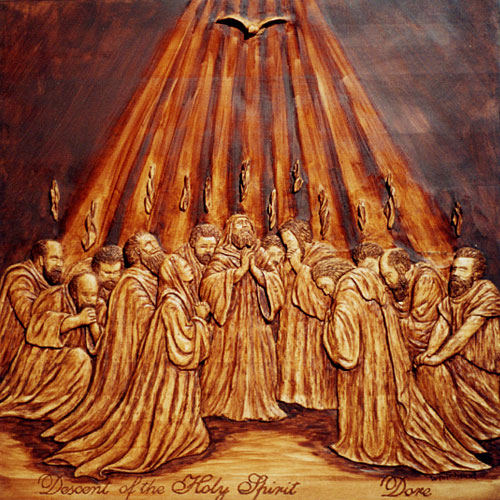
Descent of the Holy Spirit DoreSo here we are in Acts 2. The Apostles have stayed in Jerusalem at the Lord’s request (Acts 1:4). Jerusalem is the launching point for the gospel to go to the whole world (Acts 1:8).  They have been with the risen Christ for forty days before he ascended into heaven (Acts 1:3) and now they have waited another ten days for the Holy Spirit to come (Pentecost occurs 50 days after the Passover… Jesus was crucified at the time of the Passover). I’ve written before about Pentecost, you can read a brief PDF here.

As we anticipated yesterday something amazing happens because the disciples were obedient to the Lord’s command. The Holy Spirit comes, they preach, and three thousand souls are added to the church that day (2:41)… They are indeed fishing for men (Luke 5:1-11).

What is truly amazing is that through the power of the Holy Spirit each person is hearing the gospel in their own language. It’s the tower of Babel in reverse (Genesis 11:1-9). At the tower of Babel God had confused the language of the people because of their sin and rebellion. But now Jesus has made the ultimate sacrifice for sin. He is calling lost sinners to come home. He speaks to them through their own native language here in Jerusalem and ultimately the gospel will reach to the very ends of the earth (Revelation 5:9). What was done at Babel was coming undone.

What’s compelling here is that these men, the Apostles have come to Jerusalem. It’s not their home. This point is driven almost to the point of absurdity when men of the crowd recognize them as Galileans (2:7). This was a big deal the day because Galilee was a somewhat recently resettled state of Israel. They would have had the reputation of back wood hicks (John 1:46) and probably looked and talked differently than the folks in Jerusalem (Luke 22:59).

At this point you’re probably saying, I get that they were from Galilee… What’s the big deal? Exactly! You’re supposed to ask that! You are supposed to see that the disciples didn’t go to their home first (in all fairness they had already been there through the years of ministry with Jesus)! They went to the city and they went to the city on the day that everyone from all over the world would be there. The gospel went to the nations by way of Jerusalem because the nations were in Jerusalem that day (2:-11)!

I think the bigger point here is to obey God (even in the small things) after all it’s His plan. Yet how often do we put our confidence in the flesh thinking WE have a snazzy plan… of course our snazzy plan usually discounts the Spirit of God and chalks things like a language barrier as impossible to over come or at least a long way off. Can you imagine if the disciples had packed it in and tried to gain a stronger foothold in Galilee?

5 Benefits of a Blogging Pastor

I was first introduced to the bold new concept of a blogging pastor by the book “The Blogging Church.” Much has transpired since that time, but one thing remains the same: Blogging can be an effective tool for pastors and churches if used wisely. I have a few years of blogging experience under my belt and have enjoyed reading the blogs that my Pastor and others have produced. More recently I took somewhat of a long blogging vacation (more than a year on this blog) and I noticed that I was still constantly referring people to my blog posts (not for vanity sake, but because I thought what I posted would be truly helpful them). I composed this list of five benefits of a blogging pastor not only as a reflection on how I use my blog and other bloggers have influenced me, but also as a reminder to keep blogging for the sake of those I shepherd as well as those whom I have never met.

To Help Your People Facing a Cultural Issue. Our culture is moving and changing at a rapid pace. Often times our folks have had a week at the water cooler to discuss issues before they ever walk in the door on Sunday (and that’s just your regular attendees). Many are struggling to figure out where to embrace and where to challenge culture. It’s easy to be right on an issue, but wrong on an approach. Having a blog can be a great outlet for pastors to address cultural issues from a biblical perspective. Not just being right on the issue, but also seeking to demonstrate a godly approach. I was deeply impressed and somewhat glad when my pastor posted his thoughts on issues pertaining to the Boy Scouts of America this past year. Though I don’t yet have a Boy Scout, I know his insights were helpful to those trying to form an intelligent opinion about the issues at stake.

Your Blog is Available When You Aren’t. Pastors are busy people. Much busier than most people would expect (but that’s another post). The more people that you have a charge over the harder it can be to have a conversation about important topics or issues. Having a blog is like having another preaching post. It helps put you in front of people (even when you can’t be… like at 3AM in the morning). It also provides a great place to send people who are dealing with issue. “I blogged about that last year, check out the article I wrote and then let’s sit down and talk about it over coffee.”

Share Resources with Your Congregation. Having a blog allows you to share resources with your congregation. Whether you are sharing about a good book, blogging on a cultural issue, or just sharing links to resources and posts by other authors, a blog can be a great place to house those referrals. For example if you are speaking on spiritual gifts, you can link to several other articles or spiritual gifts surveys or if you are challenging people to pray for the nations, you can link to several mission sights. Even if you write a blog post quoting from other sights and link to them, you are broadening the horizon of those who follow your blog and giving them resources they might not otherwise have had.

Deal With Issues or Questions that May be Under the Surface. Often times a pastor is aware of issues that lurk in the shadows but may have a difficult time finding the proper forum to address it. A blog allows a pastor to begin a dialogue that can lead to more personal discussion offline. I’ve found that many of my posts dealing with various issues from pornography to leading a family devotional time have allowed folks to talk more freely about issues or concerns they have offline.  Quite often I’ve heard the words, “I saw on your blog the other day…”

To Engage with A Variety of People. One of the neat things that hosting a blog has done for me is to allow me to see things from outside my box. What I mean is that I get the benefit of hearing from atheists, Muslims, people living in different cultures, places, etc. When they are generous enough to leave a comment or question on my blog I am better informed on how they perceive what I write. Opening up the conversation to those who are outside of my worldview not only tests the integrity of my worldview but also provides a unique opportunity to engage in a conversation over issues that are too often just left to insiders.

Obviously this list isn’t exhaustive. What are some of the other benefits of a blogging pastor that you have noticed? If you’re a pastor and have a blog, I’d love to check it out. Please feel free to share a link in the comments (or if your pastor has a pretty great blog, share his blog address in the comments).

Here are some links to the pastor friends that I follow:

Chris Aiken

Gerald Kirby

THE SERVANT KING (from the Jesus StoryBook Bible).

We love reading this Storybook Bible to the kids. Here is another animated story from The Jesus Storybook Bible by Sally Lloyd Jones.

Disclosure of Material Connection: Some of the links in the post above are “affiliate links.” This means if you click on the link and purchase the item, I will receive an affiliate commission. Regardless, I only recommend products or services I use personally and believe will add value to my readers. I am disclosing this in accordance with the Federal Trade Commission’s 16 CFR, Part 255: “Guides Concerning the Use of Endorsements and Testimonials in Advertising.”


Our Favorite Sins by Todd Hunter (A Review)

Have you ever wrestled with a sin issue? You knew that you had to change, but change seemed impossible. Or maybe you’ve been attending a bible study or even church service and while you feel educated at the end of the event you know somehow that transformation doesn’t just come with education. Something more needs to happen.  Then this book is for you.

In his book, Our Favorite Sins, Todd Hunter undertakes the topic of fighting sin and does it in an ancient, yet relevant way. I think he is on to something. Many of us in the mainline protestant churches have been quick to dismiss many of the traditional church seasons and disciplines simply because we’ve considered them to be the “Catholic” thing, without giving much thought to the actual benefits of say fasting or praying the hours.  It’s a great book and well worth a read and I think it will help anyone who is seriously interested in dealing with the sin in their lives.

I really enjoyed reading Our Favorite Sins. I had the pleasure of reading it on my Kindle Touch and found myself unable to put it down.  I highly recommend it to anyone interested in growing in a relationship with Christ.

Disclosure of Material Connection: I received this book free from Thomas Nelson as part of the BookSneeze program. I was not required to write a positive review. The opinions I have expressed are my own. Some of the links in the post above are “affiliate links.” This means if you click on the link and purchase the item, I will receive an affiliate commission. Regardless, I only recommend products or services I use personally and believe will add value to my readers. I am disclosing this in accordance with the Federal Trade Commission’s 16 CFR, Part 255: “Guides Concerning the Use of Endorsements and Testimonials in Advertising.”

Children are Like Arrows: A Fresh Look At Psalm 127

Unless the LORD builds the house, those who build it labor in vain. Unless the LORD watches over the city, the watchman stays awake in vain. It is in vain that you rise up early and go late to rest, eating the bread of anxious toil; for he gives to his beloved sleep. Behold, children are a heritage from the LORD, the fruit of the womb a reward. Like arrows in the hand of a warrior are the children of one’s youth. Blessed is the man who fills his quiver with them! He shall not be put to shame when he speaks with his enemies in the gate. (Psalm 127, ESV)

I guess I hear lots about this passage in regards to having a “quiver full of kids” and “kids are a blessing.” I’ve heard all kinds of explanations about how many arrows would be in a Hebrew quiver at the time that this was written.  I’ve heard glad parents tell me that their hoping to “fill their quiver” and others express over the loud noise of a toddler that “children are a blessing.”

I see value having lots of kids and most certainly agree that children are a blessing, even on their worst day (and toddlers have some pretty bad days).  However, I think there is a bit more to this passage than that.  I think there are some riches not mined here when we gloss over this Psalm so glibly.  Take a minute and dwell on this text with me.

Arrows are offensive weapons. You don’t use them to defend yourself as much as you do to make a dent in the enemy. Swords can be defensive. Shields are defensive.  Spears perhaps even defensive.  Arrows are purely for offense.  You let them go.  While kids are a reflection of their parents, they are also their own individuals.  Sometimes as parents we can try to use our children to protect our own egos, relive a second childhood, or even provide all the things we missed out on.  The fact is that just like an arrow leaves the grasp of an archer, your children were meant to leave your grasp too.

Those parents who are oppressive with their own sense of pride expressed either in the need for perfection or the need to be needed risk warping their children.  Start with the end in mind. Just like archers shape branches to make their arrows because they know what an arrow needs to fly, so parents are to be intentional in shaping their kids to live beyond their home.  The arrows in the quiver of Psalm 127 aren’t meant to be kept in the quiver.  They were intended to be a deadly show of force and accuracy against the enemy.

I guess what I’m really trying to say is that your children won’t remain at home forever.  Arrows aren’t intended to fill quivers.  They have a greater purpose.  Because Archers know this.  They shape their arrows with their ultimate purpose in mind (to be aimed and released).

Question: How are you raising your children for the years they will live outside your home?

More thoughts on Psalm 127 to follow this week.

THE G.O.S.P.E.L.