Acts 7: Forgiveness

I know there is a lot of information in Stephens speech in Acts 7, but today I want to focus on verse 60. Seems like Stephen in the midst of his murder is able to forgive those who have violently risen against him. He carries no hatred, no malice, no bitterness, no need to cry out for God to vindicate him… Instead he cries out that his murder would not be counted against them.

This boldness reeks of the gospel. Who is this man to forgive his murderers? Who is this that now sees with the gates of Heaven opening before him and all he can think to utter is “please, don’t count it against them.” He actually wants his attackers to see what he sees! He wants them to know the peace that has come through Jesus!

This is a life rocked by the gospel. One who offers forgiveness as freely as he has received. His blood does cries out for justice… but now for forgiveness.

Acts 6: the necessary and the urgent

In Acts 6 a need arises in the community that brings a brief crisis… There is a perceived division in the church among the treatment of widows. This is a gospel crisis, either Christ’s atonement is for all (the far off and the near) or its just for the near.

The Apostles address the issue by selecting men of good reputation to address the need (and preserve the integrity of the church’s gospel witness). This also preserves the ministry of the gospel. The kingdom does not stop advancing because of inner turmoil.

Acts 5: Your Sin isn’t Small

God kills Ananias and Sapphira. Before you start to get upset about that consider that He had every right. He’s God! We all owe him our breath. We all live at his pleasure. Don’t kid yourself into thinking that God doesn’t posses the same right over you… He’s your maker.

Ananias and Sapphira wanted recognition for selling property and giving their money to the church. No worries there, but they held back and lied about the gift. I don’t know what they were holding back for, maybe a 401K, a better car, or maybe to just pay off some debts. Either way, they held back. Not that they owed all the money to the church like a debt or obligation, but that they claimed that it was everything. They were faking generosity.

Faking generosity to the church is a mockery of the gospel. Consider that this offering was going to meet the needs of the poor (4:34-35). Consider that those who sold their property were giving all of it away and this enabled the apostles to boast even more about the resurrection of Jesus (4:32-35). This unity that the church experiences is a direct witness to the power of the gospel. It puts both the present condition of those who are destitute and suffering and the eternal condition of those who profess faith in Christ in the same light… If God would not withhold his son from me, so that I might be saved… Who am I to withhold earthly goods from those who have immediate need.

The problem came when Ananias and Sapphira held back. That’s not the gospel… it’s a feigned generosity. It’s a lie. It’s a false gospel. They are not mimicking the generosity of God.  They held back. They care only about having the appearance of piety and so they lie.

The lie costs them. It costs them their lives… by the way, that is what sin costs. It’s not small. It’s not trivial. It’s not as though the cross were a small thing. The love of God compelled Christ to die for our sin and this single act is the most generous thing that has ever happened in all of history. The early church was a testimony to that in the way that the hearts of the wealthy were moved to outrageous generosity… but when one couple held back they were reminded to never take the generosity of God for granted. Sin always costs.

Acts 4: The Cornerstone

The healing of a beggar in chapter three provoked a commotion and all the officials come to see what is going on. They demand to know by what power these things are being accomplished. The Apostles declare plainly through the power of the Holy Spirit that it was in the name of Jesus. (Notice that the Holy Spirit empowers them to testify about the resurrection of Jesus… Make no mistake the book of Acts is about Jesus.)

Peter presses in to the rulers that they are the ones who crucified Jesus. He references a teaching moment of Jesus just prior to his death, burial and resurrection (2 months before this event… You can find it in Matthew 21:33-46). Jesus tells a parable about wicked tenants who reject the owners right over a certain property and ultimately kill the owners son. He then goes on to quote Psalm 118:22-23 and says “the stone the builders rejected has become the chief cornerstone,” implicating the Pharisees rejection of Jesus (and by association murder).

Now Peter throws it out again, this time spelling it out just in case they didn’t get it. “Jesus is the stone that was rejected by you, the builders, which has become the chief corner stone” (Acts 4:11, ESV). Any attempt to build a platform to reach up to Heaven must have the Risen Christ as the corner stone. These men in the temple not only rejected Jesus but among them were men who set in motion the false arrest, trial and murder of Jesus.

These are some wicked dudes and Peter lets them know. But here is where the real power of the gospel lies… The sovereign plan of God takes the most wicked sin imaginable (the murder of GOD – John 1:1-3) and uses that very same act to cause the greatest good man has ever known (redemption and the forgiveness of sins) through the resurrection… They meant it for evil… but God intended it for good.

What a glorious God we serve. Every attempt to trump the gospel is turned on its head and proves the gospel even more true: Injustice is transformed into lavish grace, where men pour out their hatred, the love of God is made manifest, where men fight to exercise control, God proves his sovereign plan.

Acts 3: The Generosity of God

The book of Acts is record of how the apostles bore witness to the resurrection of Jesus Christ. The emphasis of the first three chapters is on the power of the Holy Spirit to complete that mission. In chapter one the apostles are told to wait in Jerusalem for the Holy Spirit (1:4). In chapter two the Holy Spirit comes in Power and three thousand souls are added to the church (2:41). Now in chapter three, through the power of the Holy Spirit a lame man is healed.

This story is really amazing because it testifies to the generosity of God! Here there is a man who was born lame is sitting as close to the temple as he can get (lame men weren’t permitted inside the temple). He has no source of income, no disability check, no food stamps. He simply depends on the generosity of others. He’s no fool. He sits by the temple at the time of prayer where people will be coming in and out. He’s also situated close to where the  money changers would be doing business and as a result strangers would have a few more lose coins than normal. He begs to survive… to get by. He doesn’t have a lot of money… He’s a beggar with no hope of ever improving his situation.

But then he sees Peter and John and they don’t have any money to give him. Instead they lock eyes with him and offer them what they do have… The generous power of God to heal a beggar! Do you get it? Do you see the irony. The Beggar doesn’t have any money. That’s why he begs. He’s poor. He’s destitute. He can’t even walk. All he can do is beg. All he can do is ask for help and on this day GOD answers.

The Apostles reach out their hands and command him “Get up.” Such a harsh command for a man who cannot respond on his own, no matter how much he wills it. His body broken from birth. But something happens… he is able! God has made him able! This man who had nothing to offer. This man who has nothing to give for the miracle… gets up and walks! And he walks, no… skips right into the temple (3:8). He’s praising God. Ten minutes before, he was a lame man, but now he walks with Apostles.

How great is God that he gives to those who cannot repay Him. He is generous beyond all measure. This man who was unable to enter the temple because of his deformity is now made able by the working of the Holy Spirit. If God can heal a lame man’s body, He is most certainly able to save us all from our own spiritual bankruptcy.

Have You Seen The Gospel Transformaiton Bible

Gospel Transformation Bible The ESV Gospel Transformation Bible is an incredible bible that seeks to empower readers to understand the gospel throughout storyline of the entire Bible and help readers draw life changing, heart altering application. I’ve really enjoyed reading my copy and was amazed at the depth and simplicity of each section. The integrity of the scripture is preserved at the top of the page while notes appear in a distinct font at the bottom of the page (much like footnotes or explanatory notes). Each book (Such as Ezra)  or section (such as Psalms 1-50) is covered by an author (and there is a long list of well studied and well known pastors, authors and speakers from varying backgrounds  such as JD Greer, Elyse Fitzpatrick, Kevin DeYoung, Scotty Smith, Jared C. Wilson, Burk Parsons, R. Kent Hughes, and Bruce Ware… Just to name a few).  The entire project then falls under the editorship of Bryan Chapell (General Editor) and Dane Ortlund (Managing Editor).

It’s a fantastic work full of great insight that provokes the heart to worship. For those who are unfamiliar with the discipline of a Biblical Theology (what this ends up being) there is an article at the front from the general editor that explains the intent and conclusions drawn in the notes.

Overall I think it’s a compelling study Bible and well worth your time and investment. It’s a handy tool for pastors, bible study leaders and teachers who are always looking for how to make sure every lesson contains a gospel element. It can be especially helpful for a new believer or someone trying to read through the bible for the first time. Ultimately what you have in the Gospel Transformation Bible is a celebration of the gospel in every text.

Disclosure of Material Connection: I received this Bible free from Crossway as part of their Reviewer program. I was not required to write a positive review. The opinions I have expressed are my own. Some of the links in the post above are “affiliate links.” This means if you click on the link and purchase the item, I will receive an affiliate commission. Regardless, I only recommend products or services I use personally and believe will add value to my readers. I am disclosing this in accordance with the Federal Trade Commission’s 16 CFR, Part 255: “Guides Concerning the Use of Endorsements and Testimonials in Advertising.”

Did you enjoy this post? Did you consider it helpful? Subscribe by e-mail on the top right of this page and get fresh articles like this one and more sent straight to your e-mail inbox. Don’t for get to share on Facebook or Twitter.

Acts 2: Babel has Come Undone in Jerusalem

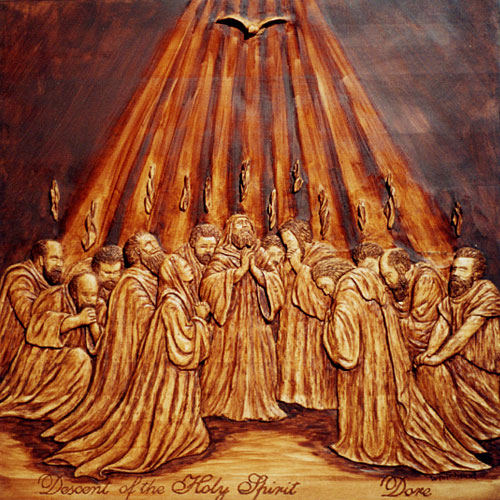
Descent of the Holy Spirit DoreSo here we are in Acts 2. The Apostles have stayed in Jerusalem at the Lord’s request (Acts 1:4). Jerusalem is the launching point for the gospel to go to the whole world (Acts 1:8).  They have been with the risen Christ for forty days before he ascended into heaven (Acts 1:3) and now they have waited another ten days for the Holy Spirit to come (Pentecost occurs 50 days after the Passover… Jesus was crucified at the time of the Passover). I’ve written before about Pentecost, you can read a brief PDF here.

As we anticipated yesterday something amazing happens because the disciples were obedient to the Lord’s command. The Holy Spirit comes, they preach, and three thousand souls are added to the church that day (2:41)… They are indeed fishing for men (Luke 5:1-11).

What is truly amazing is that through the power of the Holy Spirit each person is hearing the gospel in their own language. It’s the tower of Babel in reverse (Genesis 11:1-9). At the tower of Babel God had confused the language of the people because of their sin and rebellion. But now Jesus has made the ultimate sacrifice for sin. He is calling lost sinners to come home. He speaks to them through their own native language here in Jerusalem and ultimately the gospel will reach to the very ends of the earth (Revelation 5:9). What was done at Babel was coming undone.

What’s compelling here is that these men, the Apostles have come to Jerusalem. It’s not their home. This point is driven almost to the point of absurdity when men of the crowd recognize them as Galileans (2:7). This was a big deal the day because Galilee was a somewhat recently resettled state of Israel. They would have had the reputation of back wood hicks (John 1:46) and probably looked and talked differently than the folks in Jerusalem (Luke 22:59).

At this point you’re probably saying, I get that they were from Galilee… What’s the big deal? Exactly! You’re supposed to ask that! You are supposed to see that the disciples didn’t go to their home first (in all fairness they had already been there through the years of ministry with Jesus)! They went to the city and they went to the city on the day that everyone from all over the world would be there. The gospel went to the nations by way of Jerusalem because the nations were in Jerusalem that day (2:-11)!

I think the bigger point here is to obey God (even in the small things) after all it’s His plan. Yet how often do we put our confidence in the flesh thinking WE have a snazzy plan… of course our snazzy plan usually discounts the Spirit of God and chalks things like a language barrier as impossible to over come or at least a long way off. Can you imagine if the disciples had packed it in and tried to gain a stronger foothold in Galilee?

Acts 1: The Blessing of Obedience

The book of Acts or as it is often called, “The Acts of the Apostles” is actually all about the Lord Jesus Christ. We see here in the first chapter that The Lord has risen from the dead and ascended into Heaven. Before he leaves he gives the Apostles the charge to be witnesses (specifically of his resurrection) all over the world beginning in Jerusalem (See Acts 1:8).

This is where it gets interesting. The disciples aren’t from Jerusalem and Luke the author of Acts wants you to know that... Indeed two verses later (Acts 1:10) the angels address the Apostles as “Men of Galilee.” Then again just a few verses later the narrator (Luke) reminds the reader that the Apostles are not from Jerusalem because they went back to a room “where they were staying” (Acts 1:13).

I think this is important because Jesus has commanded them to wait there in Jerusalem for the Holy Spirit to come upon them (Acts 1:4). It seems like the natural bent of the disciples would not have been to stay in Jerusalem but head somewhere else (perhaps Galilee… Home). But never the less at the Lord’s command they stay, waiting for the Holy Spirit.

This reminds me of Luke 5:1-11 where Jesus first calls some of his disciples. He tells them to push back out into the water and fish again. Their natural inclination is not to do it…. they want to clean their nets. But never the less, at the word of Jesus they press out and drop the nets and pull in the biggest catch they had ever seen… It is interesting to note that it is just at that point that Jesus tells them that one day they will be fishing for men.

Now here Jesus has told them again to push out of their comfort zone and stay in the city. He will give them the Holy Spirit and they will be his Witnesses starting in the place He told them to go.

Prayer: Father, You are amazing! When these men obeyed you in the small things like casting out a net or staying in the city, you rewarded them with a real relationship with You and you invited them to be your witnesses all over the world. Today I’m reminded to be obedient to you in even the seemingly small things. I want my priorities to be a true reflection of your will. I surrender to you. Today I’m seeking YOUR Kingdom, YOUR Will and I give YOU my obedience. Help me to not to put confidence in the flesh, but trust your wisdom.

The God Puzzle

THe God PuzzleThe God Puzzle: How the Bible fits together to reveal God as Your Greatest Treasure by Valerie Ackermann is a workbook that seeks to engage children with the rich truths of God’s Word. I’ve been working through it with my 7-year-old daughter as part of a morning devotional time. I’ll cook breakfast while she works in the book on the bar behind me. She has a hunger to learn about God, loves any kind of homework and is eager to work on any project we do together so this format is right up her ally.

I don’t know how well the format will work with my son when he is old enough to work through something like this. His personality is different and I don’t see him having enough patience to complete a lesson without diligent supervision. We’ll see when he gets there.

The book leads readers to look up scripture to answer questions and has a host of different exercises like matching, crossword puzzles, etc. It’s great for someone who already has a basic grasp on how to look things up in the bible, but will require help if you child is still learning the books of the bible, etc.

Over all I think this is a great tool but probably used best as a parent-child project. I wouldn’t just hand this to my daughter and ask her to work through it out (though I might if she were at the top end of this age range). I can see it being a great conversation starter, devotional material, and even home school teaching aid. For more information about this book and what others are saying about it check out this link from the Litfuse Group: http://litfusegroup.com/author/vackermann

Disclosure of Material Connection: I received this book free from Litfuse as part of their Blog Tour. I was not required to write a positive review. The opinions I have expressed are my own. Some of the links in the post above are “affiliate links.” This means if you click on the link and purchase the item, I will receive an affiliate commission. Regardless, I only recommend products or services I use personally and believe will add value to my readers. I am disclosing this in accordance with the Federal Trade Commission’s 16 CFR, Part 255: “Guides Concerning the Use of Endorsements and Testimonials in Advertising.”

Coveting vs Contentment

I taught my daughter the Ten Commandments… She can say them all from memory. Then came the task of defining some of the words for her (she is only six at the time of the original posting of this article). She needed a definition that she could understand for the word “covet.” We did our best and came up with “not being content with what you have, so you try and satisfy your heart with thoughts of possessions that don’t belong to you… This causes you to look for happiness in things instead of God,” for coveting.

It has been interesting to see her process and try to grasp the term coveting. She uses the word coveting, but we try and highlight the positive aspect of being content. The real struggle, as with everything in parenting, is that we are imperfect parents.

Teaching my daughter about coveting has taught me more about my own heart. It seems impractical to chide my child about being content with what she has (and she has a lot), if I am buying up every new gadget out there (I’ve resisted the I-pad ever since it came out). Not that buying stuff is wrong… Coveting has nothing to do with what you buy and has everything to do with your heart. You really don’t have to buy stuff to covet. You can be poor as poor can be and in your heart think that if you just had enough money, stuff, etc. you would be satisfied. If you believe that, then your heart is turning away from God. It’s irrelevant whether or not you make the actual purchase if you look to a product, possession, job, etc. to provide you with happiness. True and lasting happiness comes with a real relationship with God through the Lord Jesus Christ. Remembering his sacrifice and his joy has helped me understand and be more content with what I have and ultimately who I am in Him. Like the Apostle Paul, I have learned to be content (though this is a battle I often fight every day and have to relearn often).

Not that I am speaking of being in need, for I have learned in whatever situation I am to be content. I know how to be brought low, and I know how to abound. In any and every circumstance, I have learned the secret of facing plenty and hunger, abundance and need. I can do all things through him who strengthens me. (Philippians 4:11-13 ESV)

This is my prayer for my kids. I know that if they grow up content in whatever situation they find themselves that they will be well rounded happy adults who are more likely to be submitted to the will of God. I wouldn’t want the desire for a bigger house keep them from the mission field (should God call). I wouldn’t want the pursuit of comfort keep them from living for the Eternal.

It’s easy to get distracted, to feel entitled, or to just plain place your hope in an object or status. It’s not that I don’t want my kids to have stuff. All good parents love giving their kids gifts. I just don’t want them looking past the gift to the next big thing and forget the one who gave them all the gifts.

To be honest it’s too easy to look past the Lord’s provision sometimes. If we are not careful we will think our situation in life is less than is should be because we don’t have an appliance, gadget, etc. Yet these things are not eternal; they do not satisfy. We were made for greater things and when we find ourselves content in little or much we are in a place to be used by God who meets all of our needs in Jesus.