When a pastor stands in the pulpit to presents a message a lot of work has gone into preparation of the sermon. He stands for one brief moment to draw our attention to the very Word of God. He stands there as a messenger. God has spoken and we should hear and respond to God in an appropriate way.

So during the weeks and months leading up to a message the pastor is engaged in reading, understanding, praying over and discerning the actual text of the sermon. He might employ his training the Greek or Hebrew language to help pull out the meaning of a text. He will do a study in geography and historical context when necessary. In short, He will do as much research as necessary to determine that he accurately opens up God’s Word before us.
A pastor, however, will also study the culture in which he presents the message. It is not enough to know the Truth… the Truth must also be applied. Application can be summed up as How someone should properly respond to the message. The application will take on nuances according to the culture in which the pastor is presenting the message. Will there be hearer’s present who are post-modern thinkers? Will there be audience members struggling with finances? How does the average hearer treat their children? What percentage of the congregation is single? How many profess a relationship with Jesus Christ? How many came just because it is Mother’s Day? How many came because of special circumstances in their lives? All these and more are questions a pastor may ask when preparing a sermon. (To know the right kind of questions to ask about culture in sermon preparation a pastor will spend a great deal of time during the week with people; both those inside the church and those outside the church).
Now comes the million dollar question: Will the pastor tailor the message for insiders (the people who are there week to week)? or will he prep the message for outsiders (the people who may be present for the very first time)? In essence will he be discipleship oriented or evangelistic?
I think we have convinced ourselves that the pastor can’t preach one sermon that is equally as relevant to both major types of people in the audience. The reason is a faulty paradigm that has entered into the Christian sub-culture. Many have rightly pictured the gospel as necessary for salvation, but have failed to also picture the gospel as necessary for sanctification (growth in Christ). In essence, we are saved by grace, but work “on our own” after salvation to be more like Christ. While few would blatantly claim this to be true, it is non-the-less a prevalent thought in the way many practice and preach Christianity.
The outworking of such thought is an unfortunate side-stepping of the gospel in favor of a “moral of the story.” In essence, the sermon becomes more like a fable than a message. The scriptures are read with a deep desire to get straight to some sort of application like, “you shouldn’t lust” or “give to the poor.” While there are many lessons to be learned from examples given us in scripture, we set people up for failure when we divorce the “moral” from the gospel message (in fact the outworking of this thought is legalism).
You see the gospel is actually everywhere in the Bible (The Old Testament included)! Yet often we moralize the message and call it “meat.” Don’t get me wrong. The morals are there, but they aren’t there to show us how to live as much as how much we don’t live like we should. The analogy to “face your giants” is actually just an expose on how you don’t face your giant like you should or the call to “get out of the boat” reveals that you are still in the boat.
So just because there is a moral to the story doesn’t mean that you can live up to it apart from Christ. That is why believers need the gospel every sermon as much as unbelievers. We tend to forget that Jesus left heaven for us and that the only way we will ever be able to fulfill the moral to the story is by faith in the only one who has ever perfectly fulfilled the moral of the story. The truth is that no matter how hard you try you don’t have the power to conquire lust, greed, unforgiveness or any other sin in your life. The moral just reflects how you have failed and even if you set out to achieve the moral you have to admit that you are starting from a position of failure. You haven’t had the faith to face your giants in the past, how could you face them now with 3 easy points from the life of David? This is self-help and it isn’t Biblical. The gospel (and the Biblical message) is about God-help. You can’t face your giants until you understand the one who stood in your place and faced the only real giant that could ever really kill you! The gospel message is the only way that you will ever be able to have victory in your life. It is the hope of “Christ in you” that gives you any kind of chance to actually overcome the sin in your life.
You can’t fight the sin in your life without the gospel. Don’t pretend that you have out grown it. We need the gospel every day. It is good for a pastor to sound more like an evangelist than an in-depth Bible teacher, he maybe proclaiming what mature believers as well as unbelievers need to hear. If you think that you have moved beyond a need to hear the gospel in every sermon, you may want to reevaluate your motives… are you like those mentioned in I Corinthians 3 and 1 Timothy 1? The gospel continues to be good news long after we have first believed in Christ and it is what separates the Christian message from religion and other fables.

 Deriving a standard definition for poverty in absolute terms is problematic. Poverty or being poor encompasses many things such as mindset, income level, management, ability, injustice, economic policy, joblessness, childcare, land laws, etc. Many attempts have been made to devise economic margins by which poverty may be measured. The most common way to measure poverty is according to a scale of ability to provide for yourself. So if an individual lacks “the financial resources to satisfy their basic needs and/or reach a minimum standard of living,”[1] they are considered poor. “According to the World Bank (2000), ‘poverty is pronounced deprivation in well-being.’ This of course begs the questions of what is meant by well-being and of what is the reference point against which to measure deprivation.”[2]
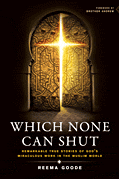
 is an incredible book of stories from the life of “Reema Goode” (her name changed for security). “Reema” is a Christian wife and mother living in a Muslim (Arab) community seeking to share the gospel with the women in her region. She shares heartfelt and compelling stories of how God has opened the door for the gospel to reach a people group.
 The Hill House