All the Disciple Now Posts in One Spot

3 Keys to a Good Disciple Now Weekend

Disciple Now Themes

Reflections on Disciple Now 2009

Student Ministry in General

7 Leadership Lessons from the Life of Alfred the Great

Okay So I read this amazing book about the life of Alfred the Great this weekend an wrote a short review that you can find here.  Then it came time for me to find a spot on my shelf and I started trying to figure out which section of my shelves it needed to be stored under and three categories came to mind.  Obviously historical biography because that is the genera in which it is written, but Alfred also demonstrated unwavering Christian Character and sought to evangelize viking leaders who were tearing into his territory and then there are the amazing leadership principles I gleaned from reading the book.  In the end I put it in the leadership category due to the amazing leadership characteristics that I saw displayed in Alfred throughout the book.

7 Leadership Lessons from the Life of Alfred the Great


1. Never give up on what really matters.

Even when he was betrayed by some of his countrymen and forced to flee to the swamp with his family, Alfred sought out ways to demonstrate that he was still the king and would defend his homeland.  He never completely abandoned hope, gave up, or ran away.  He stood his ground despite dismal circumstances.  He rallied troops to come to his aid and eventually fought back the viking hoards and won victory. Yet even in fighting back the vikings, he demonstrated a noble and Christian character in dealing mercifully with a savage enemy.

2. Don’t Ask People to do What you are Not Willing to do.

Alfred lead his troops to battle time and time again.  This was normal practice for an Anglo-Saxon king.  He demonstrated valor in the midst of battle.  He asked his men only to go so far as he was willing to go himself.  This was true both on and off the battle field.  Even in the sweeping reforms he would make concerning literacy in his nation, he first modeled by taking it upon himself to learn Latin as an Adult.  Furthermore when it came time for his scholars to translate Latin works into Anglo-Saxon, Alfred was the final translator.

3. Learn from your Mistakes.

Alfred made a few mistakes early on.  One was not pursuing the vikings once his men had them on the run.  The vikings soon learned that they were not being pursued, regrouped, came back and attacked Alfred’s celebrating troops and won the victory.  Never again did Alfred allow his troops to celebrate before they had definitively routed the enemy troops.

4. Raise the Level of Leadership around You.

One of the main concerns for Alfred was the enforcing of the law.  He was discouraged to know that many of the men in positions of power under him were illiterate and unable to read the laws of the land.  Alfred insisted that every leader learn to read.  Those who learned well were honored and given gifts.  Those who were not able to learn surrendered their posts.  Alfred also revised the laws and did his best to ensure justice was done.  He placed a great deal of importance on keeping an oath.

5. Pass on Leadership  Lessons to the Next Generation.

Alfred’s sweeping reforms also provided that children would learn to read.  He also provided ample opportunities for his sons and daughter to see his leadership in action.  His son assumed the throne and carry his father’s initiatives forward.  Alfred’s grandson would eventually route the vikings completely and send them all home saving his motherland from their onslaught.  Alfred’s daughter would outlive her husband and benefit the people of her subkingdom by leading them out to battle against the Danes.

6. Seek Expert Help on New Projects, (even if it means going outside the organization).

Alfred sought the help of naval experts outside of his Anglo-Saxon kingdom to build a navy that would eventually patrol his shoreline.  He also sought scholars from beyond the border of his kingdom when he set his heart to learn Latin and to prepare Latin works to be translated into the Anglo-Saxon tongue.  Alfred got the help he needed from the experts rather than trying to start something from the ground up.

7. Meet Challenging Goals with innovation and Invention.

Alfred created a system that allowed a standing army to be ready year-round.  He developed fortified cities with in a days travel of one another.  He developed larger boats for his navy to combat the viking forces before they ever landed on Anglo-Saxon soil.  When he set his heart to trying to raise the piety of the people in his kingdom he realized that Latin would be forgotten within a generation and set out to translate the Latin works into English.

Alfred the great was truly an amazing man and an amazing leader.  I encourage you to get the book.  You can read my brief review here.

Disclosure of Material Connection: Some of the links in the post above are “affiliate links.” This means if you click on the link and purchase the item, I will receive an affiliate commission. Regardless, I only recommend products or services I use personally and believe will add value to my readers. I am disclosing this in accordance with the Federal Trade Commission’s 16 CFR, Part 255: “Guides Concerning the Use of Endorsements and Testimonials in Advertising.”


Review: “The White Horse King” by Benjamin Merkle

The White Horse King: The Life of Alfred the Great
by Benjamin Merkle is an amazing book filled with great detail about the awe inspiring life of Alfred the Great.  Alfred was the fifth son of AEthelwulf  king of Wessex (AD 839 – 858) and by all accounts was unlikely to ever assume the throne.  Yet, through a series of unfortunate events aided by the viking raids on the Southern kingdoms of what is now called Britan, Alfred found himself wearing his father’s crown and tasked with finding a way to forge peace and prosperity for his people in the midst of viking rampage.  Alfred was eventually not only successful in repelling the viking onslaught but was able to initiate several military, cultural, and societal reforms that have set the baseline for Western civilization.

Admittedly I did not know much about Alfred the great before I picked up this book, I was just looking for an inspiring and challenging biography.  I found that and so much more in this book.  I was greatly blessed to glean several leadership and life lessons from how this noble Anglo-Saxon and decidedly Christian king handled adverse situations, dealt with his enemies, inspired a literary revolution, and raised the quality of leadership in his kingdom.

This is one of the best and most inspiring historical biographies I have read to date.   The White Horse King is an amazing book. The retail price is $14.99 (Paperback), and is available at places like Amazon.com for $11.24. I gave it five stars (and would have given it more if I could).

Disclosure of Material Connection: I received this book free from Thomas Nelson as part of the BookSneeze program. I was not required to write a positive review. The opinions I have expressed are my own. Some of the links in the post above are “affiliate links.” This means if you click on the link and purchase the item, I will receive an affiliate commission. Regardless, I only recommend products or services I use personally and believe will add value to my readers. I am disclosing this in accordance with the Federal Trade Commission’s 16 CFR, Part 255: “Guides Concerning the Use of Endorsements and Testimonials in Advertising.”

Here are some other book reviews:

3 Keys to a Good Disciple Now Weekend (Part: 3)

The Follow Up

Ok.  Here is perhaps the most important part of the whole Disciple Now weekend, Follow Up!  It begins as soon as the students head home after the morning service.  There are generally three major areas that I like to follow-up with as quickly as possible (to help keep the events of the weekend fresh).

1. Leaders

I typically enjoy having lunch with all of my leaders or scheduling another time to meet with them.  I like to discuss the event while it is still fresh in their minds.  Each leader gets an opportunity to discuss challenges the weekend posed for them, opportunities for further ministry (as they see it), and an evaluation of the whole weekend.  I treasure this time as it provides for me a great opportunity to coach my leaders through processing the event as well as provides me with another perspective on leading our students.

2. Host Homes

I usually try to follow-up with host homes casually on an individual basis in the week after the Disciple Now weekend.  I also like to give out a brief survey on things that went well and things that we can improve before the next Disciple Now weekend.  Though they did not make it to my big 3  list for a successful Dnow weekend, host homes are crucial.  Getting key insight from adults who have just spent a weekend in their home with your students is never a bad idea.

3. Students

After having an opportunity to gather as much information as possible after the event from leaders and host homes it is important to use that information to engage students.  Sometimes this comes in passing information on to LIFE group leaders (the real everyday hero’s in student ministry) in discussing how to better minister to individual students.  Sometimes this provides great opportunity to follow-up with a student who was asking questions at Disciple Now weekend.  Other times the information is applied to working on group dynamics.  As a Student Pastor or Student Ministry Leader you will be uniquely equipped to figure out the best strategy to take the information you have gathered and shepherd students.  The goal is to help move students along in process of becoming fully devoted followers of Jesus Christ.  Not just to hold a successful event.  Events are just tools that we can use along the way to develop disciples.

Book Review: Obstacles Welcome

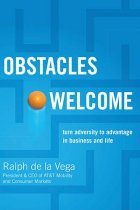
Obstacles Welcome book CoverObstacles Welcome: Turn Adversity to Advantage in Business and Life by Ralph de la Vega (President & CEO of AT&T Mobility and Consumer Markets)  is a great book  for leaders who are looking to hear from an experienced leader on overcoming adversity.   De la Vega has seen many adverse situations in his career and turned them to his advantage.  He recounts of the obstacles faced during hurricanes in South Florida, political unrest and diverse markets in South America, and the enormous task of overseeing the integration of Cingular Wireless and AT&T Wireless on a short deadline.. De la Vega takes the reader on a tour of his life and the obstacles he faced all along the way.  Yet at each point he is sure to illustrate the practical nature of the character and leadership principles that guided him along the way.

I appreciated Ralph de la Vega’s writing style.  When reading Obstacles Welcome I couldn’t help but come away feeling as thought I had been personally mentored by the man who wrote the book.  I got a glimpse into the challenges he faced early on in childhood that ultimately prepared him for the business world.  Though he shared deeply insightful and personal stories, he was careful to cultivate a leadership lesson out of each one.  The brief summary entitled “take away messages” at the end of each chapter were of a great benefit to me personally.  While the principles taught by de la Vega were not new leadership principles, they were taught in the very practical setting of real life.

This is one of the most practical books on leadership and adversity that I have ever read.   Obstacles Welcome is an excellent resource. The retail price is $24.99 (Hardcover), and is available at places like Amazon.com for $16.49. I gave it five stars.

Disclaimer: As a blogger I received a free review copy from the Thomas Nelson’s Book Review Blogger program  (http://brb.thomasnelson.com/ ).  There was no requirement to give it a positive review, just for the reviewer to call it like they see it.