Ok… This is for all the Bible Nerds out there. Enough of you have been finding my post on a little background on Senacherib. that I feel comfortable posting more nerdy stuff. A word of warning… this is a little wordy at just over 3000 words compared to my normal posts of 300-500 words. I’ll probably write a brief, application oriented post on this passage at a later time. If it’s not your cup of tea… no worries, this won’t become normal, just a brief detour for the nerds of the bunch.
Join Amazon Student FREE Two-Day Shipping for College Students
Introduction: Background to Malachi
The book of Malachi contains very little information about its authorship. The first verse of Malachi simply states, “The oracle of the word of the LORD to Israel by Malachi.”[1] Many scholars suppose that even the name Malachi is not the real name of the prophet, but a pen name of sorts meaning, “My messenger.”[2] Other scholars reject this notion stating that there are no real grounds to assume that Malachi is a pen name and if it were it would in effect be the only, “Old Testament prophetical book where the prophet’s name is not given in the opening verses.”[3] Some have even wildly asserted that Malachi was an incarnate angel.[4] The exact date for the writing of Malachi is also disputed by scholars.[5] This is in large part due to the fact that Malachi does not contain any specific details as to when it was written.[6] However, there are several references within the book that allow scholars to narrow the time frame. Two are immediately helpful keys in developing a date for Malachi. One is that the author of Malachi cites current abuses in the temple (1:7ff, 2:13, 3:10).[7] The other is that there is a strong similarity regarding the themes of Malachi and the themes present in Nehemiah.[8] This has lead several scholars to conclude that Malachi was written, “Somewhere in the period between the completion of the second Temple in 515 B.C. and the work of Ezra and Nehemiah.”[9] Despite the general vagueness surrounding the authorship and date of the book of Malachi, there are some inferences that Biblical scholars can glean from the text regarding the perspective of the people that the book of Malachi was written to address. It is supposed that the first audience of Malachi were post exile Jews who had seen the rebuilt temple, but still lacked zeal and had become quite apathetic in their acts of worship. Jerusalem, once a brilliant and vibrant city was only a mere shadow of its former glory and the second temple had seemingly temporally failed to fulfill the vision of passionate prophets like Haggai and Zechariah.[10] The nation of Israel was not short on apathy and it was precisely at this time that the prophet called by the name of Malachi declares a message from the Lord. The style of writing is somewhat enigmatic and engaging. John Hendrix, when writing on the nature of the dialogue in Malachi notes:
What is the medium that carries the message in Malachi? The style is rare if not unique. There are strands of interrogative methodology in Old Testament literature (Amos 3:3-7; Jer. 13:12-14; Ezek. 18:1-24), but none as sharply developed as in Malachi. Malachi has been called the “Hebrew Socrates” and calls our attention to the Socratic method of teaching. [11]
The style fits the culture, Hendrix goes on to compare the Hebrew people to the cultures of Greece during the time of Socrates and Denmark during Kierkegaard in communicating the immediacy of one person’s experience to another.[12] Malachi’s message was urgent. God loved Israel and had a plan to reveal Himself to the nations. Yet, an unloyal priesthood and people stood in the way with apathetic worship.[13] Brian Froese writes, noting, “God did not need the priests to reveal knowledge of himself, he chose to. And part of that choice demanded appropriate behavior.”[14] The book begins with a charge against the people of the nation of Judah. The Lord has declared His love, yet they seem to wonder at how the Lord has loved them. The Lord responds with a comparison of the nations of Edom and Israel as though providing proof of His love (1:1-5). He then proceeds to charge the priests with accepting unacceptable animals for sacrifice (1:6-10) and ultimately will not accept the offerings from their hands. What is the Covenant of Levi Mentioned in Malachi? Chapter two of Malachi begins with an appeal to a covenant that has scholars digging through the Old Testament. The covenant with Levi (2:4) does not seem to appear anywhere else in scriptures leaving scholars to debate the nature of the covenant and when it was initiated. References to covenants both with the nation of Israel and the priestly line abound leaving scholars to wonder if perhaps the covenant with Levi is really just tied up in semantics. The Covenant of Levi according to Malachi 2
My covenant with him was one of life and peace, and I gave them to him. It was a covenant of fear, and he feared me. He stood in awe of my name. True instruction was in his mouth, and no wrong was found on his lips. He walked with me in peace and uprightness, and he turned many from iniquity. For the lips of a priest should guard knowledge, and people should seek instruction from his mouth, for he is the messenger of the LORD of hosts.[15]
There are several aspects of this covenant that scholars have used to search for a previous reference in scripture. Key terms include that this was a covenant with “Levi” (2:4), it was a covenant of “peace,” and that teaching or instruction was a key part of fulfilling the covenant. Exodus 32 Shortly after Moses came down from the mountain carrying the Ten Commandments, he addressed a rebellious congregation.[16] Moses immediately called for a volunteer army of executioners to purge the evil from the camp. Without delay the tribe of Levi stepped up to the challenge and Moses commanded them, “Thus says the LORD God of Israel, ‘Put your sword on your side each of you, and go to and fro from gate to gate throughout the camp, and each of you kill his brother and his companion and his neighbor.'”[17] That day over 3000 people are slaughtered at the hands of the Levites and Moses stated, “Today you have been ordained for the service of the LORD, each one at the cost of his son and of his brother, so that he might bestow a blessing upon you this day.”[18] This has led some scholars to surmise that this event became the basis for the covenant with Levi.[19] Numbers 3 George Harrison notes:
Another possible setting for the exclusive covenant with Levi is found in Num 3:5-13. After reminding Israel of the special sanctity of the first offspring based upon the Passover event, the Lord commanded Moses to number all the firstborn males among the Levites (Num 3:15). A second census was taken of the first male offspring among the other tribes (Num 3:40). The two totals were nearly identical. Then a momentous decision was announced: “Take the Levites for me in place of all the firstborn of the Israelites, and the livestock of the Levites in place of all the firstborn of the livestock of the Israelites. I am the Lord” (Num 3:41, NIV). Instead of disrupting the family solidarity of Israelite society, the Levites could serve the Lord as proxy firstborn. The support of the Levitical priesthood with tithes and offerings surely must have been accepted more readily because of this explanation. Each Hebrew family unit could declare, “We have a son in the ministry of worship.” [20]
Deuteronomy 33 Yet another striking possibility is in Deuteronomy 33:8-10:
And of Levi he said, “Give to Levi your Thummim, and your Urim to your godly one, whom you tested at Massah, with whom you quarreled at the waters of Meribah; who said of his father and mother, ‘I regard them not’; he disowned his brothers and ignored his children. For they observed your word and kept your covenant. They shall teach Jacob your rules and Israel your law; they shall put incense before you and whole burnt offerings on your altar.[21]
This passage seems particularly fetching because it includes two key aspects of the covenant mentioned in Malachi, the tribe of Levi and the responsibility of Levi to guard or teach God’s Law. J. D. W. Watts notes, “Levi is given a place of spiritual leadership with the functions of determining God’s will, teaching the law, and serving at the altar.[22] Keil and Delitzsch also note, “The priests alone were actually entrusted with the instruction of the people in the law and the sacrificial worship; but the rest of the Levites were given them as assistants in their service, this service might properly be ascribed to the whole tribe.”[23] However, Stephen McKenzie and Howard Wallace note, “In Deuteronomy 33… the covenant seems to be with all Israel, not with Levi alone. The priesthood of Levi in Deuteronomy 33 is given as a consequence of Levi’s faithfulness to an existing covenant.”[24] Numbers 25 Numbers 25 holds the key to a “Covenant of Peace:”
“Phinehas the son of Eleazar, son of Aaron the priest, has turned back my wrath from the people of Israel, in that he was jealous with my jealousy among them, so that I did not consume the people of Israel in my jealousy. Therefore say, ‘Behold, I give to him my covenant of peace, and it shall be to him and to his descendants after him the covenant of a perpetual priesthood, because he was jealous for his God and made atonement for the people of Israel.'”[25]
The problem with this covenant, however, is that this covenant is specifically for Phinehas and his clan, not for the whole tribe of Levi.[26] The Salt Covenant Earlier there is mention of a salt covenant with Levi, “All the holy contributions that the people of Israel present to the LORD I give to you, and to your sons and daughters with you, as a perpetual due. It is a covenant of salt forever before the LORD for you and for your offspring with you.”[27] This also appears in Leviticus 2:13, “You shall season all your grain offerings with salt. You shall not let the salt of the covenant with your God be missing from your grain offering; with all your offerings you shall offer salt.[28] However, the covenant referred to in these passages is clearly held with priests in particular and not Levites in general as the covenant in Malachi would seem to indicate. McKenzie and Wallace note, “Both passages concern a covenant with priests, but they offer little aid for understanding the covenant of Levi in Malachi. In both cases the covenant is mentioned in connection with sacrificial offerings brought to the priests, not as in Mal 2:1-9, where the covenant is related to the personal behavior of the priests”[29] Jeremiah 33:20-26 and Nehemiah 13:29 Jeremiah 33:20-26 contains note of two covenants, one with the house of David and the other with the Levitical priests:
“Thus says the LORD: If you can break my covenant with the day and my covenant with the night, so that day and night will not come at their appointed time, then also my covenant with David my servant may be broken, so that he shall not have a son to reign on his throne, and my covenant with the Levitical priests my ministers. As the host of heaven cannot be numbered and the sands of the sea cannot be measured, so I will multiply the offspring of David my servant, and the Levitical priests who minister to me.” The word of the LORD came to Jeremiah: “Have you not observed that these people are saying, ‘The LORD has rejected the two clans that he chose’? Thus they have despised my people so that they are no longer a nation in their sight. Thus says the LORD: If I have not established my covenant with day and night and the fixed order of heaven and earth, then I will reject the offspring of Jacob and David my servant and will not choose one of his offspring to rule over the offspring of Abraham, Isaac, and Jacob. For I will restore their fortunes and will have mercy on them.”[30]
A similar reference appears in Nehemiah 13:29, “Remember them, O my God, because they have desecrated the priesthood and the covenant of the priesthood and the Levites.”[31] While both of these passages seem to suggest a covenant relationship with Levitical priests, liberal scholars would assert that perhaps these passages are dependent upon the Malachi passage.[32] McKenzie and Wallace are keen to note:
Contrary to Malachi, Neh 13:29 refers to “the priesthood and the Lévites.” In Malachi the priests are under the covenant of Levi. Jer 33:20-26 mentions the Davidic house beside the Levitical priests and refer to the issue of legitimate heirs to both offices. These are clearly concerns different from those of Malachi.[33]
Combination of Passages from the Pentateuch Some scholars conclude that it is probable that the covenant of Levi was derived from an exegetical work on a variety of Torah passages. McKenzie and Wallace state:
Since external sources are of little help with the covenant of Levi, we can only notice Malachi’s interpretation of it. It is the basis for his rebuke of the priests. Levi was a source of knowledge and torà for the people. He feared Yahweh and turned many from evil (v. 6). Malachi stresses the priestly task of instruction here rather than the sacrificial duties emphasized in 1:6-14. In light of the reference to the covenant of Levi we should note the language used in Mai 2:2 where it states, “If you do not obey . . .,” and then continues to describe Yahweh’s curse… One could also mention the parallels in Lev 26:3, 14-32. As in Deuteronomy 28 and Leviticus 26 the conditional formula is followed by curses in Mai 2:2-3. The priests have been unfaithful to their covenant. They are warned to obey lest the covenant curses come upon them.[34]
Try Audible and Get Two Free Audiobooks
Conclusion: Textual Evidence Simply Interpreted Indicate that the Covenant of Levi in Malachi 2 was Derived from the Deuteronomy 33:8-10 Passage Deuteronomy 33:8-10 indicates that the tribe of Levi was blessed by God because of their singularity of purpose in defending truth and zeal for Lord even at the cost of personal relationships.[35] Especially striking is the phrase, “For they observed your word and kept your covenant.”[36] While others have commented that this phrase most likely is in reference to Israel’s covenant with God and is not particular to the tribe of Levi,[37] it is important to note that here Levi was considered the tribe that would always be zealously faithful to the Lord even when others were not. The actions of the Levites recorded earlier in the Pentateuch affirm this. Keil and Delitzsch comment:
The words, “who says to his father,” etc., relate to the event narrated in Ex. 32:26-29, where the Levites draw their swords against the Israelites their brethren, at the command of Moses, after the worship of the golden calf, and execute judgment upon the nation without respect of person. To this we may add Num. 25:8, where Phinehas interposes with his sword in defence of the honour of the Lord against the shameless prostitution with the daughters of Moab. On these occasions the Levites manifested the spirit which Moses predicates here of all the tribe.[38]
It was the faithfulness of tribe of Levi to God’s covenant with the whole nation that they earned the right and privilege of the priesthood.[39] Yet, in Malachi the whole nation appears to be waning from religious zeal. What makes God’s charges against the Levites so damning isn’t the fact that they had a special covenant with God apart from the nation of Israel. It was that they were historically the leaders in keeping the covenant. They were leaders to the degree that they had been blessed with the rights of priesthood and assisting in temple duties. Yet in Malachi the priests are no longer leaders in righteousness. They have accepted worthless sacrifices. They have not stood for truth at all cost. They had made serious compromises. They were no longer acting in the character of Levi described by Moses in Deuteronomy 33 and they were in danger of seeing their blessings become a curse.[40] Levi had broken covenant. Given the nature, context, and history of the Deuteronomy 33 passage it is the opinion of this student that the covenant of Levi referred to in Malachi 2 is a reference to Deuteronomy 33 and the historical character of the tribe of Levi in being guardians the covenant with the Lord.
[1] Malachi 1:1, ESV [2] George L. Klein, “An Introduction to Malachi,” Criswell Theological Review 2, no. 1 (Fall 1987), 23. [3] F. B. Huey, “An exposition of Malachi,” Southwestern Journal of Theology30, No. 1 (Fall 1987), 12. [4] T. Miles Bennet, “Malachi,” The Broadman Bible Commentary, vol. 7, (Nashville: Broadman Press, 1972), 366. [5] Joel F. Drinkard, Jr., “The Socio-Historical Setting of Malachi,” Review and Expositor 84, no. 3 (Summer 1987), 387. [6] George L. Klein, “An Introduction to Malachi,” Criswell Theological Review 2, no. 1 (Fall 1987), 23. [7] Ibid. [8] Ibid. [9] Joel F. Drinkard, Jr., “The Socio-Historical Setting of Malachi,” 387. [10] T. Miles Bennet, “Malachi,” The Broadman Bible Commentary, vol. 7, (Nashville: Broadman Press, 1972), 366. [11] John D. Hendrix, “’You Say’: Confrontational Dialogue in Malachi,” Review and Expositor 84, no.3 (Summer 1987), 469. [12] John D. Hendrix, “’You Say’: Confrontational Dialogue in Malachi,” 469. [13] Brian Froese, “Approaching a Theology of the Book of Malachi,” Direction 25, no. 1, (Spring 1996), 14. [14] Brian Froese, “Approaching a Theology of the Book of Malachi,” 14. [15] Malachi 2:5-7, ESV. [16] Exodus 32:7-24. [17] Exodus 32:27, ESV. [18] Exodus 32:29, ESV. [19] George Harrison, “Covenant Unfaithfulness in Malachi 2:1-16,” Criswell Theological Review 2, no. 1 (Fall 1987), 63-64. [20] George Harrison, “Covenant Unfaithfulness in Malachi 2:1-16,” 64. [21] Deuteronomy 3:8-10, ESV. [22] J.D.W. Watts, “Deuteronomy,” The Broadman Bible Commentary, vol. 2, (Nashville: Broadman Press, 1970), 293. [23] C.F. Keil and F. Delitzsch, “Pentatuch,” Commentary on the Old Testament, vol.1 (Peabody: Hendrickson, 2006), 1012. [24] Steven L McKenzie and Howard N. Wallace, “Covenant Themes in Malachi,” Catholic Biblical Quarterly 45, no. 4 (October 1983), 550. [25] Numbers 25:11-13, ESV. [26] Marvin Tate, “Questions for Priests and the People in Malachi 1:2-2:16,” Review and Expositor 84, no.3 (Summer 1987), 400. [27] Numbers 18:19 [28] Leviticus 2:13 [29] Steven L McKenzie and Howard N. Wallace, “Covenant Themes in Malachi,” 550. [30] Jeremiah 33:20-26, ESV. [31] Nehemiah 13:29, ESV. [32] Marvin Tate, “Questions for Priests and the People in Malachi 1:2-2:16,” 400. [33] Steven L McKenzie and Howard N. Wallace, “Covenant Themes in Malachi,” 551. [34] Ibid. [35] Deuteronomy 33:9. [36] Deuteronomy 33:9b, ESV. [37] Steven L McKenzie and Howard N. Wallace, “Covenant Themes in Malachi,” 550. [38] C.F. Keil and F. Delitzsch, “Pentatuch,” 1011. [39] Ibid. [40] Malachi 2:2

 Outlive Your Life: You Were Made to Make A Difference

 by Jack Countryman is more or less a coffee table book. It is an attractively bound hardcover book with a soft leathery feel. The pages have golden edge and the books general appearance is one of quality and value. Unfortunately the pages themselves are thick and glossy, contradicting by nature the cover and golden edged nature of the work.
 by Benson Bobrick and
  by Bruce M. Metzger. These books are a bit more academic in nature, but provide a great resource for understanding the context from which the English versions of the Bible (including the KJV) emerged.
 By Ian Morgan Cron is an interesting and engaging book. The book is written in novel format, but seeks to serve as an introduction to the life of St. Francis of Assisi. Francis was called by God to “rebuild the church” and set about living a lifestyle and organizing a monastic order that set about to live out the Sermon on the Mount. According to the author and those who endorse the book, St. Francis has a lot to offer the Western church today. I was impressed with how well the modern-day fictional story of a pastor in the midst of spiritual crisis “chasing” the footsteps of Francis on a pilgrimage really did lend itself to being a catchy introduction to the life of St Francis.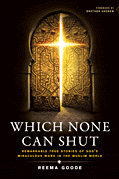
 is an incredible book of stories from the life of “Reema Goode” (her name changed for security). “Reema” is a Christian wife and mother living in a Muslim (Arab) community seeking to share the gospel with the women in her region. She shares heartfelt and compelling stories of how God has opened the door for the gospel to reach a people group.
 is a great book to help you figure out the history behind the middle eastern conflict. I was excited to get my copy in the mail and read it over the weekend in my down time between events. It was an easy read (perhaps too easy of a read given the subject matter).
 , I was a bit skeptical. I’ve been through several finance courses, studies, etc. (By the way, the best studies I’ve come across are
  ‘s books). However, as soon as I saw the cover I was encouraged to see Dave’s endorsement on the front. As I began to read

 by Andy Andrews is a large hardback children’s book based on the inspirational gift book
  The Hill House